
Affiliate Disclosure: As an Amazon Associate, I earn from qualifying purchases. This page contains affiliate links. If you click through and make a purchase, I may earn a small commission at no extra cost to you. Every product recommended below has been thoroughly researched based on specifications, real-world user reviews, brand reliability, and value for money.
Whether you are preparing for hurricane season, outfitting a camper van, or simply want silent, fume-free backup power at home, a solar generator (also called a portable power station) is the most practical and rapidly evolving clean-energy investment you can make in 2026.
But the market is flooded with confusing specifications, inflated watt-hour claims, and cheap imitations. A unit that looks powerful on paper can fail to start your refrigerator, take eight hours to recharge from a wall outlet, or lose half its capacity after 300 cycles. This guide cuts through the noise with data-backed, researched recommendations for every use case and budget.
We have researched the current market across Amazon, manufacturer specs, verified user reviews, and availability to bring you this definitive 2026 buyer’s guide. Every product listed is confirmed available, LiFePO4-based, and linked to a current Amazon listing.
How Solar Generators Work: Clean, Silent Power Explained
Unlike a traditional gasoline inverter generator that burns fuel to spin an alternator, a solar generator is an all-electric system with three core components working together:
- Battery (Storage): A high-capacity Lithium Iron Phosphate (LiFePO4) battery bank stores energy. Modern units range from 200Wh (charge phones and laptops) to over 6,000Wh (run a full-size refrigerator for days).
- Inverter (Conversion): Converts stored DC battery power into household AC electricity through pure sine wave technology, safe for sensitive electronics like CPAP machines, laptops, and medical devices.
- Charge Controller (Input): Manages incoming power from solar panels, wall outlets, or your vehicle’s 12V port. Premium units feature MPPT (Maximum Power Point Tracking) solar controllers that extract up to 30% more energy from your panels than cheaper PWM alternatives.
The result? Silent, emission-free, indoor-safe power that can be recharged indefinitely from the sun — no gasoline runs, no carbon monoxide risk, no oil changes.
Key Features to Evaluate in 2026
1. Capacity (Watt-hours / Wh)
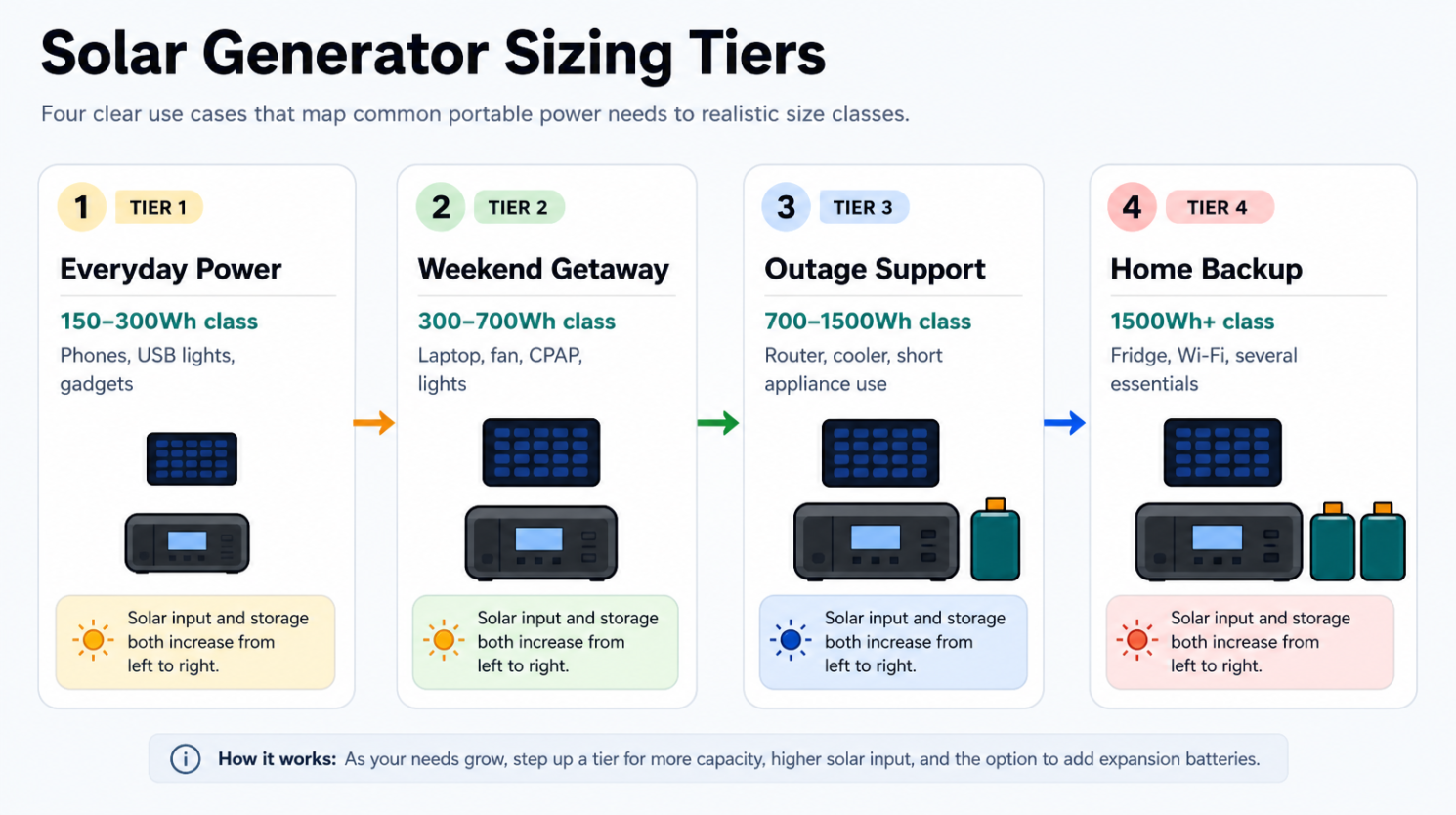
This is your “fuel tank” size. A 1,000Wh unit can run a 100W device for roughly 10 hours (in reality, 8–9 hours accounting for inverter efficiency loss). Use our Solar Backup Calculator to estimate your exact needs.
- 200–500Wh: Phones, tablets, laptops, LED lights, CPAP (1 night)
- 1,000–1,500Wh: Mini-fridge (8–12h), TV, power tools, camping essentials
- 2,000–3,000Wh: Full-size fridge (24h+), microwave, sump pump, home office
- 3,800Wh+: Whole-home circuits via transfer switch, multi-day backup
2. Output Power (Watts, Continuous vs. Surge)
Check the continuous AC output — this is what the unit can sustain for hours. The surge rating covers momentary spikes when motors start (fridge compressors, power tools). A 1,800W continuous / 3,600W surge unit will start most refrigerators; a 600W unit will not.
3. Battery Chemistry: LiFePO4 Is the 2026 Standard
Lithium Iron Phosphate (LiFePO4 / LFP) has replaced older NMC lithium-ion in every quality power station. The difference is massive:
- Cycle life: 3,000–6,000+ cycles to 80% capacity (vs. 500–800 for NMC)
- Safety: Far lower thermal runaway risk — critical for indoor use
- Longevity: 10+ years of regular use before significant degradation
Every unit recommended in this guide uses LiFePO4 chemistry.
4. Charging Speed & Solar Input
Fast AC charging (0–80% in under 1 hour) is now standard in mid-range and premium units. For solar, look at the maximum solar input wattage: a 500W solar input means you can connect up to 500W of panels and recharge in roughly 2–3 hours of good sun. Units with MPPT controllers are significantly more efficient in solar charging.
5. Portability & Expandability
Weight scales with capacity. A 1,000Wh unit typically weighs 22–28 lbs. If you need both portability and high capacity, look for modular/expandable systems that let you add battery packs later. Some premium units support 240V output and home integration panels for whole-home backup.
Top 5 Solar Generators of 2026: Researched & Ranked
Below is our hand-selected lineup. Every model has been verified for current availability, LiFePO4 battery chemistry, and real-world use case fit. Prices are approximate as of mid-2026.
What size solar generator do I need? For phones and laptops, 200–500Wh is enough. For a refrigerator, choose 1,500–2,000Wh. For whole-home backup circuits, look at 3,000Wh+ with transfer switch support.
Comparison Table: At-a-Glance
Product listings and stock change often. When an exact item is unavailable, use the Amazon search link to verify the current model, seller, and warranty before buying.
| Model | Capacity | AC Output | Battery | Solar Input | Weight | Best Use |
|---|---|---|---|---|---|---|
| EF ECOFLOW DELTA 3 Classic Check price on Amazon |
1,024 Wh | 1,800W (3,600W surge) | LiFePO4 | 500W | 28 lbs | Best Overall Mid-Range |
| BLUETTI AC180 Check price on Amazon |
1,152 Wh | 1,800W (2,700W surge) | LiFePO4 | 500W | 37 lbs | Best Value / RV |
| Anker SOLIX C1000 Check price on Amazon |
1,056 Wh | 1,800W (2,400W surge) | LiFePO4 | 600W | 28 lbs | Best Compact / Camping |
| Anker SOLIX F3800 Check price on Amazon |
3,840 Wh | 6,000W (120V/240V) | LiFePO4 | 2,400W | 132 lbs | Most Powerful / Home Backup |
| UDPOWER S2400 Check price on Amazon |
2,083 Wh | 2,400W (3,000W surge) | LiFePO4 | 1,200W | 51 lbs | Best Budget High-Capacity |
Detailed Reviews
1. EF ECOFLOW DELTA 3 Classic — Best Overall Mid-Range Solar Generator
- Capacity: 1,024 Wh (expandable with extra batteries)
- AC Output: 1,800W continuous / 3,600W surge (X-Boost mode)
- Battery: LiFePO4 — 3,000+ cycles to 80%
- Charging: 0–80% in 55 minutes (AC); 500W max solar input
- Ports: 5 AC outlets, 2 USB-C (100W), 2 USB-A, 12V car port
- Weight: 28 lbs
The EF ECOFLOW DELTA 3 Classic hits the sweet spot that most households actually need. With 1,024 watt-hours of LiFePO4 storage and a genuinely capable 1,800W pure sine wave inverter (3,600W surge), it can run a full-size refrigerator for 8–12 hours, power a CPAP machine for multiple nights, or keep a home office running through an outage. The X-Boost mode allows it to handle resistive loads up to 2,400W — enough for a microwave or small space heater.
Pros
- Industry-leading 55-minute fast charge (AC)
- Clean, intuitive LCD display with real-time input/output wattage
- ECOFLOW app provides remote control, scheduling, and firmware updates
- EPS (Emergency Power Supply) mode switches in under 20ms — safe for computers
- Expandable battery ecosystem for future capacity upgrades
Cons
- 1,024 Wh may feel limiting for multi-day outages without solar panels
- No built-in 30A RV outlet (use BLUETTI AC180 for that)
2. BLUETTI AC180 — Best Value for RVs, Campers & Home Backup
- Capacity: 1,152 Wh
- AC Output: 1,800W continuous / 2,700W surge
- Battery: LiFePO4 — 3,500+ cycles to 80%
- Charging: 0–80% in 45 minutes (1,440W AC); 500W solar
- Ports: 4 AC outlets, 1 USB-C (100W), 2 USB-A, 12V car port, wireless charging pad
- Weight: 37 lbs
The BLUETTI AC180 has earned its reputation as the go-to mid-capacity power station for RV owners, van-lifers, and homeowners wanting reliable backup without spending over $1,000. Its 1,152Wh capacity is slightly higher than the DELTA 3 Classic, and the 1,440W AC charging speed is among the fastest in its class — 0 to 80% in just 45 minutes. The built-in wireless charging pad on top is a thoughtful touch for topping up phones without hunting for cables.
Pros
- Blazing 1,440W AC fast charge — ready before you finish packing
- BLUETTI app with Bluetooth monitoring and UPS mode configuration
- Multiple output modes: Standard, Turbo (for high-draw appliances), Silent (low fan noise for camping)
- Excellent build quality with rubberized corner bumpers for RV travel
Cons
- At 37 lbs, heavier than the DELTA 3 Classic despite similar capacity
- No 30A RV outlet — uses standard AC plugs
3. Anker SOLIX C1000 — Best Compact Solar Generator for Camping & Outdoors
- Capacity: 1,056 Wh
- AC Output: 1,800W continuous / 2,400W surge
- Battery: LiFePO4 — 3,000+ cycles to 80%
- Charging: 0–80% in 58 minutes (AC); 600W max solar
- Ports: 6 AC outlets, 2 USB-C (100W), 2 USB-A, 12V car port
- Weight: 28 lbs
Anker has rapidly become a top-tier player in portable power, and the SOLIX C1000 demonstrates why. This unit packs 1,056 Wh into a remarkably compact 28-pound frame with an industry-leading six AC outlets — more than any competitor in its class. With 600W of solar input capacity, it charges from the sun noticeably faster than units capped at 500W, making it the best pick for campers and outdoor enthusiasts who rely primarily on solar panels.
Pros
- Six AC outlets — plug in everything at once without a power strip
- 600W solar input for faster off-grid recharging
- Anker’s signature quality control and 5-year warranty
- SurgePad technology handles motor-start surges gracefully
- App control with energy monitoring and scheduling
Cons
- Premium pricing compared to similar-capacity alternatives
- Expandability options are more limited than EcoFlow’s ecosystem
4. Anker SOLIX F3800 — Most Powerful: Whole-Home Backup Solar Generator
- Capacity: 3,840 Wh (expandable to 53.8 kWh with battery packs)
- AC Output: 6,000W continuous / 120V & 240V split-phase
- Battery: LiFePO4 — 3,000+ cycles to 80%
- Charging: 0–80% in 1.5 hours (AC); 2,400W solar
- Ports: NEMA 14-50 (240V), NEMA L14-30, 6 AC outlets, USB-C, USB-A
- Weight: 132 lbs (wheeled trolley design)
If you are serious about whole-home backup without installing a permanent battery wall, the Anker SOLIX F3800 is the current king of portable power stations. Its 3,840 watt-hours of base capacity is already impressive, but the real breakthrough is 240V split-phase output — meaning it can power well pumps, electric water heaters, EV charging, and home HVAC through a transfer switch. The expandable battery ecosystem lets you scale all the way up to 53.8 kWh, which rivals permanent Tesla Powerwall installations.
Pros
- True 240V split-phase output — runs well pumps, EV chargers, and home circuits
- Massive 6,000W continuous output handles multiple large appliances simultaneously
- 2,400W solar input for rapid off-grid recharging
- Expandable to 53.8 kWh with additional battery packs
- Anker Home Power Panel integration for automatic transfer switching
Cons
- Significant investment — best for those needing whole-home backup specifically
- 132 lbs; built-in wheels help but this is not casually portable
- Overkill for camping, tailgating, or basic emergency kits
5. UDPOWER S2400 — Best Budget High-Capacity Solar Generator
- Capacity: 2,083 Wh
- AC Output: 2,400W continuous / 3,000W surge
- Battery: LiFePO4 — 3,500+ cycles to 80%
- Charging: 1,200W max (AC + solar combined)
- Ports: 6 AC outlets, USB-C, USB-A, 12V car port, 30A RV outlet
- Weight: 51 lbs
For buyers who need serious capacity without the premium price tag of Tier-1 brands, the UDPOWER S2400 delivers exceptional value. At roughly half the cost per watt-hour of premium competitors, you get 2,083Wh of LiFePO4 storage, 2,400W of continuous AC output, and a dedicated 30A RV outlet for direct camper hookup. The combined 1,200W charging (AC wall + solar simultaneously) means you can refill the battery surprisingly fast.
Pros
- Outstanding capacity-per-dollar ratio — best value in the 2,000Wh+ category
- Built-in 30A RV outlet eliminates adapters for camper use
- UPS function with under 10ms transfer time
- Large clear LCD display with all key metrics visible at once
Cons
- App connectivity and smart features are less polished than EcoFlow or Anker
- Heavier at 51 lbs — less convenient for frequent transport
- Brand has shorter track record; long-term service network still developing
Sizing Your Solar Generator: Use Our Free Calculator
The single biggest mistake buyers make is guessing their power needs instead of calculating them. A unit that looks “big enough” on paper may fail to start your refrigerator’s compressor or run your CPAP through the night.
Use our free, interactive Solar Backup Calculator to enter your specific appliances, run times, and backup duration. It will output a precise watt-hour requirement, recommended battery capacity, and solar panel sizing — no guesswork required.
You can also subscribe to our newsletter on the home page to get the free Solar Backup Buyer’s Checklist — a printable system planning guide with load worksheets, battery comparison tables, and an installation verification checklist.
Frequently Asked Questions
What is the difference between a solar generator and a gas inverter generator?
A solar generator stores electricity in a battery and outputs it silently through an inverter — zero emissions, zero fumes, safe for indoor use. A gas inverter generator burns gasoline to produce electricity, creating noise (50–70 dB), carbon monoxide (never use indoors), and requiring regular fuel and maintenance. Solar generators have higher upfront cost but near-zero operating cost; gas generators are cheaper to buy but require ongoing fuel purchases.
How long will a solar generator run my refrigerator?
A modern Energy Star refrigerator draws roughly 100–250 watts when the compressor is running (about 30–40% of the time). A 1,000Wh unit like the DELTA 3 Classic can run a typical fridge for 8–12 hours; a 2,000Wh unit can go 16–24 hours; the 3,840Wh Anker F3800 can handle 30+ hours. Actual runtime depends on ambient temperature, door openings, and fridge efficiency.
Can a solar generator power my entire house?
Most consumer solar generators (1,000–2,000Wh) are designed for essential circuit backup, not whole-home power. To run an entire house including HVAC, well pump, and large appliances, you need a unit with 240V output and at least 3,800+ Wh — like the Anker SOLIX F3800 — paired with a manual or automatic transfer switch. For whole-home backup comparable to a Tesla Powerwall, budget $2,000–$5,000+ for the power station plus installation of the home integration kit.
How many solar panels do I need to recharge a solar generator?
A 100W portable solar panel produces roughly 400–600Wh per day in good sunlight (4–6 peak sun hours). To fully recharge a 1,000Wh unit in one day, you need 200–300W of solar panels (two to three 100W panels). Check your unit’s maximum solar input — the DELTA 3 Classic accepts up to 500W, meaning you can connect up to five 100W panels for faster charging. Our calculator can estimate solar panel recommendations based on your location.
Are solar generators safe to use indoors?
Yes — this is one of their biggest advantages over gas generators. Solar generators produce zero carbon monoxide, zero fumes, and near-zero noise. They can be safely operated inside your home, garage, RV, or tent. Just avoid exposing the unit to water, extreme heat, or blocking its ventilation fans.
What does LiFePO4 mean and why does it matter?
Lithium Iron Phosphate (LiFePO4 or LFP) is a battery chemistry that prioritizes safety, longevity, and thermal stability over raw energy density. Compared to the NMC (Nickel Manganese Cobalt) lithium batteries found in older power stations and laptops: LiFePO4 lasts 4–6x more charge cycles, is far less prone to thermal runaway (fire risk), and maintains stable performance across a wider temperature range. All products recommended in this guide use LiFePO4.
Can a solar generator run a refrigerator?
Yes, but you need the right size. A typical full-size refrigerator uses 150–400 watts and needs 1,500–2,000Wh of capacity to run for 8–12 hours. Look for a solar generator with at least 1,800W continuous output to handle the compressor startup surge.
How long do solar generators last?
Modern solar generators with LiFePO4 batteries last 3,000–6,000+ charge cycles before capacity drops to 80%. For most users, that means 8–15 years of regular use. LiFePO4 lasts 5–10x longer than older NMC lithium-ion batteries.
Which Solar Generator Should You Buy?
Here is a quick decision path to match your situation to the right unit:
- You want one unit for camping, tailgating, and occasional home backup (fridge, lights, devices): Choose the EF ECOFLOW DELTA 3 Classic. Its combination of lightweight portability, fast charging, and expandability covers the broadest range of real-world use cases.
- You live in an RV full-time or need reliable off-grid power for a camper van build: Choose the BLUETTI AC180. The fastest AC charging in its class and proven durability make it the RV community’s favorite.
- You primarily camp, hike, or need maximum portability with plenty of outlets: Choose the Anker SOLIX C1000. Six AC outlets and 600W solar input are ideal for group camping where everyone needs to charge.
- You want whole-home backup that rivals a permanent battery installation: Choose the Anker SOLIX F3800. 240V split-phase output and expandability to 53.8 kWh make this a genuine home backup solution — not just an emergency kit.
- You need maximum watt-hours per dollar without sacrificing LiFePO4 quality: Choose the UDPOWER S2400. The built-in 30A RV outlet and 2,083Wh at this price point deliver exceptional value.
Related Guides: integrated MPPT charge controllers | Solar Backup Calculator | Solar Backup Buyer’s Checklist (subscribe to our newsletter on the home page to get the free report) | Best Home Solar Kits | Solar Pool Heaters Guide
Last updated: July 2026. Product availability and prices checked at time of research. As an Amazon Associate, AESV earns from qualifying purchases. Our recommendations are based on published specifications, verified user reviews, brand track records, and value-for-money analysis — not paid placements.
