
AFFILIATE DISCLOSURE: We may earn a commission when you click on links to products on this page. As an Amazon Associate, we earn from qualifying purchases. This does not affect our recommendations — every product is selected based on published specifications, customer reviews, availability, and use-case fit.
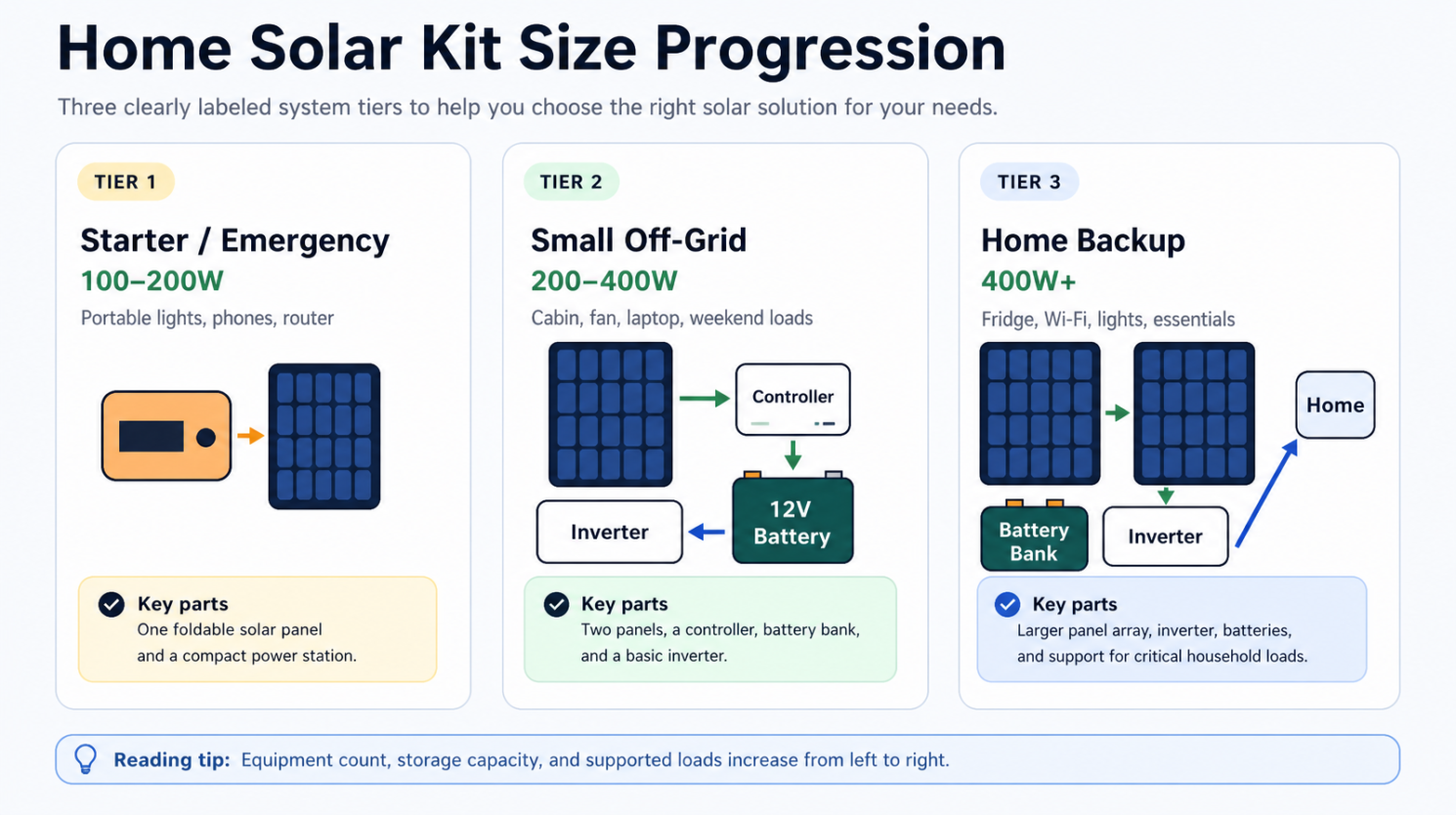
What size home solar kit do I need? For 500–1,000 Wh daily use (phones, lights, small devices), a 100–200W kit works. For 2,000–4,000 Wh (fridge, tools, appliances), choose 400W+. Use our free solar calculator to get your exact number.
Why Trust Our Solar Kit Picks?
We’ve researched and compared the most popular home solar kits on the market, evaluating them on panel wattage, included components (charge controller, inverter compatibility, mounting hardware), real-world customer feedback, warranty coverage, and overall value. Our recommendations are updated for 2026 based on current availability and product revisions.
Best Home Solar Kits Compared (2026)
Product listings and stock change often. When an exact item is unavailable, use the Amazon search link to verify the current model, seller, and warranty before buying.
| Kit | Total Wattage | Panels | Charge Controller | Best For |
|---|---|---|---|---|
| Renogy 400W Premium Kit Search Amazon |
400W | 4x 100W monocrystalline | 40A MPPT (Rover) | Small cabins, workshops, RV full hookups |
| Renogy 200W Starter Kit Search Amazon |
200W | 2x 100W monocrystalline | 30A PWM (Wanderer) | RVs, boats, small off-grid sheds |
| Renogy 100W Starter Kit Search Amazon |
100W | 1x 100W monocrystalline | 30A PWM (Wanderer) | Entry-level, camping, trickle charging |
| WindyNation 400W Kit Search Amazon |
400W | 4x 100W polycrystalline | 30A PWM | Budget-conscious off-grid cabins |
| Grape Solar 100W Kit Search Amazon |
100W | 1x 100W polycrystalline | Basic PWM included | Light-duty, DIY learning projects |
What’s Inside a Typical Solar Kit?
When you buy a home solar kit, you’re usually getting more than just panels. Most complete kits include:
- Solar panels — monocrystalline (higher efficiency) or polycrystalline (more affordable)
- Charge controller — either PWM (simpler, cheaper) or MPPT (more efficient, captures 15–30% more energy)
- Mounting hardware — Z-brackets, rails, or tilt mounts for roof or ground installation
- Wiring and connectors — MC4 cables, tray cables, and fuses
- Installation manual — step-by-step instructions
What’s usually NOT included: Batteries, inverters, and AC distribution panels. You’ll need to size and purchase these separately. Use our Solar Backup Sizing Calculator to estimate your total system needs before buying.
How to Choose the Right Kit Size
Match the kit wattage to your daily energy consumption. As a rough guide:
| Daily Usage | Recommended Kit Size | Example Applications |
|---|---|---|
| 500–1,000 Wh | 100W–200W | Lights, phone charging, small fans, laptop |
| 1,000–2,500 Wh | 200W–400W | RV basics, small fridge, LED TV, water pump |
| 2,500–5,000 Wh | 400W–800W | Small cabin, full RV, workshop tools |
| 5,000+ Wh | 800W+ (multiple kits) | Full off-grid home, large workshop |
For a precise calculation tailored to your appliances, use our free Solar Backup Sizing Calculator. It factors in your specific appliances, sun hours, and backup duration to recommend the right solar array size.
PWM vs MPPT Charge Controllers
The charge controller is arguably the most important component in a kit. Here’s the difference:
- PWM (Pulse Width Modulation): Simpler, cheaper, and perfectly fine for small systems under 200W. They work by reducing the voltage from the panels to match the battery. Efficiency: ~75–80%.
- MPPT (Maximum Power Point Tracking): More sophisticated and pricier, but they extract 15–30% more power from the same panels — especially in cold weather or low-light conditions. Worth the upgrade for systems 200W and above. See our safely sizing your solar charge controller for detailed recommendations.
Installation Tips for DIY Solar Kits
- Check local regulations: Some areas require permits for roof-mounted solar, even for small systems.
- Orientation matters: In the Northern Hemisphere, face panels true south at a tilt angle roughly equal to your latitude for maximum year-round production.
- Avoid shading: Even partial shading on one panel can significantly reduce the output of the entire string if panels are wired in series.
- Size your wiring correctly: Undersized cables cause voltage drop and heat. Most kits include adequate wiring for the included panels.
- Ground your system: Proper grounding protects against lightning strikes and electrical faults.
- Check all connections: Loose MC4 connectors are a common cause of system failure. Tighten and weatherproof every connection.
Solar Kit FAQ
Can I expand my solar kit later?
Yes, most kits are expandable. You can add more panels of the same voltage, but make sure your charge controller and wiring can handle the additional current. Check the controller’s maximum input specifications before adding panels.
Do I need a battery with my solar kit?
Kits produce DC power during daylight only. Without a battery, you can only use power while the sun is shining. For 24/7 power, you’ll need a battery bank. See our Solar Battery Guide to learn about your options, and use our Sizing Calculator to determine how much battery capacity you need.
How long do solar panels last?
Most quality panels come with a 25-year performance warranty, guaranteeing at least 80% of rated output after 25 years. The actual lifespan often exceeds 30 years, though output degrades slowly (typically ~0.5% per year).
Monocrystalline vs Polycrystalline: which is better?
Monocrystalline panels are more efficient (18–22%) and perform better in low-light and high-temperature conditions. Polycrystalline panels are less efficient (15–17%) but cost less per watt. For most home kits, the difference is marginal — choose mono if space is limited, poly if budget is the priority.
Our Research Methodology
We selected these kits based on a combination of published specifications, verified customer reviews, manufacturer warranty terms, price-to-watt value, and real-world performance data from solar forums and testing communities. We have not personally installed every kit listed — our recommendations reflect research and comparison, not hands-on testing of every unit. Product availability and pricing were checked as of mid-2026.
Next Steps: Beyond the Kit
- Size your system: Use our free Solar Backup Sizing Calculator to calculate your daily watt-hours, battery needs, and panel requirements.
- Understand charge controllers: Read the controller selection notes below to pick the right controller for your setup.
- Checklist: Subscribe to our newsletter on the home page to get the free Solar Backup Buyer’s Checklist — a printable worksheet to plan your entire solar backup system.
- Explore more solar guides: Check our Buyer’s Guides hub for more product comparisons.
Last updated: July 2026. Product links include our Amazon Associate tag (alternativ0bb-20). Prices and availability may change — always verify before purchasing.
