
Affiliate Disclosure: This article contains affiliate links. If you purchase through these links, we may earn a commission at no extra cost to you. As an Amazon Associate, we earn from qualifying purchases.
Choosing the right solar panels for your home is one of the most important decisions you’ll make as a homeowner going solar. The panels you install determine how much electricity you generate, how much roof space you need, and how long your system lasts — and with dozens of brands and models on the market, the options can feel overwhelming.
This guide cuts through the noise. We’ve evaluated the top residential solar panels available in 2026 based on efficiency, warranty, temperature performance, real-world availability, and value. Whether you’re looking for maximum efficiency on a small roof, the best budget option for a large installation, or something specific like all-black aesthetics, we’ll help you find the right fit.
Looking for a deep dive on a specific panel type? Jump to our dedicated guides: Best Monocrystalline Solar Panels | Best Polycrystalline Solar Panels | Best Thin Film Solar Panels
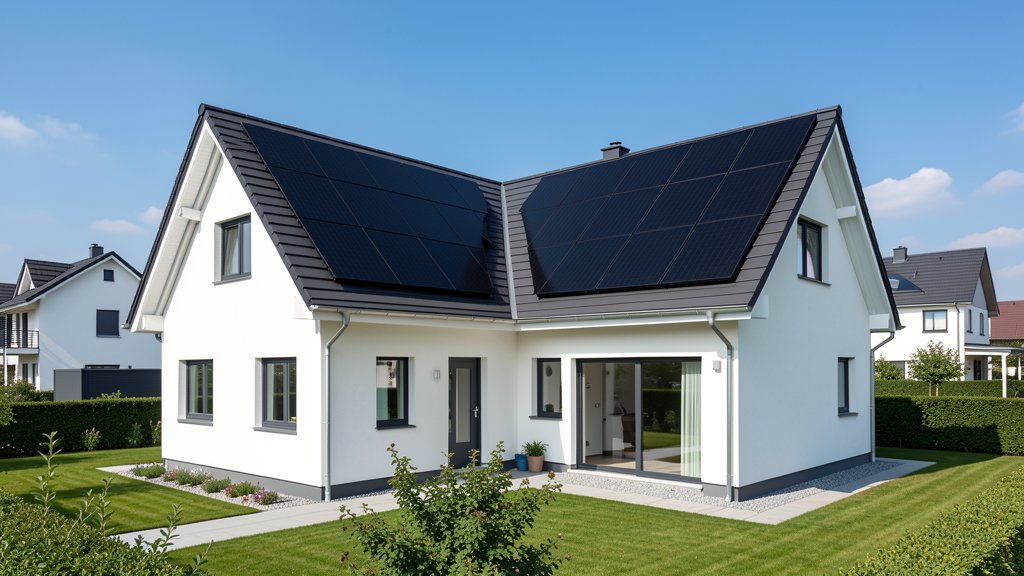
Our Top Picks: Best Solar Panels for Homes in 2026
After comparing efficiency ratings, temperature coefficients, warranty terms, production guarantees, and real-world availability, here are the panels we recommend for most homeowners:
| Panel | Max Efficiency | Temp. Coefficient | Production at 25 Yrs | Warranty | All-Black? | Best For |
|---|---|---|---|---|---|---|
| REC Alpha Pure-RX | 22.3% | 0.00%/°C | 92% | 25 years | Yes | Best overall |
| Maxeon 7 | 22.8% | -0.29%/°C | 92% | 40 years* | Yes | Longest warranty |
| Canadian Solar HiHero | 22.8% | -0.28%/°C | 88.85% | 25 years | Yes | Best efficiency |
| Panasonic EverVolt HK | 22.2% | -0.24%/°C | 92% | 25 years | Yes | Hot climates |
| JinkoSolar Tiger Neo | 22.27% | -0.29%/°C | 83.1% | 25 years | Yes | Best value |
| Q CELLS Q.Peak DUO | 20.9% | -0.34%/°C | 86% | 25 years | Yes | Budget-friendly |
* Maxeon 40-year warranty available through preferred installer network. Standard warranty is 25 years.
Not sure where to start? Use our Solar Backup Calculator to estimate your home’s energy needs and system size.
Shop Current Home Solar Panel Options
Use these broad Amazon searches to compare current listings. Confirm wattage, dimensions, connector type, warranty, seller, and compatibility with your planned system before buying.
- Browse residential solar panels on Amazon
- Browse monocrystalline solar panels for home on Amazon
- Browse solar panel mounting hardware on Amazon
Planning a complete system? Continue with our home solar kit guide and solar battery guide.
How to Choose Solar Panels for Your Home
The best solar panel for your home depends on your roof size, budget, climate, and aesthetic preferences. Here are the key factors to evaluate:
1. Efficiency Rating
Efficiency measures how much sunlight a panel converts into electricity. A 22% efficient panel converts 22% of the sunlight hitting it into usable power. Higher efficiency means fewer panels needed for the same output — critical if your roof space is limited. In 2026, top residential panels range from 20.9% to 22.8% efficiency. The difference between a 20% and 22% panel on a typical 6 kW system can mean 2–4 fewer panels.
2. Temperature Coefficient
Solar panels lose efficiency as they get hotter. The temperature coefficient tells you how much output drops per degree above 25°C (77°F). A coefficient of -0.29%/°C means the panel loses 0.29% of its power for every degree above standard test conditions. This matters most in hot climates — Arizona, Texas, and Florida homeowners should prioritize panels with low (closer to zero) temperature coefficients like Panasonic (-0.24%) or REC (0.00%).
3. Production Warranty and Degradation
All solar panels lose efficiency over time — that’s normal. What matters is how much they lose. Top panels guarantee 90–92% of original output at year 25. Budget panels may only guarantee 80–83%. Over a 25-year system life, that difference adds up to thousands of dollars in lost generation. Always compare the year-25 production guarantee, not just the warranty length.
4. Panel Type: Monocrystalline vs. Polycrystalline vs. Thin Film
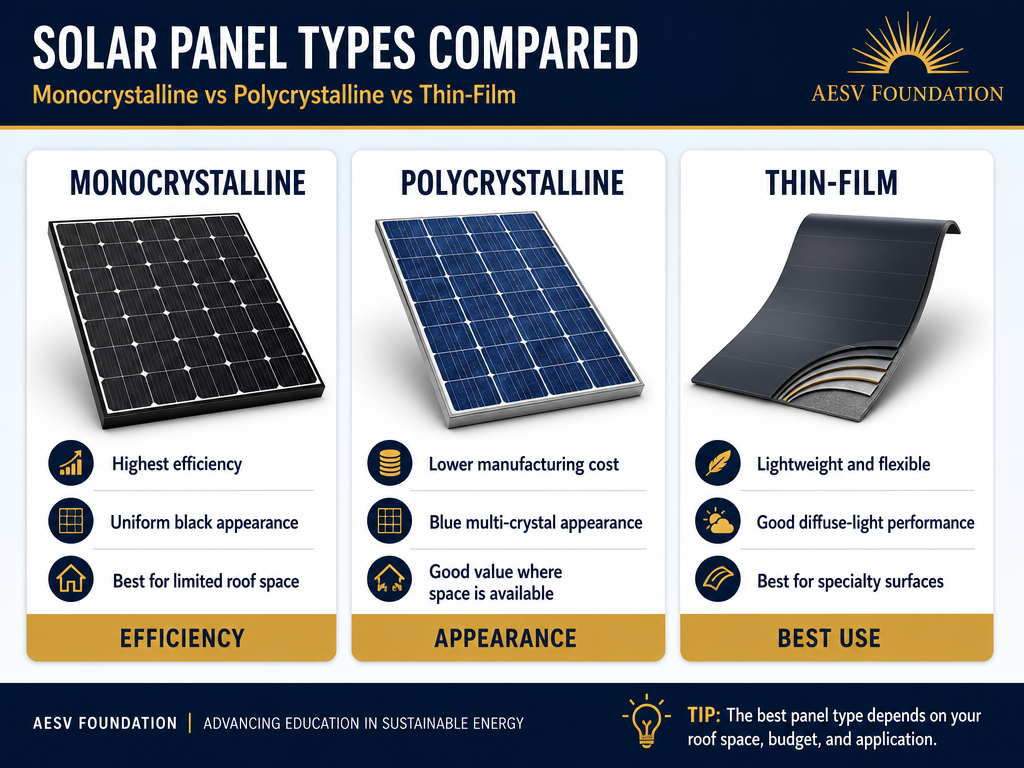
Almost all residential solar panels sold in 2026 are monocrystalline — and for good reason. Mono panels offer the highest efficiency, the best space utilization, and the longest warranties. Polycrystalline panels (recognizable by their blue color) were once popular for budget installations but have largely been phased out by manufacturers in favor of mono. Thin-film panels are primarily used in commercial and utility-scale projects, though some niche applications exist for RVs and portable setups. For a complete breakdown, see our Monocrystalline, Polycrystalline, and Thin Film guides.
5. Aesthetics: All-Black vs. Standard
All-black panels (black cells, black frame, black backsheet) offer a sleek, uniform look that many homeowners prefer — especially on dark roofs. They typically cost 5–10% more than standard silver-frame panels with visible grid lines. Most top-tier brands now offer all-black options. If curb appeal matters to you, it’s worth the modest premium.
6. Price and Value
Residential solar panel prices in 2026 typically range from $0.80 to $1.50 per watt for the panels alone (before installation). The total installed cost for a typical 6–8 kW residential system runs $15,000–$25,000 before incentives. The 30% federal Residential Clean Energy Credit (available through 2032) can reduce your net cost by $4,500–$7,500. Additional state and local incentives may apply — check the DSIRE database for programs in your area.
Tip: Don’t choose panels solely on price. A cheaper panel with a weaker warranty and lower efficiency can cost you more over 25 years than a premium panel that generates more power and degrades less.
Detailed Reviews: Top Solar Panels for Homes
REC Alpha Pure-RX — Best Overall
REC’s Alpha Pure-RX series consistently earns top marks from industry reviewers. With a maximum efficiency of 22.3% and an industry-leading temperature coefficient of 0.00%/°C, these panels maintain their output better in heat than any competitor. The 25-year warranty guarantees 92% of original production — matching the best in class.
REC panels use heterojunction cell technology (HJT), which combines crystalline silicon with ultra-thin amorphous silicon layers. This design reduces electron recombination and improves performance in low-light conditions — meaning your panels start generating earlier in the morning and later in the afternoon than conventional panels.
Key specs: Up to 430W per panel | 22.3% max efficiency | 0.00%/°C temp coefficient | 92% production at 25 years | 25-year product and performance warranty | All-black available
Maxeon 7 — Longest Warranty
Maxeon (formerly SunPower’s panel division) offers the longest warranty in the residential solar industry: 40 years through their preferred installer network. The Maxeon 7 achieved 24.9% efficiency in laboratory testing and delivers up to 22.8% in real-world residential installations. Their unique shingled cell design eliminates the busbars that cause hot spots in conventional panels, contributing to their exceptional longevity.
The catch: Maxeon panels are only available through a select network of authorized installers (Solaris Renewables, Solar Technologies, Wolf River Electric, Cobalt Power Systems, and others). You can’t buy them at retail. This exclusivity ensures proper installation but limits your installer options.
Key specs: Up to 440W per panel | 22.8% max efficiency | -0.29%/°C temp coefficient | 92% production at 25 years | 40-year warranty (through preferred partners) | All-black available
Canadian Solar HiHero — Most Efficient
Canadian Solar ties Maxeon for the highest efficiency rating at 22.8% with their HiHero series. Unlike Maxeon, Canadian Solar panels are widely available through most major installers and distributors, making them easier to source and often more competitively priced. Their TOPCon cell technology delivers strong performance across a range of conditions.
The 25-year warranty guarantees 88.85% of original production at year 25 — slightly lower than REC or Maxeon, but still solidly above the industry average. Canadian Solar is one of the world’s largest panel manufacturers by volume, which means strong parts availability and replacement support.
Key specs: Up to 440W per panel | 22.8% max efficiency | -0.28%/°C temp coefficient | 88.85% production at 25 years | 25-year warranty | All-black available
Panasonic EverVolt HK — Best for Hot Climates
Panasonic’s EverVolt HK series features the best temperature coefficient among major residential panels at -0.24%/°C. In hot climates where rooftop temperatures can exceed 65°C (149°F) on summer days, this translates to meaningfully more annual production than panels with -0.30% or worse coefficients. The 92% year-25 production guarantee matches REC and Maxeon.
Panasonic also offers an all-black design and is available through a wide installer network. Their heterojunction technology is similar to REC’s, delivering good low-light performance. If you live in the Sun Belt, the EverVolt HK deserves serious consideration.
Key specs: Up to 410W per panel | 22.2% max efficiency | -0.24%/°C temp coefficient | 92% production at 25 years | 25-year warranty | All-black available
JinkoSolar Tiger Neo — Best Value
JinkoSolar is the world’s largest solar panel manufacturer by shipment volume, and their Tiger Neo series delivers impressive specs at competitive prices. With 22.27% efficiency and a -0.29%/°C temperature coefficient, the performance is solidly in the top tier. Jinko’s global scale means their panels are widely available and often priced below comparable REC or Maxeon panels.
The year-25 production guarantee of 83.1% is lower than premium competitors, which is the main trade-off for the lower price. However, for homeowners who plan to move within 10–15 years or who prioritize upfront cost, Jinko offers excellent bang for the buck.
Key specs: Up to 440W per panel | 22.27% max efficiency | -0.29%/°C temp coefficient | 83.1% production at 25 years | 25-year warranty | All-black available
Q CELLS Q.Peak DUO — Budget-Friendly Pick
Hanwha Q CELLS is a South Korean manufacturer with U.S. manufacturing facilities, making their panels a popular “buy American” option. The Q.Peak DUO series delivers 20.9% efficiency — slightly lower than top-tier panels — but at a lower price point. With 86% year-25 production and a 25-year warranty, the performance guarantees are respectable.
Q CELLS panels are widely available through major installers and are often the default “good panel” option in many installer quotes. They’re a reliable, no-surprises choice for homeowners who want solid performance without paying premium prices.
Key specs: Up to 410W per panel | 20.9% max efficiency | -0.34%/°C temp coefficient | 86% production at 25 years | 25-year warranty | All-black available
Solar Panel Cost Breakdown for 2026
Here’s what homeowners can expect to pay for a residential solar panel system in 2026:
| System Size | Panels Needed* | Cost Before Incentives | After 30% Federal Credit | Typical Payback |
|---|---|---|---|---|
| Small (4 kW) | 9–10 | $10,000 – $14,000 | $7,000 – $9,800 | 7–10 years |
| Average (6 kW) | 14–16 | $15,000 – $21,000 | $10,500 – $14,700 | 6–9 years |
| Large (8 kW) | 18–21 | $20,000 – $28,000 | $14,000 – $19,600 | 5–8 years |
| Very Large (10 kW) | 23–26 | $25,000 – $35,000 | $17,500 – $24,500 | 5–7 years |
* Based on 400–440W panels. Actual count depends on panel wattage and energy needs. Costs include panels, inverter, racking, wiring, permits, and labor.
Important: The 30% federal Residential Clean Energy Credit applies to the total system cost (panels, inverter, installation, and battery storage if included) and is available through at least 2032. Many states offer additional rebates, tax credits, or net metering programs that can further reduce your cost.
Solar Panel Technology: What’s New in 2026
The solar industry has evolved significantly since our original 2018 guide. Here are the key developments homeowners should know about:
TOPCon Cell Technology
Tunnel Oxide Passivated Contact (TOPCon) has become the dominant cell technology in 2026, replacing the older PERC design. TOPCon cells add an ultra-thin oxide layer that reduces electron recombination, pushing efficiencies above 22% in production panels. JinkoSolar, LONGi, Trina Solar, and Canadian Solar have all adopted TOPCon as their primary residential technology. Lab records using TOPCon have reached nearly 26% efficiency.
Heterojunction (HJT) Technology
HJT cells combine crystalline silicon with amorphous silicon layers, achieving excellent temperature performance and low-light generation. REC and Panasonic use HJT in their premium lines. The main advantage is near-zero temperature degradation — REC’s Alpha Pure-RX has a 0.00%/°C temperature coefficient, meaning it loses essentially no efficiency on hot days.
N-Type vs. P-Type Cells
Most premium panels in 2026 use N-type silicon cells, which degrade slower than the P-type cells used in older panels. N-type panels lose only 0.25–0.40% of their output per year, compared to 0.50–0.70% for P-type. Over 25 years, this difference adds up to 5–10% more total energy production. When comparing panels, check whether the manufacturer uses N-type or P-type cells — N-type is worth the premium.
Frequently Asked Questions
How many solar panels do I need for my home?
The average U.S. home uses about 10,500 kWh of electricity per year. A 6 kW system (roughly 14–16 panels at 400–440W each) typically covers this in most climates. However, your actual need depends on your electricity usage, local sun hours, roof orientation, and shading. Use our Solar Backup Calculator to get a personalized estimate based on your location and energy bill.
Are solar panels worth it in 2026?
For most homeowners, yes. Panel prices have dropped roughly 70% since 2010, while efficiency has improved significantly. Combined with the 30% federal tax credit and rising utility rates, the typical payback period is 5–10 years — after which your electricity is essentially free for the remaining 15–20+ years of the panel’s life. Solar also increases home resale value by an average of 4%, according to Zillow research.
What’s the difference between monocrystalline and polycrystalline panels?
Monocrystalline panels are made from a single crystal of silicon, giving them a uniform black appearance and higher efficiency (20–23%). Polycrystalline panels are made from multiple silicon fragments melted together, resulting in a blue, speckled appearance and lower efficiency (15–17%). In 2026, nearly all residential panels are monocrystalline — polycrystalline has been largely phased out by major manufacturers. See our Monocrystalline and Polycrystalline guides for details.
How long do solar panels last?
Most solar panels come with a 25-year performance warranty, but they don’t stop working after 25 years — they just produce slightly less electricity. Panels typically degrade 0.25–0.50% per year, meaning a panel installed today should still produce 85–90% of its original output at age 25. Many panels from the 1990s are still operating today. Physical components (glass, aluminum frame) can last 30–40+ years.
Should I buy the most efficient solar panels?
Not necessarily. If you have ample roof space, slightly lower-efficiency panels at a better price per watt may give you the same total system output for less money. High-efficiency panels make the most sense when roof space is limited (small roofs, complex roof shapes, or heavy shading) and you need to maximize output from every available square foot. A good installer will help you balance efficiency, cost, and aesthetics for your specific situation.
Can I install solar panels myself?
While DIY solar installation is technically possible, we strongly recommend using a licensed, insured installer. Professional installation ensures your system meets local building codes, qualifies for the federal tax credit, passes inspection, and is safely connected to the electrical grid. Improper installation can void your panel warranty, create fire hazards, and violate local regulations. The labor cost (typically 30–40% of total system cost) is a worthwhile investment for safety and peace of mind.
Do solar panels work on cloudy days?
Yes, but at reduced output. Solar panels generate electricity from light, not heat, so they still produce power on overcast days — typically 10–25% of their rated output depending on cloud thickness. Germany, one of the world’s solar leaders, gets less sunshine than most of the U.S. Panels with good low-light performance (like REC’s HJT technology or Panasonic’s EverVolt) perform better in cloudy climates.
Key Takeaways
- Almost all residential solar panels in 2026 are monocrystalline, with efficiencies above 20%.
- REC Alpha Pure-RX is our top overall pick for its zero temperature degradation and 92% year-25 guarantee.
- Maxeon 7 offers the longest warranty (40 years) but requires using their preferred installer network.
- Canadian Solar HiHero matches Maxeon’s efficiency at 22.8% with wider availability.
- Panasonic EverVolt HK is the best choice for hot climates with its -0.24%/°C temperature coefficient.
- JinkoSolar and Q CELLS offer strong value for budget-conscious homeowners.
- The 30% federal tax credit is available through 2032 — now is a great time to go solar.
- Compare at least 3 installer quotes and check references before committing.
- Use our Solar Backup Calculator to estimate your system size and savings.
Last updated: July 2026. We research and update our buyer’s guides regularly. Efficiency ratings and warranty terms are verified against manufacturer datasheets. Pricing figures are estimates based on EnergySage, CNET, and industry averages as of mid-2026. Always verify current specs and pricing with your installer before purchasing. AESV earns a commission from qualifying purchases made through affiliate links on this page — this does not affect the price you pay or our editorial independence.
