
Polycrystalline solar panels — recognizable by their distinctive blue color and speckled crystal pattern — were once the most popular choice for budget-conscious homeowners. They offered a lower price per watt than monocrystalline panels, making them the default “good enough” option for residential solar installations.
That market has shifted dramatically. By 2026, most major solar panel manufacturers have phased out polycrystalline production in favor of monocrystalline technology. Companies like REC, Panasonic, Maxeon, and Q CELLS no longer produce residential polycrystalline panels. What remains is mostly limited stock from Chinese manufacturers and specialty applications.
This guide explains what polycrystalline panels are, where they still make sense (if at all), and what you should know if you’re considering them. For most homeowners, our Best Monocrystalline Solar Panels guide will be more relevant.
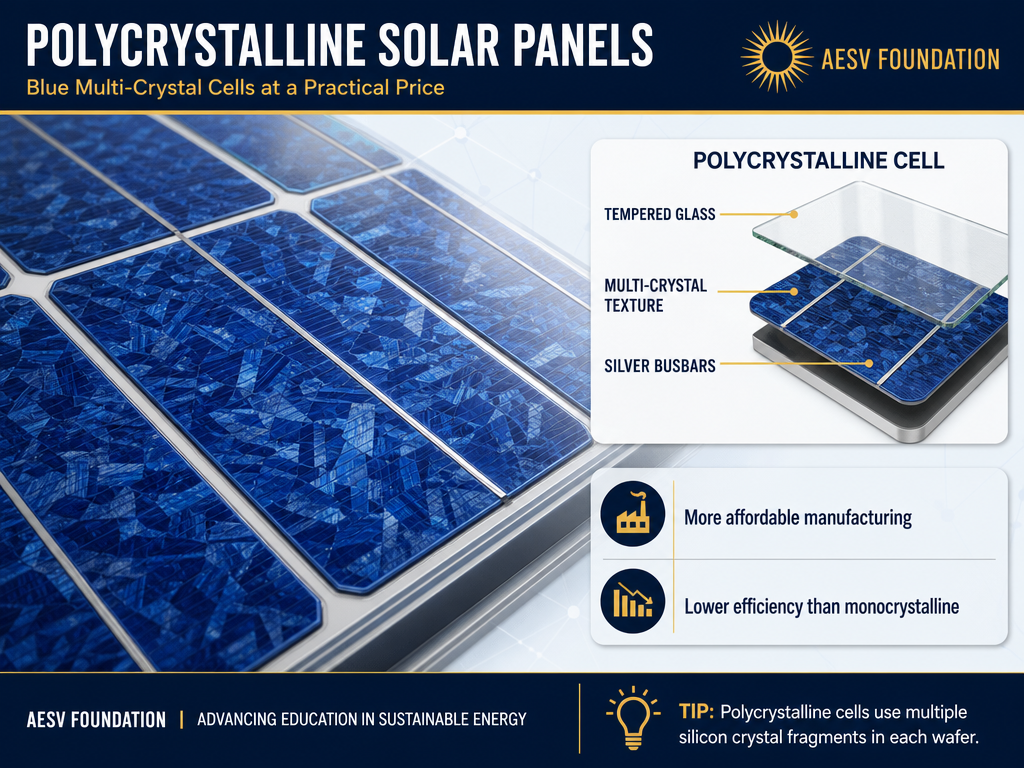
What Are Polycrystalline Solar Panels?
Polycrystalline (also called “multi-crystalline”) solar panels are made from silicon cells that contain multiple crystal structures. Instead of growing a single, pure silicon crystal (as with monocrystalline), manufacturers melt multiple fragments of raw silicon together and pour them into a square mold. The resulting ingot is sliced into wafers and assembled into cells.
This process is simpler and cheaper than the Czochralski method used for monocrystalline cells, which is why polycrystalline panels were historically less expensive. However, the multiple crystal boundaries create internal resistance that reduces electron flow — resulting in lower efficiency (typically 15–17% compared to 20–23% for monocrystalline).
How to Identify Polycrystalline Panels
- Color: Blue with visible grain boundaries between crystal fragments
- Cell shape: Square (no rounded corners, unlike monocrystalline)
- Appearance: Speckled, marbled pattern from mixed crystal orientations
- Frame: Typically silver aluminum (though black frames exist)
Why Manufacturers Are Moving Away from Polycrystalline
The shift from polycrystalline to monocrystalline isn’t a marketing trend — it’s driven by hard economics and physics:
- Efficiency gap has widened: Early monocrystalline panels were only marginally more efficient than polycrystalline. With TOPCon and HJT cell technologies, modern mono panels achieve 22–23% efficiency — a 5–7 percentage point gap over polycrystalline’s 15–17%. That gap translates directly to more power per square foot.
- Manufacturing costs have converged: Advances in monocrystalline wafer production (particularly by LONGi and other Chinese manufacturers) have driven mono production costs close to polycrystalline levels. The cost advantage that made poly attractive has largely disappeared.
- N-type silicon favors monocrystalline: The industry shift toward N-type cells (which degrade slower and perform better) works best with monocrystalline wafers. Polycrystalline N-type cells are technically possible but not cost-effective.
- Consumer preference: The uniform black appearance of monocrystalline panels is more aesthetically appealing to homeowners, which influences installer recommendations.
The bottom line: Polycrystalline isn’t bad technology — it’s simply been overtaken by better options at comparable prices. If you find polycrystalline panels at a significant discount, they can still generate electricity effectively. But for new installations in 2026, monocrystalline is almost always the better investment.
Polycrystalline Solar Panels Buyer’s Guide
If you’re considering polycrystalline panels — whether because of budget constraints, large available roof space, or existing system compatibility — here’s what to look for:
Efficiency Range
Polycrystalline panels typically deliver 15–17% efficiency. This means you’ll need 20–30% more roof space to generate the same power as a monocrystalline system. If your roof is small or has limited unshaded area, polycrystalline may not be practical regardless of price.
Temperature Performance
Polycrystalline panels generally have temperature coefficients between -0.35% and -0.45%/°C — worse than monocrystalline (-0.24% to -0.35%). In hot climates, this means polycrystalline panels lose more output during summer months. If you live in a warm region, the performance gap widens further in mono’s favor.
Weight and Size
Polycrystalline panels tend to be slightly heavier than equivalent monocrystalline panels because they require more cells and larger surface area for the same wattage. A typical 60-cell polycrystalline panel weighs 40–55 lbs. Verify your roof can handle the additional weight if installing a larger array.
Warranty Considerations
Available polycrystalline panels typically come with 10–25 year product warranties and 25-year performance warranties. However, the year-25 production guarantees tend to be lower (80–85%) compared to premium monocrystalline panels (90–92%). Verify the manufacturer is still in business and honoring warranties — some smaller poly-only manufacturers have exited the market.
Polycrystalline Panels Still Available in 2026
The selection of residential polycrystalline panels has shrunk dramatically. Here are options that may still be available through distributors and wholesalers — availability varies by region and stock levels:
| Panel | Manufacturer | Efficiency | Output | Temp. Coeff. | Weight | Warranty | Availability |
|---|---|---|---|---|---|---|---|
| CS6U-335P | Canadian Solar | 17.23% | 335W | -0.39%/°C | 49.4 lbs | 10 yr product / 25 yr perf. | Limited (legacy stock) |
| JAP72S | JA Solar | 17.0% | 340W | -0.37%/°C | 50.7 lbs | 12 yr product / 25 yr perf. | Limited |
| TSM-330DD | Trina Solar | 17.1% | 330W | -0.39%/°C | 48.5 lbs | 10 yr product / 25 yr perf. | Legacy / clearance |
| JKM335P | JinkoSolar | 17.0% | 335W | -0.38%/°C | 49 lbs | 10 yr product / 25 yr perf. | Limited |
Note: These models may be available as new-old-stock through distributors. Verify current availability and pricing before committing. Some models have been replaced by monocrystalline equivalents.
Canadian Solar CS6U-335P
Canadian Solar was one of the last major manufacturers to produce residential polycrystalline panels at scale. The CS6U-335P offers 17.23% efficiency with a 335W output. At 49.4 lbs, it’s heavier than comparable monocrystalline panels. The 10-year product warranty is shorter than the 25-year warranties common on mono panels. This model is typically available as legacy stock through distributors — it’s being replaced by Canadian Solar’s monocrystalline HiKu and HiHero lines.
Pros: Established manufacturer | Reasonable price | 25-year performance warranty
Cons: 17.23% efficiency (well below mono) | 10-year product warranty | Heavier than mono equivalent | Being phased out
JA Solar JAP72S
JA Solar’s polycrystalline line offers 17% efficiency and 340W output with a 12-year product warranty — slightly better than some competitors. JA Solar remains one of the world’s largest panel manufacturers and continues to honor warranties on their poly panels. However, their focus has shifted entirely to monocrystalline TOPCon technology for new products.
Pros: Strong manufacturer (will honor warranty) | 12-year product warranty | 340W output
Cons: 17% efficiency | -0.37%/°C temperature coefficient | Limited new availability
When Does Polycrystalline Still Make Sense?
There are a few scenarios where polycrystalline panels might still be a reasonable choice:
- Very large, unshaded roof or ground mount: If you have abundant space and the lower efficiency isn’t a constraint, cheaper polycrystalline panels can work for large installations where you’d need to cover the area anyway.
- Budget-critical projects: If you find polycrystalline panels at 30–40% less than comparable monocrystalline, the savings might justify the trade-offs — especially for temporary or non-critical installations (workshops, barns, sheds).
- System expansion compatibility: If you have an existing polycrystalline system and want to add panels with matching electrical characteristics, adding the same poly model (if available) avoids system imbalances.
- Developing markets: In regions where monocrystalline panels are harder to source or significantly more expensive, polycrystalline remains a practical option.
For everyone else: Monocrystalline panels offer better efficiency, better aesthetics, similar pricing, and longer warranties. See our Best Monocrystalline Solar Panels guide for current recommendations.
Polycrystalline vs. Monocrystalline: The Real Comparison
| Factor | Polycrystalline | Monocrystalline | Winner |
|---|---|---|---|
| Efficiency | 15–17% | 20–23% | Monocrystalline |
| Cost per watt | $0.60–$1.00 | $0.80–$1.50 | Polycrystalline (slightly) |
| Total system cost | Similar (more panels + racking needed) | Similar (fewer panels needed) | Tie |
| Roof space needed | 20–30% more | Less | Monocrystalline |
| Temperature coefficient | -0.35 to -0.45%/°C | -0.24 to -0.29%/°C | Monocrystalline |
| Year-25 production | 80–85% | 83–92% | Monocrystalline |
| Product warranty | 10–12 years | 25–40 years | Monocrystalline |
| Aesthetics | Blue, speckled | Black, uniform | Subjective (mono more popular) |
| 2026 availability | Limited / legacy | Excellent | Monocrystalline |
| Future support | Uncertain (manufacturers exiting) | Strong (industry standard) | Monocrystalline |
When you factor in the total system cost (panels + racking + inverter + installation labor), the per-watt savings from polycrystalline panels often evaporate — you need more panels, more racking, and more roof space to achieve the same output. For most homeowners in 2026, monocrystalline is the better investment.
Frequently Asked Questions
Are polycrystalline solar panels still being manufactured?
Yes, but in much smaller quantities. Most major manufacturers (REC, Panasonic, Maxeon, Q CELLS) have completely stopped producing residential polycrystalline panels. Some Chinese manufacturers (JA Solar, JinkoSolar, Trina Solar) still produce limited polycrystalline lines, primarily for commercial and utility-scale markets. Residential polycrystalline panels are increasingly available only as legacy stock or through secondary distributors.
Can I replace polycrystalline panels with monocrystalline?
Yes, but with some considerations. If you’re replacing your entire system, switching to monocrystalline is straightforward. If you’re adding panels to an existing polycrystalline system, you’ll need to ensure the electrical specifications (voltage, current) are compatible with your inverter. Mixing panel types on the same string is not recommended. Consult your installer about the best approach — sometimes using a separate inverter or microinverters for the new panels is the cleanest solution.
Why are polycrystalline panels blue?
The blue color comes from the way light interacts with the multiple crystal boundaries in the silicon. When light hits the varied crystal orientations, it refracts differently across the surface, producing the characteristic blue, speckled appearance. Monocrystalline panels appear black because their uniform crystal structure absorbs light more evenly. An anti-reflective coating is applied to both types to maximize light absorption.
Do polycrystalline panels degrade faster than monocrystalline?
Generally, yes. Polycrystalline panels (typically P-type silicon) degrade at about 0.50–0.70% per year, compared to 0.25–0.40% for N-type monocrystalline panels. Over 25 years, this means polycrystalline panels produce roughly 5–10% less total energy than an equivalent monocrystalline system. The year-25 production warranty on polycrystalline panels (80–85%) reflects this higher degradation rate.
Is it worth buying cheap polycrystalline panels?
It depends on the discount. If polycrystalline panels are 40%+ cheaper than comparable monocrystalline, the savings might outweigh the efficiency and warranty trade-offs — especially for large, unshaded installations. But if the discount is only 10–20%, the long-term energy production difference usually favors monocrystalline. Always calculate total system cost (including additional racking and installation labor for the extra panels) before deciding.
Key Takeaways
- Polycrystalline panels were once the budget choice but have been largely phased out by major manufacturers.
- Efficiency (15–17%) is 5–7 percentage points below modern monocrystalline panels.
- The per-watt savings often disappear when you account for needing more panels, racking, and roof space.
- Polycrystalline still makes sense for very large installations with abundant space and tight budgets.
- Verify manufacturer support before buying — some poly-only manufacturers have exited the market.
- For most homeowners in 2026, monocrystalline is the better investment. See our Best Monocrystalline Solar Panels guide.
- If you have an existing poly system, you can upgrade to mono when expanding or replacing — consult your installer for compatibility.
Last updated: July 2026. We research and update our buyer’s guides regularly. The polycrystalline market continues to contract — availability information was accurate at time of publication but may change. AESV earns a commission from qualifying purchases made through affiliate links on this page — this does not affect the price you pay or our editorial independence.
