
Last updated: July 2026
Quick verdict: The best outdoor solar post lights use monocrystalline panels, at least 10–20 lumens per light for pathways and 50+ lumens for security, a replaceable rechargeable battery, and a weather-resistant housing rated IP65 or higher. Cheap solar post lights with tiny amorphous panels and sealed Ni-Cd batteries will dim after one season. Spending a little more upfront saves frustration and gives you lights that actually last.
Quick answer: For most yards, choose solar post cap lights with a 4–6 inch fit, 15–30 lumens of warm-white LED output, a monocrystalline solar panel on top, and a replaceable AA or AAA NiMH or lithium battery. For fence posts, match the cap size to your post width and check that the mounting base fits snugly.
Why solar post lights are worth getting right
Solar post lights are one of the easiest outdoor upgrades you can make. No wiring, no electrician, no trenching. You mount them on fence posts, deck posts, mailbox posts, or along a pathway, and the sun does the rest. But there is a huge quality range in this category — and the difference between a good set and a cheap set shows up within months.
A quality solar post light should give you 6–10 hours of soft illumination on a full charge, survive rain and frost without corroding, and keep working for 2–3 years before you need to swap the battery. Cheap ones often dim to almost nothing after the first winter because the solar panel is too small, the battery is sealed and non-replaceable, or the housing leaks.
This guide walks you through every factor that matters when choosing solar post lights for your yard, garden, driveway, or deck.
Types of outdoor solar post lights
Before comparing specs, it helps to know the main categories:
| Type | Where to use | Typical brightness | Look and style |
|---|---|---|---|
| Post cap lights | Top of fence posts, deck posts, mailbox posts | 5–40 lumens | Decorative — visible cap sits on top of the post, shines down and/or outward |
| Post-top lanterns | Garden posts, patio pillars, entry columns | 15–80 lumens | Lantern or globe style — more decorative, often with a flickering or warm-white LED |
| Pathway post lights | Along walkways, garden borders, driveway edges | 10–30 lumens | Slim stake-mounted — functional path lighting with a post-style design |
| Fence-mounted lights | Attached to fence rails or panels | 20–60 lumens | Downlights or sconces that mount on the face of the fence rather than on top of a post |
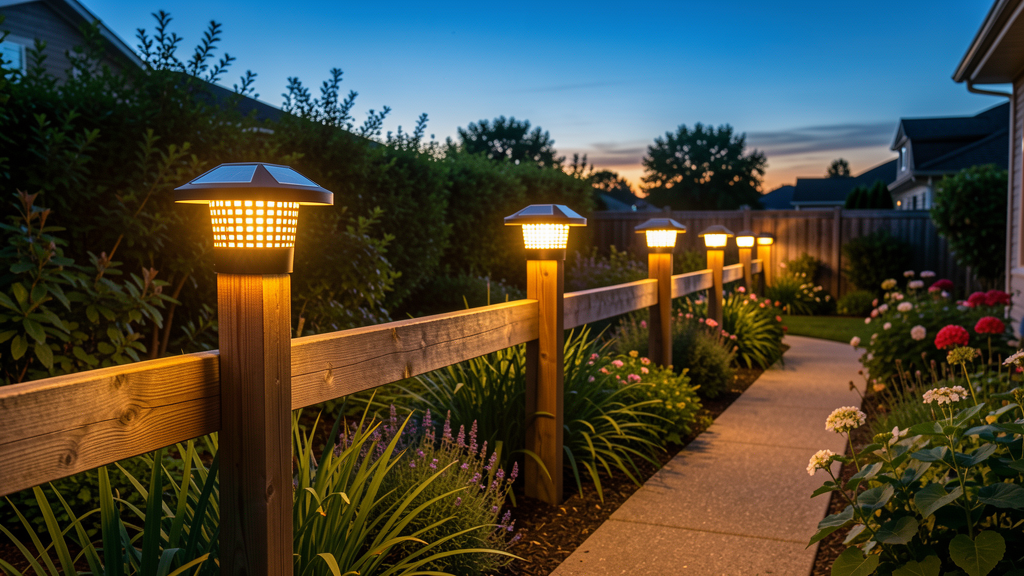
Most people shopping for “solar post lights” are looking for post cap lights — the ones that sit on top of a 4×4, 5×5, or 6×6 fence post. That is the main focus of this guide.
7 things to check before buying solar post lights
1. Post size and fit
Measure your post before you shop. Standard US lumber posts come in nominal 4×4 (actual 3.5 × 3.5 inches), 6×6 (actual 5.5 × 5.5 inches), and sometimes 5×5 (actual 4.5 × 4.5 inches). Many solar caps are designed for one size and include adapter rings or base plates for others. A light that wobbles on your post will not survive the first windstorm.
2. Brightness (lumens)
Lumens measure total visible light output. For solar post lights:
| Use case | Lumens needed | Notes |
|---|---|---|
| Decorative / ambient | 5–15 lumens | Enough to define the post and add a warm glow. Not enough to walk by safely. |
| Pathway marking | 15–30 lumens | Good for defining edges. Comfortable to walk along. |
| General area lighting | 30–60 lumens | Lights up a small patio or seating area around the post. |
| Security / task lighting | 60–150+ lumens | Bright enough to see faces and read house numbers. Often requires a larger panel and battery. |
3. Solar panel quality
The solar panel is the engine of the light. A small, cheap amorphous (thin-film) panel charges slowly and produces less power in partial shade. A monocrystalline panel charges faster, works better in low light, and lasts longer. For post cap lights where the panel is built into the top of the cap, monocrystalline is strongly preferred — the panel area is already small, so you need every watt of charging efficiency.
4. Battery type and replaceability
This is the factor most buyers overlook — and it is the one that determines whether your lights last one year or five.
- Ni-Cd (nickel-cadmium): Cheap, common in budget lights. Holds less charge, develops memory effect over time, and is being phased out in many markets for environmental reasons.
- NiMH (nickel-metal hydride): Better capacity, less memory effect, and widely available as replacement AA and AAA cells. A good choice for mid-range lights.
- Lithium-ion / LiFePO4: Best energy density and longest life. Found in premium solar lights. Some are replaceable, some are not.
Plain-English rule: Always check whether the battery is replaceable. A solar post light with a non-replaceable battery is disposable — when the battery dies (usually in 1–3 years), the whole light goes in the trash. Look for lights that use a standard AA, AAA, or 18650 cell you can swap yourself.
5. Color temperature
LED color temperature is measured in Kelvin (K). For outdoor post lights:
- 2700K–3000K (warm white): The most popular choice for residential yards. Gives a cozy, inviting amber glow that works with wood, brick, and natural landscaping.
- 4000K–5000K (neutral/cool white): Brighter and more clinical. Better for security lighting or modern architectural styles. Can look harsh in a garden setting.
- RGB / color-changing: Fun for parties and holidays. Not ideal for everyday pathway lighting.
6. Weather resistance and materials
Outdoor solar lights face rain, snow, UV exposure, and temperature swings. Look for:
- IP rating: IP65 means dust-tight and protected against water jets — good enough for most climates. IP44 is splash-resistant only and may not survive heavy rain or snow.
- Housing material: Cast aluminum or stainless steel lasts much longer than plastic. ABS plastic is acceptable for budget lights but will fade and crack faster in strong UV climates.
- Finish: Powder-coated metal resists rust better than painted or bare metal. Black, bronze, and copper-tone finishes are the most popular and age well.
7. Lighting mode
Many solar post lights offer multiple modes:
- Steady on: Consistent light all evening. Best for pathways and gathering areas.
- Dim + bright on motion: Stays dim for ambiance, brightens when someone walks by. Saves battery and adds security.
- Color cycling: Rotates through colors. Decorative only.
For most yards, a warm-white steady-on mode with a dim/bright motion option gives you the best balance of ambiance and battery life.
How to choose the right solar post lights for your yard
Decision guide: match the light to your situation
- Fence post caps (wooden fence): Measure your posts, choose a cap that fits snugly, look for 15–30 lumens warm white, replaceable NiMH battery, and IP65 rating. Search solar post cap lights on Amazon
- Deck post lights: Same as fence caps, but check that the base does not overhang the post too much — decks have tighter tolerances. Low-profile designs work best. Search deck post cap lights on Amazon
- Garden pathway markers: Slim stake-mounted post lights with 10–20 lumens. Space them 6–8 feet apart for a continuous line of light. Search pathway solar lights on Amazon
- Mailbox or address post: Choose a brighter light (30–60 lumens) so visitors can read the house number. Consider a light with a built-in address plaque. Search mailbox post lights on Amazon
- Security / driveway entrance: Go for 60+ lumens with a motion-activated bright mode. Wall-mounted or post-top lantern style works well. Search security solar post lights on Amazon
What to look for on the product page
Good buying signs
Good buying signs
- Lumens rating clearly stated (not just “ultra bright”).
- Specific battery type and size listed (e.g., “1× AA NiMH 1.2V 1200mAh”).
- IP65 or higher weather rating.
- Monocrystalline solar panel mentioned.
- Replacement battery availability noted or battery is standard AA/AAA.
- Real product photos showing the actual light, not stock renders.
- Reviews with photos from buyers showing the light after months of use.
Red flags
- No lumens number — only “super bright” or “high power.”
- Sealed battery with no replacement option.
- No IP rating mentioned at all.
- “Works up to 8 hours” without specifying brightness level or charge conditions.
- All 5-star reviews posted within the same week (likely incentivized).
- Plastic housing with no UV-resistance claims.
Installation tips for solar post lights
Getting the most from your solar post lights is mostly about placement and basic care:
- Face the solar panel toward the sun. For post cap lights, the panel is on top — make sure the cap is not shaded by a tree branch, eave, or neighboring structure during peak sun hours (10 am to 3 pm).
- Clean the panel a few times per year. Dust, pollen, and bird droppings reduce charging efficiency. A soft cloth and water is all you need.
- Replace batteries every 1–2 years. Even NiMH batteries degrade. A fresh set of rechargeable AA batteries costs a few dollars and restores full brightness.
- Tighten mounting hardware seasonally. Temperature changes cause wood and metal to expand and contract. Check that caps are still snug after winter and summer extremes.
- Store decorative lights indoors in harsh winters. If you live in a climate with prolonged sub-zero temperatures, bringing lights indoors for the worst months extends their life significantly.
How long do solar post lights last?
| Component | Budget lights | Mid-range lights | Premium lights |
|---|---|---|---|
| LED module | 2–4 years | 4–7 years | 7–10+ years |
| Battery | 6–18 months | 1–3 years | 2–5 years |
| Solar panel | 2–3 years | 3–5 years | 5–10+ years |
| Housing / finish | 1–3 years before fading/cracking | 3–5 years | 5–10+ years |
Plain-English rule: The battery is almost always the first component to fail. Lights with replaceable batteries last dramatically longer than sealed units — and cost less over time because you swap a $2 battery instead of replacing a $20 light.
Solar post lights FAQ
Do solar post lights work in winter?
Yes, but with reduced performance. Shorter days mean less charging time, and overcast skies reduce panel output further. In northern climates, expect 4–6 hours of dim light on winter evenings instead of 8–10 hours in summer. Keeping the panel clear of snow helps.
Can I use solar post lights on a covered porch?
Only if the solar panel receives direct sunlight for at least 4–6 hours per day. Some lights have a separate solar panel on a wire that you can mount in a sunnier spot — these work well under porches and pergolas. Integrated-panel lights need unobstructed sun.
How many lumens do I need for fence post lights?
For decorative fence post caps, 5–15 lumens per light is enough to define the fence line and add ambiance. For functional pathway lighting along a fence, aim for 15–30 lumens. For security, 50+ lumens per light with a motion-bright mode is more appropriate.
What size solar post cap fits a 4×4 post?
A nominal 4×4 lumber post is actually 3.5 × 3.5 inches. Look for post caps labeled “fits 4×4” or “3.5-inch base.” Many caps include adapter plates for multiple post sizes. Always check the listed base dimensions against your actual post measurement.
Are solar post lights brighter than solar path lights?
Not necessarily. Both categories range from 5 to 60+ lumens depending on the model. Post cap lights are often more decorative (lower lumens, wider spread) while path lights are more functional (focused downward beam). Check the lumen rating rather than assuming one type is brighter.
Can I replace the batteries in solar post lights?
In many models, yes — look for a battery compartment on the underside of the light. Standard AA or AAA NiMH rechargeable cells are the most common replacements. Some premium lights use 18650 lithium cells. A few budget models seal the battery inside with no access — avoid these if you want long-term value.
Bottom line
The best solar post lights are not the cheapest or the brightest — they are the ones with a good solar panel, a replaceable battery, and a housing that survives your climate. Measure your posts, choose warm-white LEDs in the 15–30 lumen range for pathways, and always check that the battery is user-replaceable. A $15 light with a swappable battery beats a $10 sealed unit every time.
Looking for more solar outdoor lighting advice? See our guide to how extreme weather affects solar lights or explore the solar lights troubleshooting guide.
