
Tidal energy is one of the oldest forms of hydroelectric power, yet it remains one of the least deployed renewable technologies on the planet. The physics are simple — gravity creates predictable ocean tides, and those tides can spin turbines to generate electricity. The engineering is anything but simple. Tidal installations require massive infrastructure, enormous capital, and coastal geography with strong enough tidal ranges to be viable.
In this guide, we break down how tidal energy actually works, the three main technology types, what real projects exist today, how costs compare to other renewables, and — critically — why tidal power is not and will not be a residential energy solution. If you’re a homeowner looking to cut your electricity bill, this article will help you understand tidal energy’s place in the bigger renewable picture so you can make smarter decisions about what does work at the household level.
What Is Tidal Energy?
Tidal energy — also called tidal power — is a form of renewable hydroelectric energy that converts the kinetic and potential energy of ocean tides into electricity. Unlike wind energy or solar energy, tidal power is driven by gravitational interactions between the Earth, Moon, and Sun. That means tidal patterns are astronomically predictable — engineers can calculate exactly how much water will flow through a turbine site years or even decades in advance.
The concept is ancient. Tidal mills have been grinding grain since at least the 7th century. But generating electricity from tides is a modern achievement. The first large-scale tidal power plant — the Rance Tidal Power Station in Brittany, France — opened in 1966 with 240 MW of capacity across 24 turbines, producing roughly 600 GWh per year. It remains operational today, nearly six decades later.
As of 2026, global installed tidal capacity sits at approximately 520 MW across roughly a dozen operational plants. That sounds small — and it is. For context, global solar capacity exceeded 1,600 GW in 2025. Tidal energy is not scaling fast, but it fills a specific niche: reliable, predictable baseload power for coastal regions with strong tidal ranges.
How Tidal Energy Works
The Basic Physics
Ocean tides rise and fall as the Moon’s gravitational pull drags water across Earth’s surface. When the tide flows in (flood tide) or out (ebb tide), it carries enormous kinetic energy. A typical tidal power installation captures this energy using turbines — devices that convert flowing water into rotational motion, which drives an electrical generator.
Seawater is roughly 832 times denser than air. That means a tidal turbine can generate the same power as a wind turbine at a fraction of the flow speed. This density advantage is also why tidal structures must be engineered to withstand forces that would destroy most onshore equipment.
Two-Way Flow
Unlike a conventional hydroelectric dam where water flows one direction, tidal water reverses direction every ~6 hours. This creates a design challenge: turbines must either be reversible (expensive) or the system must capture energy on one or both flow directions with specialized turbine geometries.
Capacity Factor and Predictability
Tidal energy’s standout advantage is predictability. Solar output depends on weather. Wind turbines need wind. But tidal cycles are locked to lunar and solar gravitational patterns — they don’t change with weather or seasons. The trade-off is availability: a typical tidal barrage generates power for roughly 10 hours per day during the tidal cycle, not 24. Tidal stream installations can run more hours but at variable output. Capacity factors for tidal barrages typically range from 25–30%.
The Three Main Tidal Technologies
1. Tidal Barrage
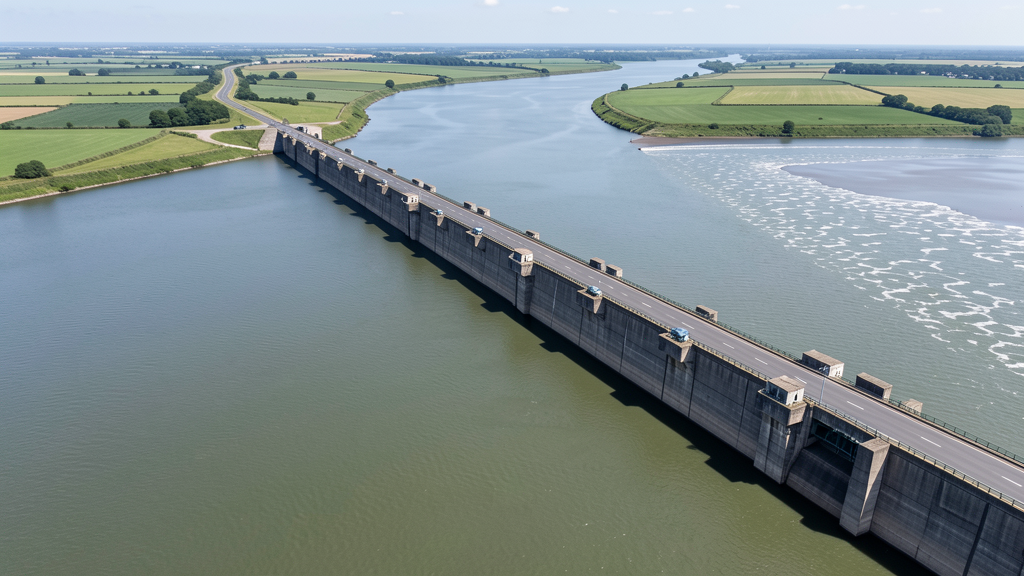
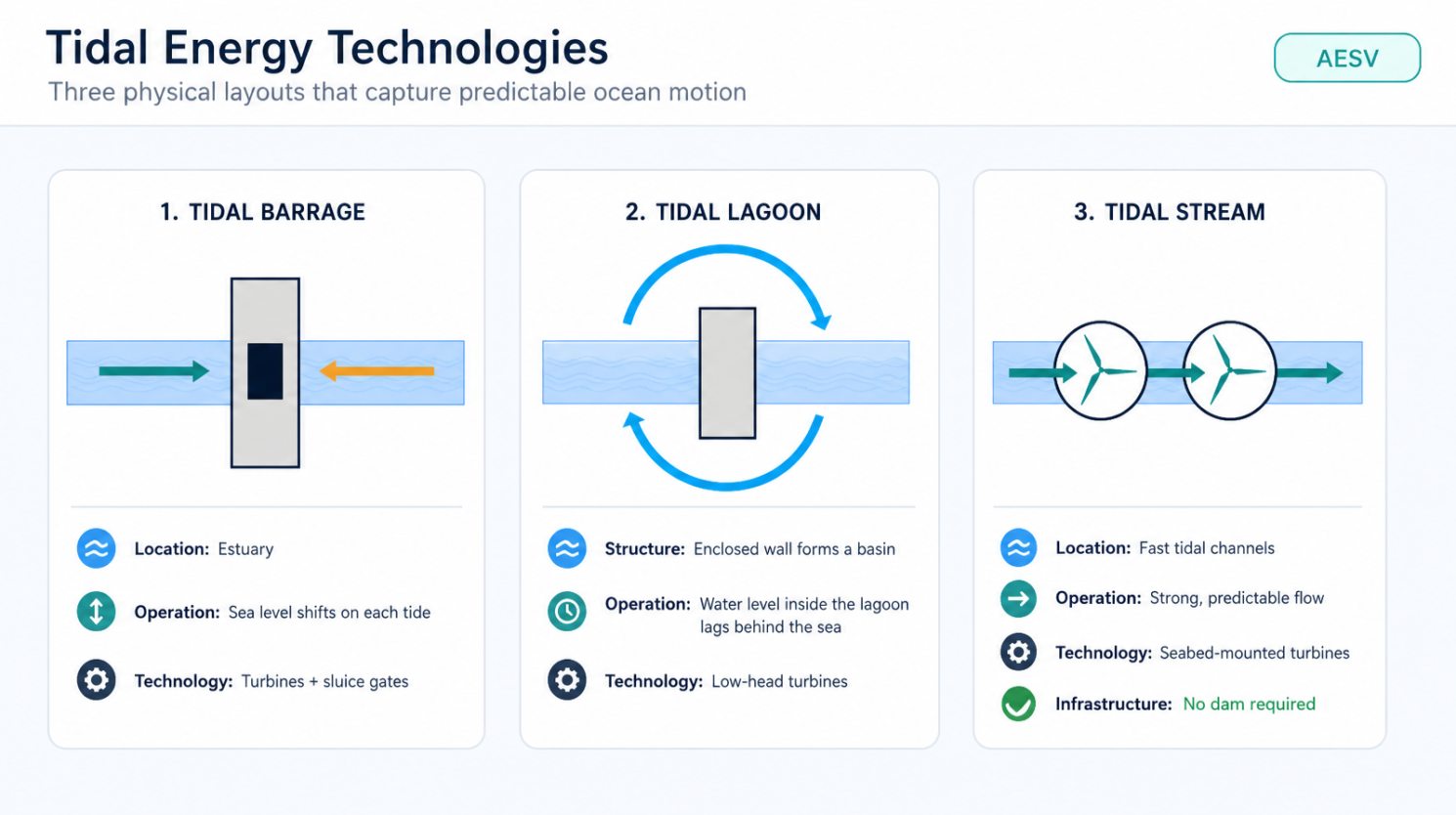
A tidal barrage is the oldest and most proven technology. It works like a dam built across an estuary or bay. During high tide, sluice gates open and fill a basin behind the barrage. When the tide drops, the trapped water flows back through turbines, generating electricity. The Rance plant in France and the Sihwa Lake station in South Korea both use this approach.
Pros: High output, proven technology, long lifespan (50+ years).
Cons: Enormous capital cost ($1–4 billion per project), significant environmental impact on estuary ecosystems, requires specific tidal range (typically 5+ meters).
2. Tidal Lagoon
Tidal lagoons are self-contained structures built offshore or along the coast, rather than blocking an entire estuary. They’re essentially artificial tidal basins. Water flows in and out through turbines in the lagoon walls. The Swansea Bay Tidal Lagoon proposal in Wales was the most high-profile example — though the UK government ultimately declined to fund it in 2018, the concept has seen renewed interest from developers in China and South Korea.
Pros: Lower environmental impact than barrages, can be built near population centers, potential for dual-use (recreation, aquaculture).
Cons: Still expensive per MW, no fully operational example at commercial scale yet (as of mid-2026), technology is less proven.
3. Tidal Stream (Underwater Turbines)
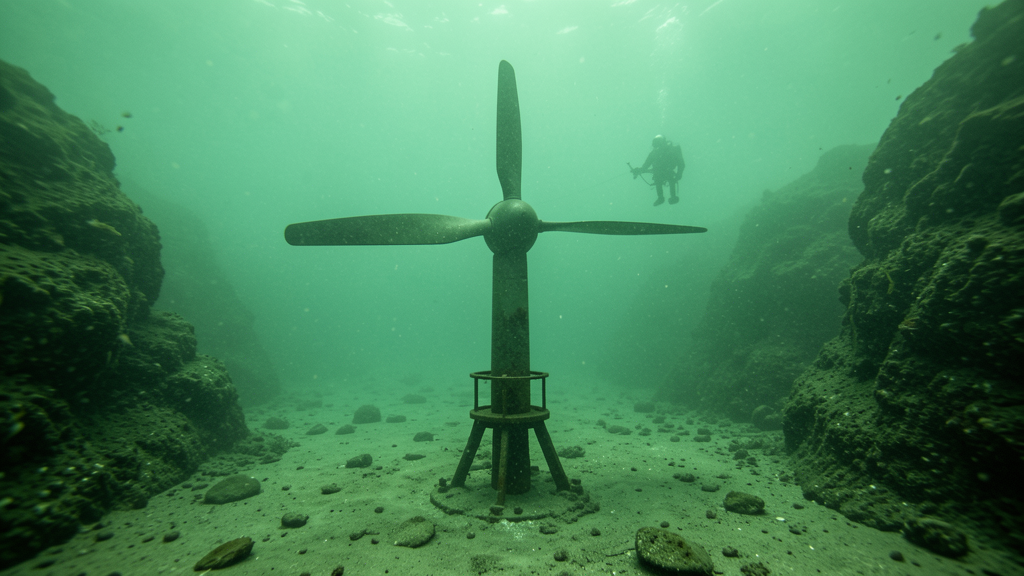
Tidal stream turbines are the newest approach and the one attracting the most venture capital. These are essentially underwater wind turbines — rotor blades mounted on the seabed or on floating platforms, designed to capture energy from tidal currents in channels, straits, or around headlands.
Companies like Orbital Marine Power (Scotland), Simec Atlantis Energy, and Hydroquest (France) are developing and deploying tidal stream devices. Orbital’s O2 turbine, deployed at the European Marine Energy Centre in Orkney, Scotland, became the world’s most powerful tidal stream turbine at 2 MW.
Pros: Smaller environmental footprint, modular/scalable, lower upfront cost per unit.
Cons: Technology is still maturing, harsh marine maintenance conditions, lower total output per device, limited to locations with strong tidal currents.
Bonus: Tidal Fence
A tidal fence is a line of vertical-axis turbines mounted on a bridge-like structure across a tidal channel. Water flows through the turbines as the tide changes direction. The concept was proposed for San Bernardino Strait in the Philippines (2,200 MW potential, estimated $3 billion cost) but has not been built at commercial scale.
Tidal Energy vs. Other Renewables
Here’s how tidal power stacks up against the renewable sources most homeowners and businesses actually consider in 2026:
| Factor | Tidal Energy | Solar | Wind | Hydroelectric | Geothermal |
|---|---|---|---|---|---|
| Predictability | Excellent (astronomical) | Moderate (weather-dependent) | Low (weather-dependent) | High (seasonal flow) | Excellent (baseload) |
| Capacity Factor | 25–30% | 15–25% | 25–45% | 35–60% | 70–90% |
| LCOE (2026 avg.) | $200–400/MWh | $24–50/MWh | $25–60/MWh | $30–70/MWh | $50–100/MWh |
| Residential Scalable? | No | Yes | Small-scale possible | No | Geography-dependent |
| Typical Project Cost | $1–4 billion | $1–3/watt (residential) | $1–2 million/MW | $2–5 billion | $50–200 million |
| Operational Lifespan | 50–100 years (barrage) | 25–30 years | 20–25 years | 50–100 years | 30–50 years |
| CO? Emissions (lifecycle) | ~15 g/kWh | ~40 g/kWh | ~11 g/kWh | ~24 g/kWh | ~38 g/kWh |
| Global Installed Capacity | ~520 MW | 1,600+ GW | 1,000+ GW | 1,400+ GW | ~16 GW |
Key takeaway: Tidal energy is extremely predictable and has near-zero lifecycle emissions, but its LCOE is 4–10× higher than solar or wind. For homeowners, solar remains the most accessible and cost-effective renewable. For utility planners, tidal makes sense in specific coastal geographies where predictability and long asset life justify the upfront investment.
Cost of Tidal Energy in 2026
Cost has been tidal energy’s biggest barrier to adoption. Here’s the reality in 2026:
- Levelized Cost of Energy (LCOE): Tidal barrage systems run $200–400/MWh, roughly 8–10× the cost of utility-scale solar ($24–50/MWh). Tidal stream is slightly cheaper at $200–350/MWh but still far above mainstream renewables.
- Capital intensity: A single tidal barrage project costs $1–4 billion. The proposed Severn Estuary barrage in the UK was estimated at $15 billion for 8,000 MW. These are national-infrastructure-scale investments.
- Operating costs are low: Once built, tidal plants have very low marginal operating costs. The Rance plant has been running since 1966 with minimal fuel cost (it’s gravity-powered).
- Government support is growing: The U.S. Department of Energy invested $16 million across 17 tidal projects. The EU’s Horizon Europe program has allocated €350 million to marine energy R&D through 2027. The UK’s Contracts for Difference scheme now includes tidal stream energy, and the MeyGen project in Scotland won a CfD at £178.54/MWh in 2022 — a record low for tidal.
Real-World Tidal Projects Worldwide
Here are the major operational and under-construction tidal energy projects as of July 2026:
| Project | Country | Type | Capacity | Status |
|---|---|---|---|---|
| Rance Tidal Power Station | France | Barrage | 240 MW | Operational (since 1966) |
| Sihwa Lake Tidal Power Station | South Korea | Barrage | 254 MW | Operational (world’s largest) |
| MeyGen | Scotland, UK | Stream | 6 MW (Phase 1) / 398 MW (full) | Phase 1 operational; expansion planned |
| Orbital O2 | Scotland, UK | Stream | 2 MW | Operational at EMEC |
| Annapolis Royal Generating Station | Canada | Barrage | 20 MW | Operational (since 1984) |
| Jiangxia Tidal Power Station | China | Barrage | 3.2 MW | Operational (since 1980) |
| Kislaya Guba | Russia | Barrage | 1.7 MW | Operational (since 1968) |
| Swansea Bay (proposed) | Wales, UK | Lagoon | 320 MW | Shelved; revived interest 2025 |
| San Bernardino Strait (proposed) | Philippines | Fence | 2,200 MW | Proposed |
The bottom line: South Korea, France, the UK, and Canada have the longest track records. China and Russia operate small demonstration plants. Scotland is emerging as the global hub for tidal stream technology. No country yet has tidal energy contributing more than 0.5% of its total electricity mix.
Pros and Cons of Tidal Energy
Pros
- Predictable: Tidal patterns are calculated decades in advance — no weather dependency.
- Renewable and clean: No greenhouse gas emissions during operation; no fuel costs.
- Extremely long lifespan: Barrage systems last 50–100 years (the Rance plant has operated since 1966).
- Low operating costs: Once built, marginal costs are minimal — gravity does the work.
- High energy density: Seawater is 832× denser than air, so turbines produce more power per unit area than wind.
- Quiet operation: Underwater turbines are naturally muffled by seawater.
- Minimal visual impact: Most infrastructure is submerged or low-profile.
- Baseload potential: Tidal power is predictable and doesn’t fluctuate like solar or wind.
Cons
- Extremely high capital cost: Projects run $1–4 billion; not viable for small-scale or residential use.
- Limited geography: Only works where tidal range exceeds ~5 meters or tidal currents exceed ~2 m/s.
- Environmental impact: Barrages can disrupt estuary ecosystems, fish migration, and sediment patterns.
- Intermittent availability: Power generation typically occurs ~10 hours per day, not continuously.
- Maintenance challenges: Servicing equipment underwater is expensive and hazardous.
- Corrosion and biofouling: Saltwater is brutal on metal components; anti-fouling and maintenance costs add up.
- Long transmission infrastructure: Undersea cables to connect to the onshore grid are expensive and technically complex.
- Small industry: Limited supply chain, few specialized contractors, slow cost reduction.
Why Tidal Energy Is Not a Residential Solution
This is the most important section for AESV readers. Let’s be direct:
Tidal energy is not available to homeowners. Not today, not in the foreseeable future. Here’s why:
- Scale: The smallest commercial tidal barrage (Annapolis Royal, Canada) cost $63 million for 20 MW. The smallest tidal stream turbine (Orbital O2) is a 2 MW floating structure the size of a small building. These are industrial machines, not rooftop accessories.
- Geography: You need a specific coastal site with strong tides. Most people don’t live on a tidal channel with sufficient flow velocity.
- Cost: Even if you could install a tidal turbine at your beachfront property, the equipment alone would cost millions — with a payback period measured in centuries at residential electricity prices.
- Regulation: Marine energy installations require environmental impact assessments, navigation safety approvals, fishing rights agreements, and often international maritime permits.
- Grid connection: You’d need to connect your personal tidal turbine to the grid — through subsea cable, transformer, and utility interconnection — an engineering project worth far more than any energy savings.
What should homeowners do instead? If you’re on the AESV site looking for practical renewable energy for your home, start here:
- Solar Energy: Complete Guide — the most accessible, affordable, and proven residential renewable.
- Solar Battery Guide — store solar energy for nighttime and outages.
- Solar-Powered Generators — portable and emergency power from the sun.
- Energy Savings Calculator — estimate your solar savings in minutes.
- Biomass Energy Guide — another utility-scale option worth understanding.
- Geothermal Energy Importance — ground-source heat is residential-friendly in the right conditions.
The Future of Tidal Energy
Tidal energy won’t replace solar or wind. But it has a real and growing role in the renewable energy mix, particularly for:
- Island nations with limited land for solar/wind but strong tidal currents (e.g., Indonesia, Philippines, Pacific Islands).
- Coastal cities seeking predictable baseload power to complement variable solar and wind.
- Nations with heavy marine engineering capability (UK, France, South Korea, China) looking to export tidal technology.
Key trends to watch in 2026–2030:
- Tidal stream cost reduction: As Orbital Marine Power, Simec Atlantis, and others deploy more units, costs should follow the learning curve that solar and wind experienced. The UK’s CfD scheme now includes tidal, providing revenue certainty.
- Tidal lagoon revival: The Swansea Bay project may see a successor proposal. China is building its first commercial tidal lagoon near Zhoushan.
- Hybrid ocean-energy platforms: Combining tidal, wave, and offshore wind on shared infrastructure could reduce per-MW costs dramatically.
- Climate adaptation: Rising sea levels will alter tidal patterns — both a challenge (existing sites may change) and an opportunity (new tidal ranges may become viable).
Frequently Asked Questions
Can I use tidal energy to power my home?
No. Tidal energy is exclusively a utility-scale technology. The smallest commercial tidal installation costs tens of millions of dollars and requires specific coastal geography. If you want residential renewable energy, solar panels are your best option — affordable, proven, and installable on most rooftops.
How does tidal energy compare to solar and wind?
Tidal energy is far more predictable than solar or wind, but it costs 4–10× more per megawatt-hour. Solar LCOE has dropped to $24–50/MWh globally, while tidal sits at $200–400/MWh. Tidal’s advantage is reliability — tides don’t depend on weather. See our full solar guide and wind guide for comparison data.
What is the world’s largest tidal power plant?
Is tidal energy environmentally friendly?
Tidal energy produces no greenhouse gas emissions during operation and has very low lifecycle emissions (~15 g/kWh). However, tidal barrages can disrupt estuary ecosystems, change sediment patterns, and affect fish migration. Tidal stream turbines have a much smaller environmental footprint. Overall, tidal is among the cleanest energy sources available — but not impact-free.
How much does tidal energy cost per kWh?
As of 2026, tidal barrage LCOE is roughly $0.20–0.40 per kWh ($200–400/MWh). Tidal stream is slightly lower at $0.20–0.35/kWh. For comparison, residential solar in the US averages $0.06–0.12/kWh including financing. Tidal is not cost-competitive at current scale, but costs are expected to decline as more projects are built.
What countries use tidal energy?
Does tidal energy cause pollution?
No. Tidal energy produces zero direct emissions. The only environmental concerns relate to physical infrastructure — barrages can alter marine ecosystems, and underwater turbines can pose collision risks to marine life. These impacts are generally considered minor compared to fossil fuel alternatives.
Is tidal energy renewable or non-renewable?
Tidal energy is fully renewable. It is driven by gravitational forces from the Moon and Sun — forces that will persist for billions of years. Unlike biomass, it requires no fuel. Unlike geothermal, it doesn’t deplete a heat reservoir. It is one of the most sustainable energy sources theoretically available.
Related Guides on AESV
- Solar Energy: Complete Guide — The most practical renewable for homeowners.
- Solar Battery Guide — Store solar power for night and emergencies.
- Solar-Powered Generators — Portable clean power from the sun.
- Wind Energy Guide — How wind turbines compare to tidal and solar.
- Hydroelectric Energy Guide — Dam-based hydropower explained.
- Biomass Energy Guide — Organic matter as fuel.
- Geothermal Energy Importance — Earth’s heat as a power source.
- Energy Savings Calculator — Estimate your solar savings.
Sources and References
- U.S. Department of Energy, Office of Energy Efficiency & Renewable Energy — Ocean Energy Technologies.
- NASA Jet Propulsion Laboratory — Ocean Current Energy Harvesting Research.
- IRENA (International Renewable Energy Agency) — Renewable Energy Statistics 2025.
- UK Department for Energy Security and Net Zero — Renewable Energy Statistics 2025.
- Canadian Encyclopedia — Tidal Power in Canada.
- Orbital Marine Power — O2 Tidal Turbine Technical Specifications, 2024.
- Simec Atlantis Energy — MeyGen Project Data, 2025.
