
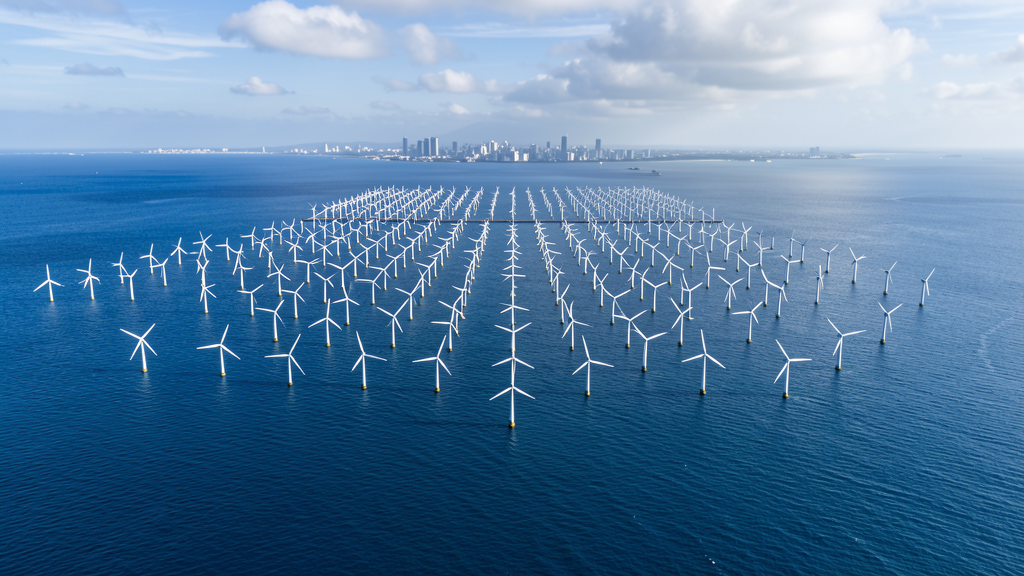
Offshore wind turbines are among the most powerful energy machines ever built. A single modern offshore turbine can generate 12–15 megawatts (MW) of capacity — enough to power thousands of homes. But how many of these giant machines would it take to power the world’s biggest cities?
We ran the numbers for 12 major cities using official energy consumption data, modern turbine specifications, and real-world capacity factors. The results show that offshore wind is technically capable of powering even the largest urban centers — but the scale of investment required is enormous.
How We Calculated the Numbers
Our estimates use the following methodology:
- City energy consumption: We used per-capita electricity consumption data from the International Energy Agency (IEA) and multiplied by city population to estimate annual electricity demand. Where available, we used official city-level grid data.
- Turbine reference: We used the Siemens Gamesa SG 14-236 DD — a 14 MW offshore turbine with a 236-meter rotor diameter, currently being deployed in North Sea projects. This is representative of the latest generation of large offshore turbines.
- Capacity factor: We assumed a 45% capacity factor for offshore wind, consistent with real-world performance data from the European Wind Energy Association (WindEurope) and operational North Sea wind farms. This accounts for variable wind, maintenance downtime, and wake effects.
- Annual energy per turbine: At 45% capacity factor, a 14 MW turbine produces approximately 55,200 MWh per year (14 MW × 8,760 hours × 0.45).
- Turbine spacing: Offshore turbines are typically spaced 7–10 rotor diameters apart. For a 236m rotor, that means roughly 1,650–2,360 meters between turbines. We used 7 rotor diameters (1,652m) per UK government guidelines.
How Many Offshore Turbines Per City?
Here is what it would take to fully power 12 major cities using only offshore wind with modern 14 MW turbines:
| City | Country | Population (metro) | Annual Electricity (TWh) | Turbines Needed (14 MW) | Wind Farm Area (km²) |
|---|---|---|---|---|---|
| Tokyo | Japan | ~37 million | ~135 | ~2,450 | ~6,500 |
| New York | United States | ~20 million | ~115 | ~2,080 | ~5,500 |
| Shanghai | China | ~29 million | ~105 | ~1,900 | ~5,000 |
| London | United Kingdom | ~14 million | ~55 | ~1,000 | ~2,600 |
| Mumbai | India | ~21 million | ~25 | ~450 | ~1,200 |
| São Paulo | Brazil | ~22 million | ~40 | ~725 | ~1,900 |
| Seoul | South Korea | ~25 million | ~80 | ~1,450 | ~3,800 |
| Paris | France | ~12 million | ~45 | ~815 | ~2,150 |
| Lagos | Nigeria | ~16 million | ~8 | ~145 | ~380 |
| Dubai | UAE | ~3.5 million | ~40 | ~725 | ~1,900 |
| Sydney | Australia | ~5.3 million | ~22 | ~400 | ~1,050 |
| Berlin | Germany | ~3.6 million | ~14 | ~255 | ~670 |
Important context: These numbers assume 100% of electricity comes from offshore wind — which is not how real grids work. In practice, cities use a mix of sources. The table shows the theoretical scale required if offshore wind were the only source. Real offshore wind farms would serve regional grids, not individual cities, and would be complemented by solar, storage, and other generation.
Why Tokyo and New York Need So Many Turbines
Tokyo and New York top the list because of their combination of large populations and high per-capita electricity consumption. Japan’s per-capita consumption is roughly 7,800 kWh/year, and the U.S. is about 12,000 kWh/year. A metro area of 20–37 million people at those consumption levels produces enormous total demand.
By contrast, Mumbai’s per-capita consumption is roughly 1,200 kWh/year — much lower than Western cities — so even with a population of 21 million, the total demand and turbine count are much smaller.
How Big Is the Wind Farm Area?
The “wind farm area” in the table is the total sea surface area occupied by the turbines and their spacing zones. To put it in perspective:
- Tokyo (~6,500 km²): Roughly 1.5× the area of Tokyo’s 23 special wards. That is a massive offshore installation, but the Sea of Japan and Pacific coast offer suitable deep-water sites.
- New York (~5,500 km²): About 3× the land area of New York City. The U.S. East Coast has some of the best offshore wind resources in the world, and lease areas are already being auctioned.
- London (~2,600 km²): Roughly 1.6× Greater London’s area. The North Sea is already home to many of the world’s largest offshore wind farms.
- Berlin (~670 km²): About 0.75× Berlin’s area. Germany’s North Sea and Baltic coast wind farms already contribute significantly to the national grid.
The World’s Largest Offshore Wind Farms
To understand the scale of what is already being built, here are some of the largest offshore wind farms operating or under construction:
| Wind Farm | Location | Capacity | Status | Homes Powered (est.) |
|---|---|---|---|---|
| Hornsea 2 | UK, North Sea | 1.4 GW | Operating (2022) | ~1.3 million |
| Hornsea 1 | UK, North Sea | 1.2 GW | Operating (2019) | ~1 million |
| Seagreen | UK, North Sea | 1.1 GW | Operating (2023) | ~1 million |
| Dogger Bank | UK, North Sea | 4.8 GW (total, phased) | Under construction | ~6 million |
| Borssele I & II | Netherlands, North Sea | 752 MW | Operating (2020) | ~750,000 |
| Vineyard Wind | US, Massachusetts | 804 MW | Operating (2026) | ~400,000 |
Dogger Bank, when fully complete, will be the world’s largest offshore wind farm at 4.8 GW — using hundreds of GE Haliade-X 13 MW+ turbines. It will generate enough electricity to power 6 million UK homes, roughly equivalent to powering the Greater Manchester metro area.
Why Offshore Instead of Onshore?
Offshore wind has several advantages over onshore for powering large cities:
Advantages
- Stronger, steadier winds: Ocean winds are less turbulent and more consistent than land-based winds, yielding higher capacity factors (40–55% offshore vs 25–40% onshore).
- Massive turbine sizes: Offshore turbines can be much larger than onshore — up to 15 MW per unit — because there are no road transport constraints for components.
- No land competition: Wind farms at sea do not compete with agriculture, housing, or natural habitats on land.
- Proximity to coastal cities: Most of the world’s largest cities are near coastlines, reducing transmission distances.
- Minimal visual impact: At 20+ km from shore, offshore wind farms are often invisible from the coast.
Challenges
- Higher cost: Offshore wind LCOE (~$0.075/kWh) is roughly double onshore (~$0.033/kWh), though the gap is closing.
- Construction complexity: Installation requires specialized vessels, subsea cables, and offshore substations — all expensive and weather-dependent.
- Maintenance difficulty: Accessing turbines offshore for repairs requires crew transfer vessels or helicopters, and is only possible in suitable weather.
- Environmental permitting: Marine ecosystems, fishing rights, shipping lanes, and military zones all create regulatory complexity.
- Grid connection: Subsea cables and onshore grid upgrades are needed to deliver offshore power to urban consumers.
Floating Offshore Wind: The Next Frontier
Most offshore wind turbines today are mounted on fixed foundations (monopiles, jackets, or gravity bases) in water depths up to 60 meters. But many of the world’s best offshore wind resources are in deeper water — 60–1,000 meters — where fixed foundations are impractical.
Floating offshore wind uses turbines mounted on buoyant platforms anchored to the seabed with mooring lines. This technology could unlock wind resources for cities like:
- Tokyo and Osaka: Japan’s coastline drops off quickly, making floating wind essential for large-scale offshore development.
- Los Angeles and San Francisco: The U.S. West Coast has deep water close to shore — ideal for floating turbines.
- Lisbon and Barcelona: The Mediterranean’s deep waters suit floating platforms.
- Busan and Seoul: South Korea is investing heavily in floating wind pilot projects.
Hywind Scotland (30 MW), the world’s first commercial floating wind farm, has operated since 2017 with capacity factors exceeding 50% — higher than most fixed-bottom offshore farms. Larger floating projects, like the 88 MW Kincardine farm off Scotland and the 96 MW Groix-Belle Île pilot in France, are proving the technology at scale.
For a broader overview of wind energy and how it works, see our guide to wind energy’s global potential.
What Does This Mean for the Future?
The numbers in this article are theoretical — no city will be powered by offshore wind alone. But they illustrate an important reality: the offshore wind resource exists to power even the world’s largest cities. The question is economic and political, not technical.
Several trends are making this increasingly realistic:
- Turbine technology: Offshore turbines have grown from 3 MW in 2010 to 15+ MW today. Larger turbines mean fewer units needed per gigawatt.
- Cost reduction: Offshore wind costs have fallen ~58% since 2010 and are projected to fall further as supply chains mature.
- Policy support: The EU targets 300 GW of offshore wind by 2050. The UK aims for 50 GW by 2030. China is installing offshore wind faster than any other country.
- Floating wind: Unlocking deep-water resources could multiply the global offshore wind potential by 3–4×.
- Green hydrogen: Offshore wind can produce green hydrogen, enabling decarbonization of shipping, heavy industry, and heating — sectors that are hard to electrify directly.
Frequently Asked Questions
How much electricity does one offshore wind turbine produce?
Why are offshore turbines so much bigger than onshore ones?
Transporting turbine blades, tower sections, and nacelles by road limits onshore turbine size. Offshore components are transported by ship, which has far fewer size constraints. Larger rotors capture more energy, and taller towers reach stronger winds — so bigger is always better offshore. The latest generation (14–15 MW) has rotor diameters exceeding 230 meters, with blades over 115 meters long.
How far offshore are wind farms typically built?
Most current offshore wind farms are 10–80 km from shore. Closer installations (10–30 km) are common in the North Sea and Baltic. Newer projects, especially in the U.S. and Asia, are being planned 30–80+ km offshore to reduce visual impact and access stronger winds. Floating wind can be deployed 50–200+ km from shore in deep water.
Can offshore wind farms survive hurricanes and typhoons?
Modern offshore turbines are engineered for extreme weather. In typhoon-prone regions like East Asia, turbines are designed to withstand Category 4+ conditions with reinforced towers, storm-pitch blade settings, and robust foundations. The first typhoon-rated offshore turbines are already operating in Chinese and Taiwanese waters. However, siting decisions must carefully account for extreme weather risk.
Do offshore wind farms harm marine life?
Construction noise (especially pile driving) can disturb marine mammals, but bubble curtains and soft-start protocols significantly reduce impact. Once operating, turbine foundations often act as artificial reefs, attracting fish and crustaceans. Studies from European offshore wind farms have found that marine biodiversity can actually increase around foundations. Careful environmental impact assessments are required before construction begins.
How much does offshore wind cost compared to other energy sources?
The global average LCOE for offshore wind in 2022 was approximately $0.081/kWh (IRENA). This is higher than onshore wind (~$0.033/kWh) and solar PV (~$0.044/kWh), but lower than new coal ($0.065–$0.15/kWh) and competitive with new natural gas plants ($0.045–$0.10/kWh) in many markets. NREL projects costs will fall to ~$0.053/kWh for fixed-bottom and ~$0.064/kWh for floating offshore wind by 2035.
Which country has the most offshore wind capacity?
China overtook the United Kingdom as the world’s largest offshore wind market in 2021 and had approximately 38 GW installed by end of 2024. The UK was second with ~15 GW, followed by Germany (~8 GW), the Netherlands (~5 GW), and Denmark (~3 GW). China’s rapid expansion — adding 20+ GW in 2022–2024 alone — has transformed the global offshore wind landscape.
Is floating offshore wind commercially viable?
Floating offshore wind is currently more expensive than fixed-bottom offshore wind, with early projects costing $0.10–$0.15/kWh. However, costs are expected to fall to $0.05–$0.08/kWh by the mid-2030s as the technology scales, according to the Carbon Trust and WindEurope. Pilot projects like Hywind Scotland and Kincardine have demonstrated strong performance, and commercial-scale floating wind farms are now under development in Norway, France, South Korea, and California.
Key Takeaways
- A single 14 MW offshore turbine produces ~55,200 MWh/year — enough for 14,000 European homes.
- Tokyo would need ~2,450 turbines; New York ~2,080; London ~1,000; Berlin ~255 (assuming 100% offshore wind).
- The Dogger Bank wind farm (3.6 GW) will power 6 million UK homes when complete.
- Offshore wind costs have fallen ~58% since 2010 and continue to decline.
- China leads global offshore wind with ~38 GW installed; the UK is second at ~15 GW.
- Floating wind technology could unlock deep-water resources for Japan, the U.S. West Coast, and the Mediterranean.
- Offshore wind farms can increase marine biodiversity by acting as artificial reefs.
- No city will rely on offshore wind alone, but the resource is more than sufficient to play a major role in urban decarbonization.
To learn more about wind energy and how it compares to other renewable sources, explore our guide to wind energy’s global potential, our practical guide to home wind power, and our wind turbines vs solar panels comparison. To estimate your own energy needs, try our Solar Backup Calculator.
