
Monocrystalline solar panels are the gold standard for residential solar in 2026. They deliver the highest efficiency, the longest lifespan, and the best space utilization of any panel type — and they now account for more than 95% of all residential installations in the United States. If you’re shopping for home solar panels, monocrystalline is almost certainly what you’ll end up with.
In this guide, we explain how monocrystalline technology works, what to look for when comparing panels, and which specific models offer the best combination of performance, warranty, and value. For a broader overview of all panel types, see our Best Solar Panels for Homes guide.
What Makes Monocrystalline Panels Different
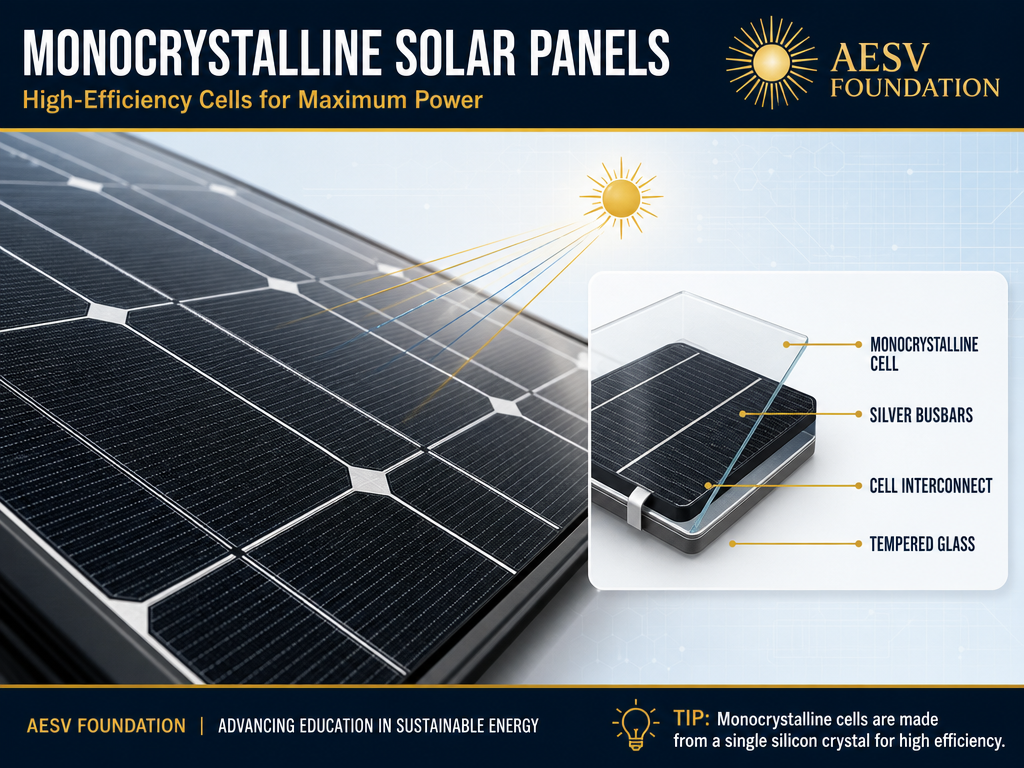
Monocrystalline cells are made from a single, continuous crystal of silicon. Manufacturers grow a large cylindrical silicon crystal (called an ingot) using the Czochralski process, then slice it into thin wafers. Because the crystal lattice is unbroken, electrons flow more freely through the material — resulting in higher efficiency than panels made from multiple crystal fragments.
You can identify monocrystalline panels by their uniform dark black color and the rounded corners on each cell (a byproduct of the cylindrical ingot). Polycrystalline panels, by contrast, have a speckled blue appearance from their mixed crystal structure.
Cell Technologies: PERC vs. TOPCon vs. HJT
Not all monocrystalline cells are created equal. The cell architecture inside the panel makes a significant difference in performance:
| Technology | How It Works | Typical Efficiency | Status in 2026 |
|---|---|---|---|
| PERC (Passivated Emitter and Rear Cell) | Adds a reflective layer behind the cell to bounce unabsorbed light back for a second pass | 20–21.5% | Legacy — being phased out |
| TOPCon (Tunnel Oxide Passivated Contact) | Adds an ultra-thin oxide layer that reduces electron recombination at the cell surface | 21.5–23% | Dominant — used by Jinko, LONGi, Canadian Solar, Trina |
| HJT (Heterojunction) | Combines crystalline silicon with amorphous silicon layers for near-zero surface recombination | 22–24% | Premium — used by REC, Panasonic |
Bottom line: If you’re comparing panels in 2026, TOPCon and HJT are the technologies to look for. PERC-based panels are still functional but represent older generation tech. Most new residential panels use TOPCon, while HJT powers the premium tier.
N-Type vs. P-Type Silicon
Another key distinction is the type of silicon wafer used:
- N-type: Doped with phosphorus. Degrades slower (0.25–0.40% per year), resistant to light-induced degradation (LID). Used by REC, Maxeon, Panasonic, and most premium panels.
- P-type: Doped with boron. Historically cheaper to manufacture but degrades faster (0.50–0.70% per year). Used in older and budget panels.
Over a 25-year system life, N-type panels produce 5–10% more total energy than equivalent P-type panels due to lower degradation. For most homeowners, N-type is worth the modest premium. Check the manufacturer’s datasheet — it will specify whether the cells are N-type or P-type.
Monocrystalline Solar Panels Buyer’s Guide
When comparing monocrystalline panels, focus on these key specifications:
Efficiency
Panel efficiency in 2026 ranges from about 20% to 23% for residential models. Higher efficiency means more power from less roof space. For a typical home with 300 sq ft of usable roof, the difference between 20% and 22% efficient panels is roughly 400–600 kWh per year — about $50–$80 in electricity savings annually. If your roof is small or partially shaded, prioritize efficiency. If you have plenty of open roof space, you can save money with slightly lower-efficiency panels.
Temperature Coefficient
This number (expressed as %/°C) tells you how much output drops for each degree above 25°C. A coefficient of -0.29%/°C is average; -0.24%/°C is excellent; 0.00%/°C (REC’s HJT panels) is best-in-class. In hot climates where rooftop temperatures regularly exceed 50°C (122°F), a better temperature coefficient can mean 3–5% more annual production.
Production Warranty (Year-25 Guarantee)
This is the percentage of original power output the manufacturer guarantees at year 25. Industry standard is 80–83%; premium panels guarantee 90–92%. Over 25 years, the difference between 83% and 92% retention is substantial — thousands of kWh and dollars in lost generation. Always compare this number, not just the warranty duration.
Wattage
Residential panels in 2026 range from 380W to 440W+. Higher wattage means fewer panels needed for the same system size. However, higher-wattage panels are physically larger — make sure your roof can accommodate the dimensions. A 440W panel is typically about 6.5 ft × 3.5 ft and weighs 45–50 lbs.
Warranty Length and Terms
Most manufacturers offer a 25-year product warranty covering defects and a separate 25-year performance warranty. Maxeon stands out with a 40-year warranty through their preferred installer network. Read the fine print — some warranties are voided by improper installation or non-authorized installers.
Best Monocrystalline Solar Panels in 2026
| Panel | Manufacturer | Cell Tech | Max Efficiency | Temp. Coeff. | Yr-25 Production | Wattage | Warranty |
|---|---|---|---|---|---|---|---|
| Alpha Pure-RX | REC | HJT (N-type) | 22.3% | 0.00%/°C | 92% | 430W | 25 years |
| Maxeon 7 | Maxeon | IBC (N-type) | 22.8% | -0.29%/°C | 92% | 440W | 40 years |
| HiHero | Canadian Solar | TOPCon (N-type) | 22.8% | -0.28%/°C | 88.85% | 440W | 25 years |
| EverVolt HK | Panasonic | HJT (N-type) | 22.2% | -0.24%/°C | 92% | 410W | 25 years |
| Tiger Neo | JinkoSolar | TOPCon (N-type) | 22.27% | -0.29%/°C | 83.1% | 440W | 25 years |
| HiDM | JA Solar | TOPCon (N-type) | 21.5% | -0.35%/°C | 89.6% | 420W | 30 years |
| Hi-MO 6 | LONGi | TOPCon (N-type) | 21.3% | -0.34%/°C | 84.8% | 430W | 25 years |
| Q.Peak DUO | Q CELLS | TOPCon (N-type) | 20.9% | -0.34%/°C | 86% | 410W | 25 years |
REC Alpha Pure-RX — Best Temperature Performance
The REC Alpha Pure-RX stands alone with its 0.00%/°C temperature coefficient — the best in the residential market. This means the panel loses essentially no efficiency on hot days, unlike competitors that drop 0.25–0.35% per degree. Combined with 92% year-25 production and HJT cell technology, it’s the top choice for homeowners who want maximum real-world energy production, especially in warm climates.
Pros: Best-in-class temperature performance | Excellent low-light generation | 92% year-25 guarantee | All-black design available
Cons: Higher price per watt than TOPCon-based panels | Slightly lower peak efficiency than Maxeon or Canadian Solar
Maxeon 7 — Best Long-Term Warranty
Maxeon’s unique shingled cell design eliminates front busbars, reducing resistive losses and eliminating common failure points. The Maxeon 7 holds the real-world efficiency crown at 22.8% and comes with a 40-year warranty through preferred installers — the longest in the industry. The shingled design also gives the panel a distinctive all-black appearance with no visible grid lines.
Pros: Highest efficiency (22.8%) | 40-year warranty | Shingled cell design eliminates hot spots | Beautiful all-black aesthetics
Cons: Only available through preferred installer network | Higher cost | Limited installer options
Canadian Solar HiHero — Best Availability and Efficiency
Canadian Solar ties Maxeon at 22.8% efficiency but with far wider availability — available through most major installers and distributors. Their TOPCon cell technology is mature and well-proven. As one of the world’s largest solar manufacturers, Canadian Solar offers strong parts availability and replacement support. The 88.85% year-25 guarantee is slightly lower than the premium tier but still above average.
Pros: 22.8% efficiency | Wide installer availability | Competitive pricing | Strong manufacturer backing
Cons: 88.85% year-25 guarantee is below REC/Maxeon/Panasonic tier
Panasonic EverVolt HK — Best for Hot Climates
Panasonic’s EverVolt HK features the best temperature coefficient among widely-available panels at -0.24%/°C. For homeowners in Arizona, Texas, Nevada, and other hot states, this translates to meaningfully more production on the hottest days of the year. The 92% year-25 production guarantee matches REC and Maxeon, and Panasonic’s brand carries significant trust with homeowners.
Pros: Excellent temperature coefficient (-0.24%) | 92% year-25 guarantee | Trusted brand | Good low-light performance
Cons: Lower wattage (410W) means more panels needed | Premium pricing
JinkoSolar Tiger Neo — Best Value Monocrystalline
JinkoSolar’s Tiger Neo delivers top-tier specs at mid-range prices. At 22.27% efficiency with a -0.29%/°C temperature coefficient, performance is solid. The main trade-off is the lower year-25 production guarantee (83.1%), but the upfront savings often outweigh this for homeowners who prioritize initial cost or plan to move within 10–15 years.
Pros: 22.27% efficiency at competitive price | 440W output | Widely available | All-black option
Cons: 83.1% year-25 guarantee is below premium tier | Chinese manufacturer (support concerns for some buyers)
LONGi Hi-MO 6 — Solid Mid-Range Option
LONGi is the world’s largest monocrystalline wafer producer, and their Hi-MO 6 panels bring that manufacturing expertise to residential installations. At 21.3% efficiency with a 25-year warranty, it’s a reliable, no-frills option. LONGi panels are widely available globally and are often competitively priced.
Pros: Competitive pricing | Strong manufacturer (world’s largest wafer producer) | Good global availability
Cons: 21.3% efficiency is below top tier | 84.8% year-25 guarantee | No all-black option currently
JA Solar HiDM — Longest Standard Warranty
JA Solar’s HiDM offers a 30-year standard warranty — 5 years longer than most competitors — with an 89.6% year-25 production guarantee. At 21.5% efficiency, it’s not the most efficient panel on this list, but the extended warranty provides extra peace of mind. JA Solar is one of the world’s top 5 panel manufacturers by volume.
Pros: 30-year warranty | 89.6% year-25 guarantee | Strong manufacturer
Cons: 21.5% efficiency is mid-range | No all-black option | -0.35%/°C temp coefficient is average
Monocrystalline vs. Other Panel Types
| Feature | Monocrystalline | Polycrystalline | Thin Film |
|---|---|---|---|
| Efficiency | 20–23% | 15–17% | 8–18% |
| Space needed | Least | More | Most |
| Cost per watt | $0.80–$1.50 | $0.60–$1.00 (limited availability) | $0.50–$1.50 |
| Lifespan | 25–40 years | 25 years | 10–25 years |
| Appearance | Black, uniform | Blue, speckled | Smooth, dark |
| Best for | Most residential | Budget, large roofs | RVs, portable, commercial |
| 2026 availability | Excellent | Limited | Niche |
For the vast majority of homeowners, monocrystalline is the clear choice. The efficiency advantage means fewer panels, less roof space, and better long-term returns. Polycrystalline panels have been largely discontinued by major manufacturers, and thin-film panels are primarily designed for commercial and utility-scale applications. See our Polycrystalline and Thin Film guides for the exceptions where those types make sense.
Frequently Asked Questions
Are monocrystalline solar panels worth the higher price?
Yes, for most homeowners. While mono panels cost slightly more per watt than polycrystalline, their higher efficiency means you need fewer panels to generate the same power. When you factor in the cost of racking, wiring, inverters, and installation labor (which are the same regardless of panel type), the total system cost difference is small — and the long-term energy production advantage is significant.
How are monocrystalline panels made?
Monocrystalline cells start as a large, cylindrical silicon crystal grown using the Czochralski process. A seed crystal is dipped into molten silicon and slowly pulled upward, forming a pure ingot. The ingot is then sliced into thin wafers (about 0.2mm thick), treated with anti-reflective coatings, and assembled into cells. The entire process produces the uniform, single-crystal structure that gives these panels their high efficiency.
What is the lifespan of monocrystalline solar panels?
Monocrystalline panels typically come with a 25-year performance warranty, but they continue producing electricity well beyond that. Panels degrade 0.25–0.50% per year (N-type on the low end, P-type on the high end), meaning a panel installed today should still produce 85–92% of its original output at age 25. Physical components (glass, aluminum frame, junction box) can last 30–40+ years. Many panels installed in the early 2000s are still operating today.
Do monocrystalline panels work in shade?
Monocrystalline panels handle partial shade better than polycrystalline panels, but shade still significantly impacts performance. If your roof has heavy shading from trees or nearby buildings, consider panels with half-cut cell design (standard on most 2026 panels) and microinverters or power optimizers, which allow each panel to operate independently. HJT panels (like REC and Panasonic) tend to perform better in low-light conditions than standard TOPCon panels.
Can I mix monocrystalline and polycrystalline panels on my roof?
Technically possible but not recommended. The two types have different electrical characteristics (voltage, current, temperature coefficients), which can cause system imbalances and reduce overall output. If you’re adding panels to an existing system, try to use the same type and similar wattage. Mixing old and new monocrystalline panels is less problematic but still requires matching electrical specifications.
Key Takeaways
- Monocrystalline panels account for 95%+ of residential installations in 2026.
- Look for TOPCon or HJT cell technology — PERC is being phased out.
- N-type silicon panels degrade slower and produce 5–10% more energy over 25 years than P-type.
- REC Alpha Pure-RX offers the best temperature performance (0.00%/°C coefficient).
- Maxeon 7 provides the longest warranty (40 years) and highest efficiency (22.8%).
- Canadian Solar HiHero ties for highest efficiency with wider availability.
- Panasonic EverVolt HK is the top pick for hot-climate homeowners.
- Compare year-25 production guarantees — they range from 83% to 92% and make a huge long-term difference.
- For a complete comparison of all panel types, see our Best Solar Panels for Homes guide.
Last updated: July 2026. We research and update our buyer’s guides regularly. Efficiency ratings and warranty terms are verified against manufacturer datasheets. AESV earns a commission from qualifying purchases made through affiliate links on this page — this does not affect the price you pay or our editorial independence.
