
Thin-film solar panels represent a fundamentally different approach to converting sunlight into electricity. Instead of rigid silicon wafers, thin-film panels use layers of semiconductor material just a few micrometers thick — roughly 1/100th the thickness of a human hair — deposited onto glass, metal, or flexible substrates.
While thin-film technology powers some of the world’s largest solar farms, its role in residential solar is more nuanced. Thin-film panels are not the best choice for most rooftop installations — monocrystalline panels offer higher efficiency and better space utilization. But thin-film excels in specific applications where its unique properties matter: RVs, boats, portable setups, curved surfaces, and building-integrated designs.
This guide explains the different thin-film technologies, where they genuinely shine, and which products are worth considering. For standard home rooftop installations, see our Best Solar Panels for Homes guide instead.
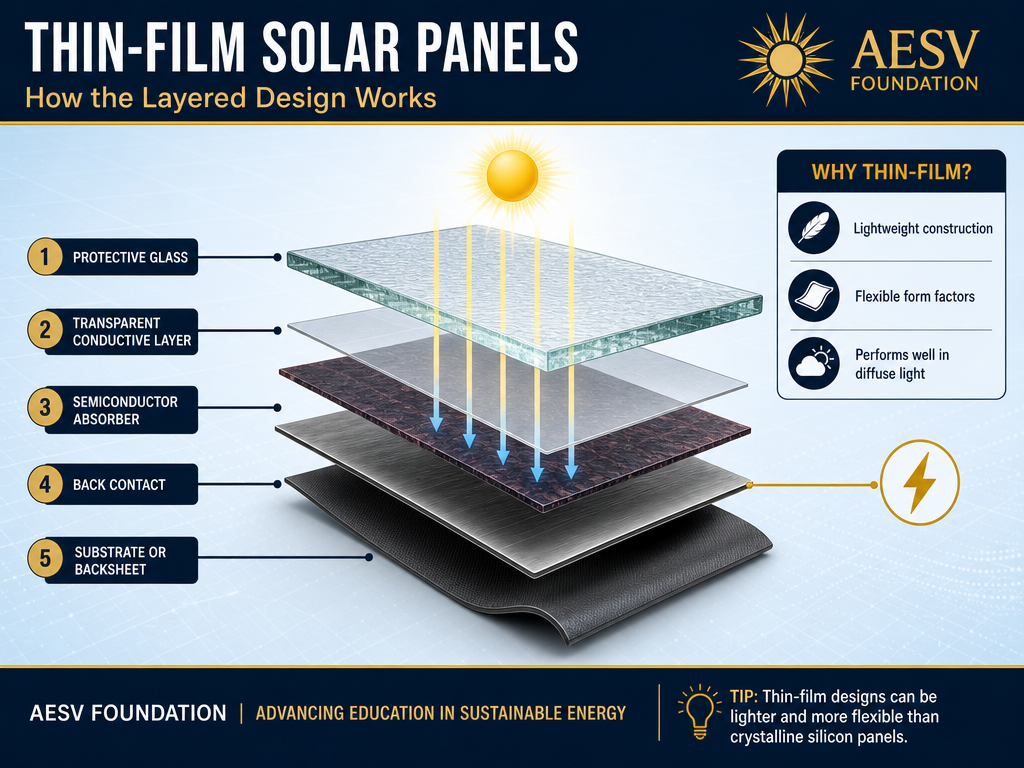
Types of Thin-Film Solar Technology
There are four main thin-film solar technologies, each with different materials, efficiency levels, and applications:
Cadmium Telluride (CdTe)
CdTe is the most commercially successful thin-film technology, accounting for roughly 50% of the global thin-film market. First Solar — the world’s largest thin-film manufacturer — uses CdTe in their Series 6 and Series 7 modules for utility-scale solar farms. CdTe panels achieve 17–19% efficiency in production and offer the lowest cost per watt of any solar technology.
The catch: CdTe contains cadmium, a toxic heavy metal. While the cadmium is safely encapsulated during normal operation, end-of-life disposal and recycling require careful handling. First Solar operates a comprehensive recycling program, but smaller CdTe manufacturers may not. CdTe panels are also primarily designed for large-scale ground-mount installations — they’re not practical for residential rooftops.
Copper Indium Gallium Selenide (CIGS)
CIGS is the most efficient thin-film technology, with lab records exceeding 23% and production panels reaching 15–18%. CIGS can be deposited on flexible substrates, making it the leading technology for flexible solar panels used on RVs, boats, and curved surfaces. The main challenge has been manufacturing consistency — CIGS production is more complex than CdTe, which has limited its cost competitiveness.
CIGS panels are the most relevant thin-film option for homeowners seeking flexible, lightweight panels for non-rooftop applications.
Amorphous Silicon (a-Si)
Amorphous silicon was the first thin-film technology and remains popular for small-scale applications: calculators, watches, sensors, and some building-integrated products. At 6–10% efficiency, a-Si is the least efficient thin-film type but the cheapest to produce. Its main advantage is excellent performance in low-light and diffuse-light conditions — it generates more power per watt than crystalline panels on cloudy days.
For residential solar, a-Si is rarely the right choice due to its low efficiency. However, it appears in some building-integrated photovoltaic (BIPV) products like solar roof tiles and solar facades where the aesthetic integration matters more than raw efficiency.
Gallium Arsenide (GaAs)
GaAs holds the record for the highest single-junction solar cell efficiency at 28.8%. However, it’s extremely expensive to produce and is used almost exclusively in space applications (satellites, Mars rovers) and specialized high-performance settings. You won’t find GaAs panels at your local solar installer — it’s included here for completeness.
Thin-Film Solar Panels Buyer’s Guide
If you’re considering thin-film panels, here are the key factors to evaluate:
Efficiency
Thin-film efficiency ranges widely: 6–10% for a-Si, 15–18% for CIGS, 17–19% for CdTe. Lower efficiency means more surface area needed for the same power output. For a 400W system, you’d need roughly 22–25 sq ft of monocrystalline panels but 30–65 sq ft of thin-film depending on the technology. This makes thin-film impractical for space-constrained rooftops but fine for applications where surface area is abundant.
Flexibility and Weight
Thin-film panels can be deposited on flexible polymer substrates, creating bendable panels that conform to curved surfaces. Flexible CIGS panels typically weigh 3–7 lbs per 100W — a fraction of the 10–12 lbs per 100W for rigid monocrystalline panels. This makes them ideal for RVs, boats, tents, and portable applications where weight and conformability matter.
Low-Light and Shade Performance
Thin-film panels generally perform better in low-light conditions than crystalline panels. They also handle partial shading better because their continuous film structure doesn’t suffer the same “Christmas light effect” where one shaded cell blocks an entire string. If your installation site has significant morning/evening shade or frequent overcast conditions, thin-film may generate more daily energy per watt than crystalline alternatives.
Temperature Coefficient
Thin-film panels typically have better (closer to zero) temperature coefficients than crystalline panels. CdTe panels from First Solar have coefficients around -0.28%/°C, competitive with monocrystalline. CIGS panels range from -0.20% to -0.35%/°C. This means thin-film panels maintain their output better in hot conditions.
Durability and Warranty
Thin-film warranties vary more than crystalline panels. Utility-scale CdTe panels (First Solar) come with 25-year performance warranties. Flexible CIGS panels for RV/portable use typically have 5–10 year warranties. Amorphous silicon products may have only 1–5 year warranties. The shorter warranty on flexible panels reflects their intended use — they’re designed for mobile applications, not permanent rooftop installations.
Best Thin-Film Solar Panels for Niche Applications (2026)
These are the thin-film products worth considering for specific use cases where crystalline panels aren’t ideal:
| Product | Technology | Use Case | Efficiency | Wattage | Weight | Warranty | Flex? |
|---|---|---|---|---|---|---|---|
| First Solar Series 6 | CdTe | Commercial / utility | 17–19% | 420–445W | 77 lbs | 10yr product / 25yr perf. | No |
| Renogy 100W Flexible | CIGS | RV, boat, portable | ~10% | 100W | 4.4 lbs | 5 years | Yes (248° arc) |
| Suaoki 100W Flexible | CIGS | RV, boat, camping | ~11% | 100W | 5 lbs | 5 years | Yes |
| Flisom Flex Series | CIGS | BIPV, curved surfaces | 16% | 100–150W | 5.5 lbs | 10 years | Yes |
| Kaneka a-Si | a-Si | Building-integrated | 8–10% | 100–120W | 40 lbs | 5yr product / 25yr perf. | No |
Note: First Solar panels are sold exclusively to commercial and utility-scale customers — not available for residential purchase. Flexible panel availability and specs may vary.
First Solar Series 6 — Best for Commercial / Utility-Scale
First Solar is the undisputed leader in thin-film solar, with over 20 GW of installed capacity worldwide. Their Series 6 CdTe modules achieve 17–19% efficiency — competitive with many monocrystalline panels — at the lowest manufacturing cost per watt in the industry. First Solar panels are used in some of the world’s largest solar farms and perform exceptionally well in hot, humid climates where crystalline panels struggle.
The reality: First Solar sells exclusively to commercial and utility-scale customers. You cannot buy these panels for your home. If you’re a commercial property owner or developer, First Solar modules are worth evaluating through their sales channels.
Pros: Industry-leading thin-film efficiency | Lowest cost per watt | Excellent hot-climate performance | 25-year performance warranty | Built-in recycling program
Cons: Not available for residential purchase | Heavy (77 lbs) | Contains cadmium
Renogy 100W Flexible — Best for RVs and Boats
Renogy’s flexible CIGS panel is one of the most popular choices for RV and marine applications. At just 4.4 lbs and capable of bending to a 248° arc, it can be mounted on curved RV roofs, boat decks, and other surfaces where rigid panels won’t fit. The 100W output is suitable for charging batteries, running small appliances, and off-grid power systems.
Pros: Ultra-lightweight (4.4 lbs) | Highly flexible | Easy DIY installation with adhesive | Good low-light performance
Cons: ~10% efficiency (need more surface area) | 5-year warranty | Lower output than rigid 100W mono panels | Higher cost per watt
Flisom Flex Series — Best for Building Integration
Flisom produces premium CIGS flexible panels with 16% efficiency — significantly higher than most flexible alternatives. Their panels are designed for building-integrated photovoltaics (BIPV), including curved facades, standing-seam metal roofs, and custom architectural applications. At 10-year warranty and 16% efficiency, Flisom bridges the gap between portable thin-film and permanent installations.
Pros: 16% efficiency (best in flexible class) | 10-year warranty | Designed for permanent installation | Architectural-grade
Cons: Premium pricing | Limited retail availability (primarily through BIPV installers) | Still lower efficiency than rigid mono
Kaneka a-Si — Building-Integrated Option
Kaneka’s amorphous silicon panels are designed for building-integrated applications where the panel serves a dual purpose (power generation and building material). At 8–10% efficiency, the power output is modest, but the panels’ uniform appearance and low-light performance make them suitable for solar facades, skylights, and architectural features where aesthetics matter as much as generation.
Pros: Excellent low-light performance | Uniform appearance | 25-year performance warranty | Good for architectural integration
Cons: Very low efficiency (8–10%) | Heavy for its output | 5-year product warranty | Limited availability
When to Choose Thin-Film Over Crystalline
Thin-film panels make sense in specific scenarios where their unique properties provide genuine advantages:
| Scenario | Best Choice | Why |
|---|---|---|
| Standard residential rooftop | Monocrystalline | Higher efficiency, better space utilization, longer warranty |
| RV or camper van | Flexible CIGS | Lightweight, conforms to curved roof, easy DIY install |
| Sailboat or yacht | Flexible CIGS | Lightweight, bendable, handles salt spray |
| Camping / portable power | Flexible CIGS | Ultra-portable, folds/rolls for transport |
| Commercial warehouse roof | Either (CdTe or mono) | Large flat roof = space isn’t a constraint; CdTe may be cheaper |
| Utility-scale solar farm | CdTe (First Solar) | Lowest cost/watt, excellent hot-climate performance |
| Curved building facade | CIGS (Flisom or similar) | Flexibility enables architectural integration |
| Shaded installation | Thin-film or mono + optimizers | Thin-film handles shade better; mono + microinverters also works |
Frequently Asked Questions
Are thin-film solar panels better than monocrystalline?
For most residential rooftop installations, no. Monocrystalline panels offer 20–23% efficiency compared to 6–19% for thin-film (depending on technology), which means you need far less roof space for the same power output. Monocrystalline panels also come with longer warranties (25–40 years vs. 5–25 years for thin-film) and have better long-term availability and support. Thin-film panels are better for niche applications where flexibility, weight, or low-light performance matter more than raw efficiency.
Can I use thin-film panels on my house roof?
Technically yes, but it’s rarely practical. Thin-film panels’ lower efficiency means you’d need 30–100% more roof area to generate the same power as monocrystalline panels. For a typical 6 kW residential system, monocrystalline panels need about 300 sq ft of roof space, while thin-film panels would need 400–700 sq ft depending on the technology. If you have a large, unshaded roof and find thin-film panels at a significant discount, it could work — but the total system cost (including additional racking and wiring) usually favors monocrystalline.
Do thin-film panels last as long as crystalline panels?
It depends on the type. Utility-scale CdTe panels (First Solar) come with 25-year performance warranties, comparable to crystalline. Flexible CIGS panels designed for RVs and portable use typically have 5–10 year warranties — shorter because they’re designed for mobile, not permanent, installations. Amorphous silicon panels can degrade faster (1–2% per year vs. 0.25–0.50% for crystalline), which is reflected in their shorter product warranties.
Are thin-film panels cheaper than monocrystalline?
On a per-watt basis, some thin-film technologies (especially CdTe) are cheaper than monocrystalline. However, when you factor in the additional surface area, racking, and installation labor needed for lower-efficiency panels, the total system cost is often similar or higher. For flexible CIGS panels (the most relevant thin-film type for homeowners), the cost per watt is typically higher than rigid monocrystalline panels due to the specialized manufacturing process.
What is the most efficient thin-film solar panel?
In production, First Solar’s CdTe modules lead at 17–19% efficiency. In the flexible category, Flisom’s CIGS panels achieve about 16%. In laboratory settings, CIGS cells have reached 23.35% efficiency (Swiss Federal Laboratories for Materials Science and Technology, 2019), and GaAs cells hold the single-junction record at 28.8% (Alta Devices). For practical residential use, CIGS flexible panels at 10–16% efficiency are the most accessible thin-film option.
Can thin-film panels handle shade better than monocrystalline?
Generally, yes. Thin-film panels’ continuous film structure means partial shading doesn’t have the same dramatic impact as on crystalline panels, where one shaded cell can reduce output for the entire string. However, modern monocrystalline panels with half-cut cell design and paired with microinverters or power optimizers also handle shade well. If shading is your primary concern, either technology can work — discuss the specific shading pattern with your installer.
Key Takeaways
- Thin-film panels use semiconductor layers 1/100th the thickness of silicon wafers.
- CdTe (First Solar) dominates utility-scale but isn’t available for residential purchase.
- CIGS is the most relevant thin-film technology for homeowners — it powers flexible panels for RVs, boats, and portable use.
- Thin-film efficiency (6–19%) is lower than monocrystalline (20–23%), requiring more surface area.
- Thin-film excels in flexibility, weight, low-light performance, and shade tolerance.
- For standard residential rooftops, monocrystalline is almost always the better choice. See our Best Solar Panels for Homes guide.
- Thin-film is best for RVs, boats, portable power, curved surfaces, and building-integrated applications.
- Flexible CIGS panels (Renogy, Flisom) are the practical thin-film option for most homeowners.
Last updated: July 2026. We research and update our buyer’s guides regularly. Product availability and specifications may vary — verify with manufacturers before purchasing. AESV earns a commission from qualifying purchases made through affiliate links on this page — this does not affect the price you pay or our editorial independence.
