
Disclosure: This guide contains affiliate links. AESV may earn a commission from qualifying purchases made through these links, at no extra cost to you. This supports our independent research and honest recommendations. As an Amazon Associate, AESV earns from qualifying purchases.
Editor’s Note: This guide was originally published in 2019 and has been thoroughly updated for 2026. Two of the three products from our earlier list are no longer available (SunQuest and Sun2Solar). We restructured this guide to cover solar pool heating options more broadly, including the SmartPool S601P we are keeping and the Fafco Solar Bear as an additional recommendation.
Heating an inground pool with solar panels is one of the smartest investments a pool owner can make. After the upfront cost of the panels, the heat is essentially free — no gas bills, no electric heaters running up your utility tab. A good solar pool heating system can extend your swimming season by 2–3 months and pay for itself in a year or two.
The challenge is that solar pool heaters are heavily seasonal products. Many models are only available from spring through early fall, and some brands come and go. Two of the three products from our previous list are no longer available, so we restructured this guide to help you understand what to look for and give you the best currently recommended options.
Quick links: Jump to Our Top Picks, How They Work, How to Choose, or FAQ.
How Solar Pool Heaters Work
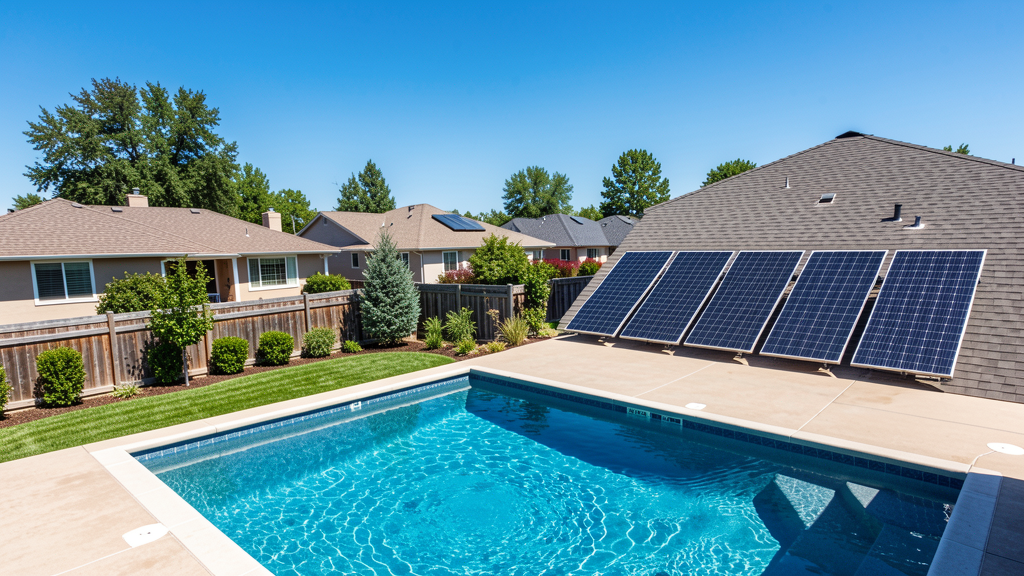
A solar pool heater is simpler than you might think. Your existing pool pump pushes water through a series of rubber or plastic panels mounted on your roof (or on a ground-mounted rack). The sun heats the panels, the panels heat the water, and the warm water flows back into your pool. No extra pumps, no gas lines, no electricity beyond what your pump already uses.
The key components are:
- Solar collector panels: Rubber or plastic panels that absorb heat from the sun and transfer it to the water flowing through them
- Flow control valve: A diverter valve that sends water through the panels when heat is needed and bypasses them when the pool is already warm enough
- Temperature sensor: Measures pool water temperature and tells the valve when to activate
A properly sized system can raise your pool temperature by 5–15°F, which is the difference between a pool you use three months a year and one you use five or six.
Our Top Picks for 2026
1. SmartPool SunHeater Universal Collector Systems — Best DIY Starting Point
SmartPool’s current SunHeater ecosystem is a more dependable starting point than the older S601P listing, which no longer showed a reliable primary offer. Buy collectors, connection kits, and controls as a matched system rather than assuming one panel will heat an inground pool.
Collector area usually matters more than brand: many pools need solar collector area equal to roughly 50–100% of the pool surface, adjusted for climate, shade, orientation, wind, and desired temperature rise.
Pros
- Current ecosystem: SunHeater kits and accessories remain searchable.
- Modular: Add collector area to suit the pool and climate.
- DIY-friendly components: Connection kits and controls are available separately.
Cons
- System design required: A kit alone may not include enough collector area.
- Roof work: Safe mounting and leak-free plumbing are essential.
Check current options on Amazon
2. Professionally Sized Polypropylene Collectors — Best for Permanent Inground Pools
A dealer-sized polypropylene collector array is the strongest replacement for discontinued consumer kits when the goal is dependable whole-pool heating. A pool professional can account for roof area, pump head, plumbing length, wind exposure, and local freeze conditions.
This route costs more upfront but avoids the common mistake of buying too little collector area or incompatible hardware.
Pros
- Correct sizing: Designed around the actual pool and site.
- Durable installation: Proper mounting, valves, and controls.
- Better support: Installer-backed troubleshooting and warranty path.
Cons
- Higher installed cost: Labor and controls add expense.
- Quote required: Not a one-box marketplace purchase.
Compare current collector options
3. Solar Cover Plus Collector System — Best Efficiency Upgrade
A solar cover is not a replacement for collector panels, but pairing one with a properly sized solar heating system can sharply reduce nighttime and wind-driven heat loss. That lets the collectors spend more of the next day increasing water temperature instead of recovering yesterday’s losses.
Choose a cover that fits the pool geometry and use a reel or safe storage method so the cover is practical to deploy consistently.
Pros
- Reduces heat loss: Helps preserve gains from the collector array.
- Lower operating demand: Can reduce the collector area or runtime needed.
- Widely available: Many current sizes and thicknesses are sold.
Cons
- Handling: Large covers can be awkward without a reel.
- Safety: A solar cover is not a safety cover.
How to Choose a Solar Pool Heater
Sizing: How Many Panels Do You Need?
The general rule is that your total solar collector area should equal 50–100% of your pool’s surface area. For a standard 15? × 30? pool (450 sq ft), you need 225–450 square feet of collector panels. Each standard 2? × 20? panel provides 40 square feet of collector area, so you need 6–12 panels.
If you live in a warm climate (Florida, Texas, Arizona), 50–60% coverage is usually enough. In cooler northern climates, aim for 80–100% coverage to get meaningful temperature gains.
Roof vs. Ground Mounting
Roof mounting is the most common approach — it uses otherwise wasted space and gets better sun exposure. But not every roof is suitable. You need a south-facing roof (in the Northern Hemisphere) with minimal shade from trees or neighboring buildings. The roof also needs to be in good condition — installing solar panels on a roof that needs replacing in a few years is a waste.
Ground-mounted racks are a good alternative if your roof is not suitable. They are easier to install and maintain, but they take up yard space and may not get as much sun as a roof installation.
Automatic vs. Manual Control
Most solar pool heater kits include a temperature sensor and diverter valve that automatically route water through the panels when the pool temperature drops below your set point. This is the way to go — manual valves require you to remember to open and close them, and you will inevitably forget on a cold night.
Payback Period
A solar pool heating system typically costs $500–$2,000 installed (or $200–$500 for DIY). A gas pool heater costs $1,500–$3,500 to install plus $200–$500 per month in gas bills during the swimming season. Solar heating pays for itself in 1–3 years in most cases, and the panels last 10–20 years.
Frequently Asked Questions
How much warmer will a solar pool heater make my pool?
Typically 5–15°F warmer than an unheated pool, depending on your climate, pool size, solar panel coverage, and sun exposure. In sunny southern states, a well-sized system can raise the temperature from 72°F to 85°F or higher. In northern states, expect more modest gains of 5–10°F.
Do solar pool heaters work in winter?
In most of the US, no. Solar pool heaters need strong direct sunlight to work effectively, and winter sun is too weak and too low in the sky in northern states to provide meaningful heating. In southern states like Florida or Southern California, solar heating can extend the season into late fall and early spring, but even there it is not effective in winter.
How long do solar pool heater panels last?
High-quality rubber or polypropylene panels last 15–20 years with minimal maintenance. Cheaper panels may last 7–10 years. The most common failure point is UV degradation of the panel material, which causes cracking and leaks. Panels with UV-stabilized materials last longer.
Can I install a solar pool heater myself?
Yes, if you are comfortable with basic plumbing (PVC pipe cutting and gluing) and roof work. Most DIY kits come with detailed instructions and all the hardware you need. The main steps are: mounting the panels on the roof, connecting them with PVC pipe, installing the diverter valve, and wiring the temperature sensor. Plan for a full weekend of work. If you are not comfortable on the roof, hire a pool contractor — installation typically costs $200–$500 in labor.
Do I need a separate pump for solar pool heating?
No. Your existing pool pump provides all the pressure needed to push water through rooftop solar panels. The pump needs to overcome the extra head pressure of pushing water up to the roof, which is usually 10–15 feet of vertical lift. If your pump is already marginal, you may need a slightly larger pump, but most standard pool pumps handle the extra load without issues.
Solar Pool Heater vs. Gas vs. Heat Pump
| Feature | Solar | Gas Heater | Heat Pump |
|---|---|---|---|
| Upfront cost | $500–$2,000 | $1,500–$3,500 | $2,500–$5,000 |
| Operating cost | Free (sun) | $200–$500/month | $50–$150/month |
| Heating speed | Slow (2–3°F/day) | Fast (1–2°F/hour) | Moderate (1–2°F/day) |
| Lifespan | 15–20 years | 5–10 years | 10–15 years |
| Best climate | Sunny, mild to warm | Any climate | Mild to warm |
| Environmental impact | Zero emissions | Natural gas or propane | Electricity (varies) |
Which Option Should You Pick?
| Your Situation | Best Pick |
|---|---|
| Want a complete, top-rated kit | SmartPool S601P (seasonal — check during pool season) |
| Want a long-lasting system from an established brand | Fafco Solar Bear (contact a dealer) |
| On a tight budget, comfortable with DIY | DIY rubber panel system ($200–$400) |
For most inground pool owners, the SmartPool S601P is the best starting point — it is a complete system with top reviews and a reasonable price. If you want the best long-term investment and do not mind a higher upfront cost, the Fafco Solar Bear is built to last decades. And if you are handy, a DIY rubber panel system gives you the most bang for your buck.
Next step: Pair your solar pool heater with a solar charge controller if you are building a broader solar system, or check out our guide to solar batteries for off-grid backup power.
