
Disclosure: This guide may contain affiliate links. AESV may earn a commission from qualifying purchases made through these links, at no extra cost to you. This supports our independent research and honest recommendations. As an Amazon Associate, AESV earns from qualifying purchases.
Equipment guide · Updated 2026
How to Select the Right Solar Charge Controller
A solar charge controller is a small box that can protect — or ruin — your battery bank. It regulates how solar panels charge batteries, and picking the wrong one wastes power or damages your system. This guide explains the two controller types, how to size them, and which models are worth your money in 2026.
Size Your System Compare Batteries
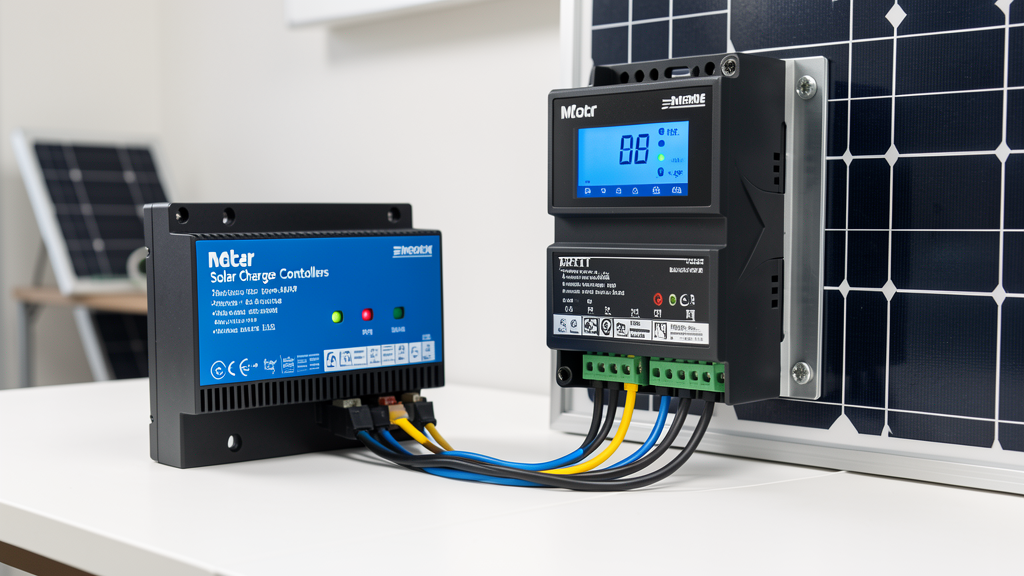
What a solar charge controller does
A charge controller manages the flow of electricity from solar panels to batteries. Without one, panels would push too much voltage into the battery bank, causing overcharging, overheating, and permanent damage.
- Regulate charging voltage. Panels produce variable voltage. The controller keeps it within the battery’s safe range.
- Prevent overcharging. When batteries are full, the controller reduces or stops charging current.
- Prevent over-discharging. Low-voltage disconnect cuts power to loads when battery voltage drops too low.
- Display system status. Battery voltage, charging current, and system state.
Required for any system that charges batteries from solar panels. Grid-tied systems without batteries do not need one.
MPPT vs PWM: the two controller types
| Feature | PWM | MPPT |
|---|---|---|
| How it works | Connects panels directly to battery voltage. Wastes excess voltage as heat. | DC-DC conversion extracts maximum power. Converts excess voltage into charging current. |
| Efficiency | Baseline. | 15–30% more energy than PWM. |
| Panel voltage flexibility | Panel voltage must closely match battery. | Can use higher-voltage panels with lower-voltage batteries. |
| Best for | Small systems under 150W. Budget builds. | Systems over 150W. Cold climates. Mismatched voltages. |
| Cost | $15–$50 | $80–$400+ |
Choose MPPT for most systems over 150 watts. The extra energy harvest pays for the price difference quickly.
How to size a solar charge controller
Controller amps = (Total panel wattage ÷ Battery voltage) × 1.25
Worked examples
| System | Panels | Battery | Calculation | Minimum controller |
|---|---|---|---|---|
| Small cabin | 100W | 12V | 100 ÷ 12 = 8.3A × 1.25 = 10.4A | 10A |
| RV setup | 200W | 12V | 200 ÷ 12 = 16.7A × 1.25 = 20.8A | 20A |
| Workshop | 400W | 12V | 400 ÷ 12 = 33.3A × 1.25 = 41.6A | 40–50A |
| Off-grid home | 800W | 24V | 800 ÷ 24 = 33.3A × 1.25 = 41.6A | 40–50A |
Always choose a controller above your calculated minimum. A 40A controller on a 35A system runs cooler and lasts longer.
Top solar charge controllers for 2026
Best value 40A MPPT: Renogy Rover Li 40A
40A, 12V/24V auto-detect. LCD display, Bluetooth optional, LiFePO4 compatible. ~$154. View on Amazon
Best budget 40A MPPT: EPEVER Tracer 4210AN
40A with included remote meter and temp sensor (G3+). LiFePO4 support. ~$140. View on Amazon
Best waterproof PWM: Renogy Voyager 20A
20A, IP67 waterproof. LCD display, multiple battery types. ~$49. Best for small RV/boat under 200W. View on Amazon
Best premium MPPT: Morningstar ProStar MPPT-25
25A, industry-leading reliability, 5-year warranty. ~$398. Best for mission-critical remote systems. View on Amazon
Wiring basics
- Connect batteries first, then panels. This lets the controller detect system voltage correctly.
- Use the right wire gauge. Follow manufacturer recommendations for current and wire length.
- Add a fuse between controller and battery. Size at 1.25× rated current.
- Keep wire runs short. Longer wires mean more voltage drop.
- Ground the system properly. Follow manufacturer instructions and local code.
For a complete wiring example, see the charge controller buyer’s guide.
What happens if the controller is too small?
- Clipping. Controller limits current to its max rating, wasting excess panel power.
- Overheating. Running at rated capacity generates heat, shortening lifespan.
- Shut-down. Thermal protection disables charging until cooled.
- Battery damage. Failed controller may allow unregulated current to reach batteries.
What to do next
- Calculate your system size. Use the Solar Backup Calculator.
- Choose batteries. The battery guide compares all types.
- Size the controller. Use the formula above or the charge controller buyer’s guide.
- Explore complete kits. The kit comparison includes pre-sized controllers.
- Consider portable options. Solar generators have built-in controllers.
Solar charge controller FAQ
Do I need a charge controller for every solar system?
Any system charging batteries from solar needs one. Grid-tied systems without batteries do not.
Can I use a bigger controller than I need?
Yes. It runs cooler, lasts longer, and gives room to expand. No harm in oversizing.
Do I need a controller for a solar generator?
No. Solar generators have built-in controllers. External controllers are for DIY systems.
What is the difference between a controller and an inverter?
A controller manages panel-to-battery charging. An inverter converts DC battery power to AC household power.
Can I wire two controllers to one battery bank?
Yes. Multiple controllers can charge the same bank. Each connects to its own sub-array of panels.
Should I choose MPPT for under 100W?
For under 100–150W with matched voltages, PWM is usually sufficient. MPPT shows its advantage with larger arrays.
