
Disclosure: This guide contains affiliate links. AESV may earn a commission from qualifying purchases made through these links, at no extra cost to you. This supports our independent research and honest recommendations. As an Amazon Associate, AESV earns from qualifying purchases.
Editor’s Note: This guide was originally published in 2019 and has been thoroughly updated for 2026 with current pricing, verified product availability, and replacement of five discontinued solar panels from our earlier list.
Whether you are hiking the Appalachian Trail, car camping with the family, or just want to keep your phone charged at the campsite, a portable solar panel is one of the most useful pieces of gear you can pack. The problem is that the portable solar market moves fast — panels that were best-sellers two years ago are often discontinued or replaced with newer models.
We updated this guide for 2026 by checking every product on our previous list. Five of the seven panels are no longer available, so we replaced them with current models you can actually buy. Here are the best portable solar panels for camping and hiking right now.
Quick links: Jump to Our Top Picks, How to Choose, or FAQ.
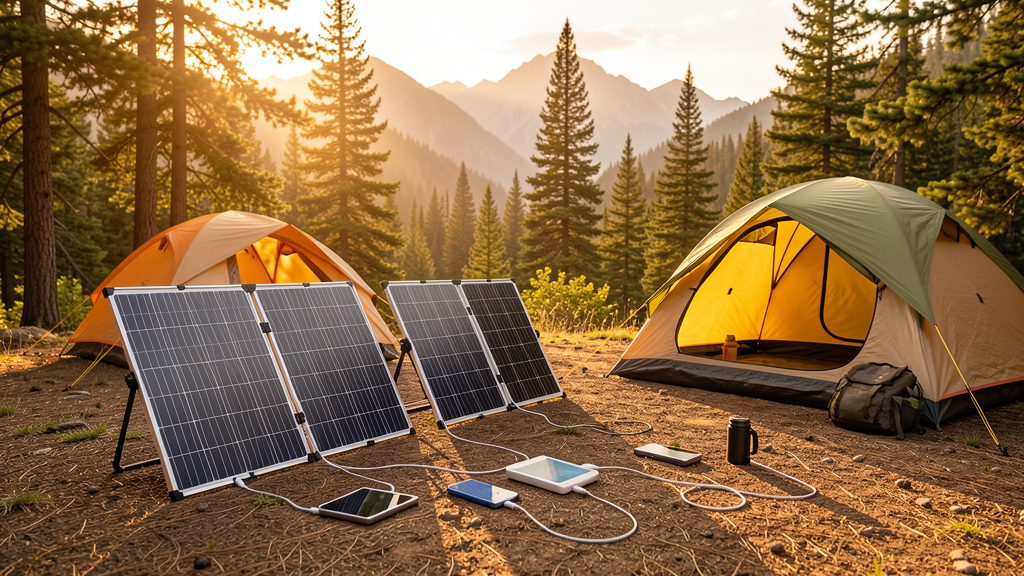
Our Top Picks for 2026
| Panel | Wattage | Weight | Price | Rating | Best For |
|---|---|---|---|---|---|
| BigBlue 28W Solar Charger | 28W | ~2.1 lbs | ~$60 | 4.4? | Best overall for camping |
| SunJack 25W Foldable Kit | 25W | ~3.5 lbs | ~$80 | 4.5? | All-in-one with power banks |
| Anker 625 Solar Panel | 21W | ~1.8 lbs | ~$55 | 4.3? | Lightweight hiking |
| Goal Zero Nomad 50 | 50W | ~6.4 lbs | ~$200 | 4.5? | High power, base camp |
| Jackery SolarSaga 60W | 60W | ~7.3 lbs | ~$180 | 4.5? | Power stations & serious off-grid |
| Sunforce 15W Charging Kit | 15W | ~4 lbs | ~$25 | 3.7? | Ultrabudget trickle charging |
Prices shown are approximate and may vary by seller. All prices verified at time of publication; check Amazon for current pricing.
1. BigBlue 28W USB-C Solar Charger — Best Overall for Camping
The current BigBlue 28W listing adds USB-C alongside USB-A, correcting the older USB-A-only description. It remains a proven phone-and-power-bank panel for campers who want useful output without moving to a large power-station panel.
Use it to charge a power bank during the day, then charge devices from the battery after sunset. Direct phone charging can pause when clouds pass.
Pros
- Current ports: USB-C and USB-A outputs.
- Portable: Folds for pack storage and camp use.
- Established listing: Current Amazon results showed active offers and substantial buyer activity.
Cons
- No built-in storage: Pair it with a power bank.
- Weather limits: Keep output ports and connected devices protected from rain.
2. FlexSolar 40W Foldable Solar Panel — Best USB-C All-Rounder
The FlexSolar 40W is a current foldable panel with USB-C, USB-A, and DC outputs. It bridges the gap between phone-only chargers and larger power-station panels, making it useful for car camping, emergency kits, and multi-device trips.
Check the voltage and connector requirements before using the DC output with a power station; USB-C is the simpler choice for phones and power banks.
Pros
- Modern connectivity: USB-C, USB-A, and DC outputs.
- Useful capacity: More headroom than 20–30W panels.
- Current availability: A live listing showed active pricing and buying options.
Cons
- More bulk: Heavier than ultralight phone-only panels.
- Variable output: Shade and poor angle reduce real-world wattage.
3. SOLUPUP 30W Foldable Solar Charger — Best Compact Current Pick
The SOLUPUP 30W is a current compact option with USB-C and USB-A charging. It replaces the outdated Anker 625 recommendation, whose name and specifications no longer matched a dependable current 21W backpacking product.
The panel is best paired with a power bank so brief cloud cover does not repeatedly interrupt phone charging.
Pros
- Current model: Live results showed active offers.
- USB-C support: Better fit for newer phones and power banks.
- Balanced size: More portable than 50–100W camp panels.
Cons
- Limited for power stations: Better for phones and small batteries.
- Weather care: Protect the electronics and connections.
4. BigBlue 35W PD USB-C Solar Charger — Best Lightweight Upgrade
The current BigBlue 35W model combines fast USB-C power delivery with a light foldable design. It replaces the older low-output battery-maintainer recommendation that was not well suited to charging phones on a camping trip.
It is a good step up when you want faster USB-C charging but still need a panel that can travel in or on a backpack.
Pros
- Fast USB-C output: Better matched to current devices.
- Low carried weight: Current listing describes a 1.54-pound panel.
- Outdoor design: Built as a portable camping charger.
Cons
- Costs more: Premium over basic 20–30W panels.
- No energy storage: A power bank is still recommended.
5. Goal Zero Nomad 50 — Best for Base Camp
The Goal Zero Nomad 50 is a larger foldable panel for base camps and compatible power stations. It is not a backpacking-first choice, but the higher output and established connector ecosystem suit longer vehicle-supported trips.
Confirm the cable or adapter required by your power station before relying on it in the field.
Pros
- Higher output: Better suited to power-station charging.
- Established ecosystem: Designed around Goal Zero portable power products.
Cons
- Heavy for hiking: Best for car or base-camp use.
- Premium cost: More expensive than USB-only panels.
6. Jackery SolarSaga 60W — Best for Compact Power Stations
The Jackery SolarSaga 60W is intended for compact portable power stations and vehicle-supported camping. Its higher output is useful when a phone-only panel would take too long to refill a battery pack.
Check the exact SolarSaga generation and included adapter because connector packages can change.
Pros
- Power-station focus: More useful output for battery packs.
- Portable format: Folding panel with an integrated stand.
Cons
- Not an ultralight panel: Better kept with vehicle gear.
- Compatibility check required: Verify connectors before purchase.
How to Choose a Portable Solar Panel for Camping
Wattage: How Much Power Do You Need?
A phone battery holds about 10–15Wh. A 20W panel in good sun can charge a phone in about an hour. If you are just keeping phones and headlamps charged, 20–28W is plenty. If you want to charge a power station or laptop, you need 50W or more.
Weight vs. Power: The Backpacker’s Trade-off
Every watt of solar capacity adds weight. The Anker 625 at 1.8 lbs gives you 21W — a good watts-per-pound ratio for hiking. The Jackery at 7.3 lbs gives you 60W, but you would not want to carry it on a trail. Match the panel to your activity: ultralight panels for backpacking, heavier panels for car camping.
Panel + Power Bank vs. All-in-One
Solar panels only charge when the sun shines. If you want power at night or on cloudy days, you need a power bank to store the energy. The SunJack kit includes power banks, which is convenient. For standalone panels like the BigBlue or Anker, pair them with a separate 10,000–20,000mAh power bank for the best experience.
Water Resistance
Camping means unpredictable weather. The SunJack has an IP67 waterproof rating, which means it can handle rain and splashes. Most other panels are water-resistant but not waterproof — they can handle a light drizzle but should not be left out in heavy rain. Check the IP rating before you buy if you camp in wet climates.
Frequently Asked Questions
Can I charge a laptop with a portable solar panel?
Technically yes, but you need a panel with 50W+ output and a power station with AC output. Small USB panels (20–28W) do not output enough voltage or wattage for laptops. The Goal Zero Nomad 50 or Jackery SolarSaga 60W paired with a compatible power station can handle laptops.
Do solar panels work on cloudy days?
Yes, but at reduced output — typically 10–25% of their rated capacity on a heavily overcast day. A 28W panel might only produce 3–7W in cloudy conditions. This is why pairing a panel with a power bank is important: charge the bank when the sun is out, use it when it is not.
How do I get the most power from my solar panel?
Angle the panel perpendicular to the sun, keep it clean, and avoid shading — even partial shade on one cell can cut output dramatically. If you are stationary, adjust the angle every few hours as the sun moves. If you are hiking, strap the panel to the top of your backpack facing up.
Can I leave a solar panel out in the rain?
Only if it has an IP67 or IP68 rating. Most foldable panels are water-resistant (can handle splashes) but not waterproof (cannot be submerged or left in heavy rain). The SunJack with IP67 is the safest choice for wet conditions. For other panels, bring them inside when rain is expected.
Which Panel Should You Pick?
| Your Activity | Best Pick |
|---|---|
| Car camping with the family | BigBlue 28W or SunJack 25W Kit |
| Backpacking / ultralight hiking | Anker 625 Solar Panel |
| Base camp with power station | Goal Zero Nomad 50 or Jackery SolarSaga 60W |
| Tight budget, basic needs | Sunforce 15W Kit |
For most campers, the BigBlue 28W is the sweet spot — powerful enough to charge two phones at once, light enough to carry, and affordable at under $60. If you want a complete kit with batteries included, the SunJack 25W is worth the extra $20.
Next step: Looking for a solar charger you can keep in your pocket? Check out our guide to the best solar phone chargers, or pair your panel with the right solar charge controller for a bigger setup.
