
AFFILIATE DISCLOSURE: We may earn a commission when you click on links to products on this page. As an Amazon Associate, we earn from qualifying purchases. This helps support our free guides at no extra cost to you.
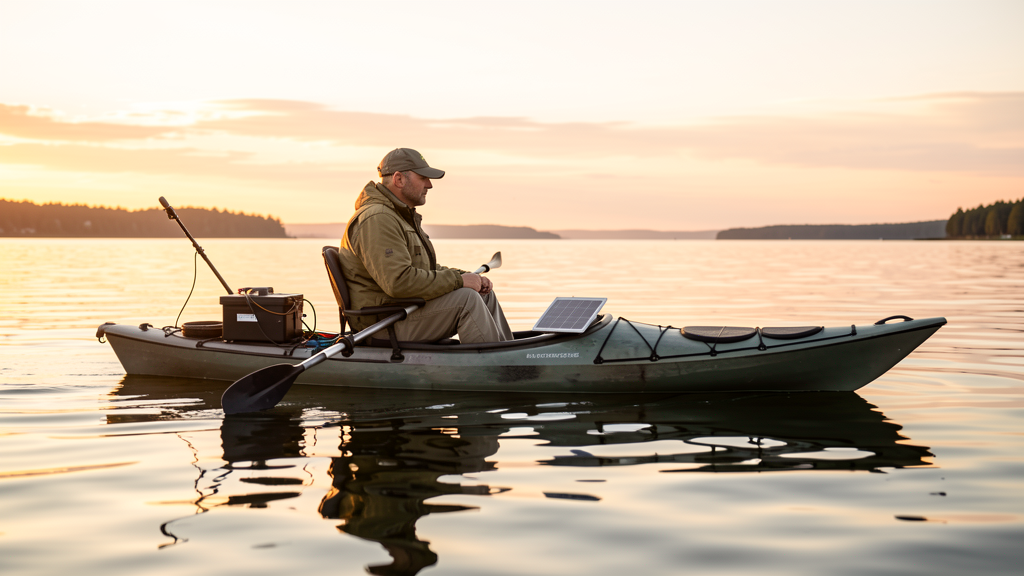
Looking for a solar-powered marine battery for kayak fishing? A portable solar panel paired with a lithium iron phosphate (LiFePO4) battery gives you silent, fume-free power for your trolling motor — no gas, no shore charging, no range anxiety. This guide covers what to buy, how to size it, and what actually works on the water in 2026.
You’re out on the lake before dawn. The trolling motor pushes your kayak silently toward the honey hole. No pull-starting, no gas smell, no dead battery halfway back. That’s the promise of solar-powered marine batteries for kayak fishing — and in 2026, the technology finally delivers on it.
Whether you’re a weekend angler or you fish tournaments from a kayak, a well-chosen solar battery setup keeps your trolling motor running all day, charges while you fish, and lasts for years. But picking the wrong battery — or the wrong solar panel — can leave you stranded. Here’s what you need to know.
Why Use Solar Power for Kayak Fishing?
Traditional lead-acid marine batteries are heavy, require shore charging, and lose capacity after a couple of seasons. Solar-powered setups solve several problems at once:
- Silent operation — No engine noise to spook fish. Trolling motors powered by lithium batteries are virtually silent.
- Extended range — A solar panel trickle-charges your battery while you fish, adding miles of range over a full day on the water.
- No shore power needed — Charge at the launch, on the water, or at camp. You’re not tied to an outlet.
- Lighter weight — LiFePO4 batteries weigh 60–70% less than lead-acid for the same usable capacity.
- Longer lifespan — Quality lithium batteries last 2,000–5,000 charge cycles vs. 300–500 for lead-acid.
How to Size a Solar Battery System for Kayak Trolling Motors
The right setup depends on your motor’s power draw, how long you fish, and your local conditions. Here’s a simple sizing framework:
Step 1: Calculate Your Power Needs
Most kayak trolling motors draw between 20–50 amps at 12V. A typical 55-lb thrust motor at half speed draws about 20A. Multiply your average draw by hours of use:
| Fishing Duration | Avg Draw (A) | Capacity Needed (Ah) | Recommended Battery |
|---|---|---|---|
| 2–3 hours | 20A | 40–60 Ah | 50 Ah LiFePO4 |
| 4–6 hours | 20–30A | 80–120 Ah | 100 Ah LiFePO4 |
| Full day (8+ hrs) | 25–40A | 150–200 Ah | 100 Ah + solar panel or 200 Ah |
Step 2: Match Your Solar Panel
A 100W solar panel produces roughly 5–6 amps in full sun. Over 5–6 hours of good sunlight, that’s 25–36 amp-hours — enough to offset a significant chunk of your motor’s draw. For kayak use, you want panels that are:
- Lightweight — Under 5 lbs for a 100W panel
- Flexible or foldable — Easy to strap to the deck or stow when not in use
- Water-resistant — IP65 rating minimum; IP67 is better for splashing
- With built-in charge controller — Prevents overcharging your battery
Step 3: Choose the Right Battery Chemistry
| Feature | Lead-Acid (AGM) | LiFePO4 (Lithium) |
|---|---|---|
| Weight (100 Ah) | 60–70 lbs | 24–28 lbs |
| Usable capacity | 50% (50 Ah usable) | 90–100% (90–100 Ah usable) |
| Cycle life | 300–500 cycles | 2,000–5,000 cycles |
| Charge time (solar) | 10–15 hours | 5–8 hours |
| Cost (100 Ah) | $150–$250 | $250–$450 |
| Lifespan | 2–4 years | 8–12 years |
Bottom line: LiFePO4 costs more upfront but lasts 3–4x longer, weighs less than half, and delivers nearly all its rated capacity. For kayak fishing — where weight matters — lithium is the clear winner.
Top Solar Battery Picks for Kayak Anglers (2026)
Here are reliable options that kayak anglers are actually using on the water. Prices are approximate and may vary:
| Product | Type | Capacity | Weight | Best For |
|---|---|---|---|---|
| Dakota Lithium 12V 10Ah | LiFePO4 | 10 Ah | 2.9 lbs | Fish finder / electronics only |
| Nocqua 10Ah 12V Pro Power Kit | LiFePO4 | 10 Ah | 3.2 lbs | Fish finder + small trolling motor |
| Dakota Lithium 12V 54Ah | LiFePO4 | 54 Ah | 16.5 lbs | Half-day trolling motor use |
| LiTime (Ampere Time) 12V 100Ah | LiFePO4 | 100 Ah | 24.2 lbs | Full-day trolling motor use |
| Renogy 100W Foldable Solar Suitcase | Solar panel | 100W output | 12.4 lbs | Shore / dock charging between trips |
| Jackery SolarSaga 100W | Solar panel | 100W output | 10.3 lbs | Portable on-water charging |
Setting Up Solar Charging on Your Kayak
A practical kayak solar setup has three components: battery, solar panel, and charge controller (often built into the panel or battery). Here’s how to wire it up:
- Mount the battery in a dry compartment or battery box secured behind your seat. Use bungee cords or a battery tray to prevent shifting.
- Connect the trolling motor to the battery terminals using the manufacturer’s wiring harness. Use marine-grade connectors.
- Attach the solar panel to your deck using suction cups, Velcro straps, or a lightweight frame. Face it toward the sun.
- Connect the solar panel to the battery through a charge controller (if not built in). Most portable panels include MC4 connectors — use an adapter cable for your battery terminals.
- Monitor charge level with a battery monitor or the indicator on your BMS. Many LiFePO4 batteries have Bluetooth apps that show real-time voltage and state of charge.
Pros and Cons of Solar-Powered Kayak Fishing
Pros
- Silent — won’t spook fish
- No gas, no fumes, no oil
- Lighter weight for kayak transport
- LiFePO4 lasts 8–12 years
- Charges while you fish
- Eco-friendly — zero emissions on the water
Cons
- Higher upfront cost than lead-acid
- Solar charging is slow (5–6A per 100W panel)
- Performance drops on cloudy days
- Panel adds deck clutter / wind resistance
- Requires BMS or charge controller
- Won’t fully recharge during a day trip
Solar Marine Battery FAQ
Can a solar panel fully charge a trolling motor battery while fishing?
Not usually during a single trip. A 100W solar panel produces about 25–36 amp-hours over a full sunny day. If your motor draws 20A, you’ll use 100+ Ah in 5 hours. Solar will offset some of that draw and extend your range by 15–30%, but it won’t keep up with continuous motor use. Charge fully before each trip and use solar to extend range.
What size solar panel do I need for a kayak trolling motor battery?
For a 50–100 Ah LiFePO4 battery, a 50W–100W portable solar panel is the sweet spot. It’s light enough to carry on a kayak (5–12 lbs) and produces enough amps to meaningfully extend your battery life. Going larger than 100W adds weight and deck space without proportional benefit for most kayak anglers.
Is LiFePO4 worth the extra cost over lead-acid for kayak fishing?
Yes, for most kayak anglers. LiFePO4 batteries weigh 60–70% less (critical on a kayak), deliver 90–100% usable capacity vs. 50% for lead-acid, and last 8–12 years vs. 2–4 years. The upfront cost is higher ($250–$450 vs. $150–$250 for 100 Ah), but the cost-per-cycle is actually lower over the battery’s lifetime.
Can I leave my solar panel connected to the battery all the time?
Yes, if you’re using a charge controller or your battery has a built-in BMS with overcharge protection. Never connect a solar panel directly to a lithium battery without a charge controller — it can overcharge and damage the battery or create a safety risk. Most quality portable panels include a built-in controller for this reason.
What voltage should I look for in a kayak trolling motor battery?
Most kayak trolling motors run on 12V. Some larger motors (80+ lb thrust) require 24V or 36V, which means connecting two or three 12V batteries in series. For typical kayak use (30–55 lb thrust), a single 12V battery is all you need. Always check your motor’s voltage requirement before buying.
Final Thoughts
A solar-powered marine battery setup for kayak fishing isn’t just an eco-friendly novelty — it’s genuinely practical. Lighter batteries, silent operation, and supplemental charging on the water add up to more time fishing and less time worrying about power. Start with a quality 100 Ah LiFePO4 battery and a 100W portable solar panel, and you’ll have a setup that lasts for years of fishing trips.
Ready to compare options? Check out our Solar Battery Backup Guide for more detailed battery comparisons, or use our Solar Backup Sizing Calculator to find the right capacity for your needs.
Last updated: July 2026. Prices and product availability are subject to change. Always verify current specs and seller details before purchasing.
