
If you are choosing between wind turbines and solar panels for your home, farm, or off-grid cabin, the right answer depends on your location, budget, energy needs, and how much maintenance you are willing to handle. Both are proven renewable technologies — but they shine in very different situations.
This guide breaks down the real-world differences between wind and solar in 2026: what each system costs, how efficient they are, where each one works best, and how to decide which makes sense for your property. We also cover hybrid setups that combine both.
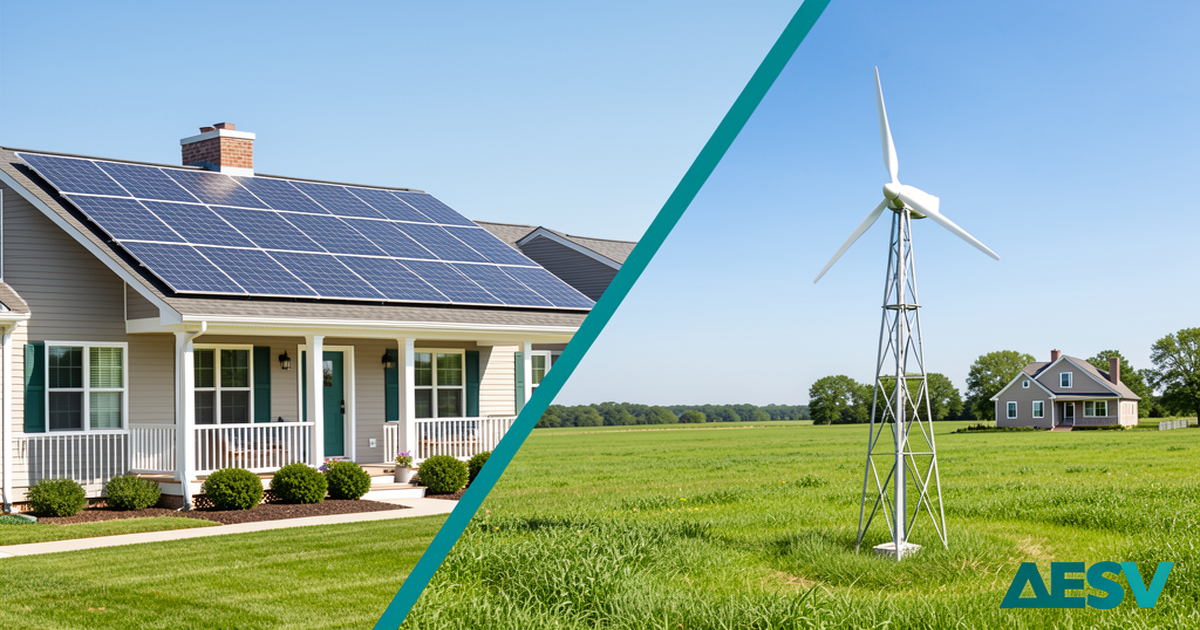
Wind Turbines vs Solar Panels: Quick Comparison
Here is a side-by-side overview before we dive into the details:
| Factor | Solar Panels | Wind Turbines |
|---|---|---|
| Upfront cost (residential) | $12,000 – $25,000 (before incentives) | $30,000 – $70,000 (before incentives) |
| Federal tax credit | 30% (through 2032) | 30% (through 2032) |
| Typical capacity | 5 – 12 kW | 2 – 10 kW |
| Annual energy production | 6,000 – 15,000 kWh | 3,000 – 12,000 kWh |
| Efficiency rating | 20 – 23% (modern panels) | 30 – 45% (at rated wind speed) |
| Lifespan | 25 – 30 years | 20 – 25 years |
| Warranty | 25 years (panel), 10–12 years (inverter) | 2 – 10 years (varies by manufacturer) |
| Maintenance | Very low — occasional cleaning | Moderate — annual inspections, moving parts |
| Works at night? | No (needs battery or grid) | Yes — wind blows day and night |
| Best locations | Most U.S. regions (4+ peak sun hours) | Rural, open land, coastal, plains (10+ mph avg wind) |
| Permitting difficulty | Usually straightforward | Often complex — height, noise, neighbor concerns |
| Scalability | Easy — add panels over time | Hard — usually one turbine per system |
Cost Comparison: What You Actually Pay in 2026
Solar Panel Costs
A typical residential solar panel system in 2026 costs between $12,000 and $25,000 before incentives, depending on your energy needs, roof type, and local labor rates. The average installed cost has dropped to roughly $2.50 – $3.50 per watt for most U.S. markets. A standard 8 kW system generates about 10,000–12,000 kWh per year in a sunny location — enough to cover most or all of a typical household’s electricity use.
After the 30% federal Residential Clean Energy Credit, your out-of-pocket cost drops to roughly $8,400 – $17,500. Many states offer additional rebates, net metering, or SREC programs that can cut the effective cost further. Solar panels have no moving parts, so ongoing maintenance costs are minimal — typically under $200 per year for occasional cleaning and inverter monitoring.
Payback period: 6–10 years in most U.S. markets, depending on local electricity rates and incentives. After payback, your electricity is essentially free for the remaining 15–20 years of the system’s life.
Wind Turbine Costs
Residential wind turbines are significantly more expensive. A small home turbine (2–10 kW) typically costs $30,000 – $70,000 fully installed, including the tower, foundation, wiring, and grid-tie equipment. The turbine itself may cost $15,000–$40,000, with the tower and installation adding another $15,000–$30,000.
Unlike solar panels, wind turbines have moving parts — blades, gearbox, generator bearings, and yaw mechanism — that require regular maintenance. Budget roughly $500 – $1,500 per year for inspections, lubrication, and occasional repairs. As the turbine ages (beyond 10–15 years), maintenance costs tend to increase.
Payback period: 10–20 years or more, heavily dependent on your local wind resource. In areas with strong, consistent wind (average 12+ mph), payback can be reasonable. In areas with average wind below 10 mph, the economics rarely work out.
Cost Summary Table
| Cost Category | Solar (8 kW system) | Wind (5 kW turbine) |
|---|---|---|
| Gross installed cost | $16,000 – $24,000 | $35,000 – $60,000 |
| Federal tax credit (30%) | -$4,800 – -$7,200 | -$10,500 – -$18,000 |
| Net cost after credit | $11,200 – $16,800 | $24,500 – $42,000 |
| Annual maintenance | $100 – $200 | $500 – $1,500 |
| Annual production (est.) | 10,000 – 12,000 kWh | 5,000 – 10,000 kWh |
| Cost per kWh (over 20 years) | $0.06 – $0.10 | $0.15 – $0.25 |
| Estimated payback | 6 – 10 years | 10 – 20 years |
Note: All figures are estimates for U.S. residential installations as of mid-2026. Actual costs vary by location, equipment, installer, and local incentives. Check the DSIRE database for state and local programs.
Efficiency: Which One Produces More Energy?
When people talk about “efficiency,” they mean different things for solar and wind. For solar panels, efficiency is the percentage of sunlight hitting the panel that gets converted to electricity — modern residential panels convert about 20–23% of incoming sunlight. For wind turbines, efficiency is how much of the wind’s kinetic energy the turbine captures — the theoretical maximum is 59.3% (Betz’s law), and real-world turbines achieve 30–45% at their rated wind speed.
But raw efficiency percentages do not tell the whole story. What matters more is capacity factor — the actual energy produced over a year compared to the theoretical maximum. Here is how they compare in practice:
| Metric | Solar Panels | Wind Turbines |
|---|---|---|
| Panel/turbine efficiency | 20 – 23% | 30 – 45% (at rated wind) |
| Capacity factor (residential) | 15 – 25% | 10 – 30% |
| Capacity factor (utility scale) | 20 – 30% | 30 – 50% |
| Energy per dollar invested | Higher for most homeowners | Higher only in strong wind zones |
| Consistency | Predictable daily/seasonal pattern | Variable — depends on wind conditions |
For most homeowners, solar panels deliver more energy per dollar invested because they work in nearly every location with adequate sunlight, cost less to install, and require almost no maintenance. Wind turbines can match or beat solar in energy production — but only in locations with strong, consistent winds averaging 12+ mph.
When Wind Has the Edge
Wind turbines have two key advantages: they produce power 24 hours a day (wind blows at night, too), and they can have a higher capacity factor in the right location. In the Great Plains, coastal areas, and elevated rural sites, a well-placed wind turbine can outperform solar panels on a per-dollar basis. Wind also produces more energy in winter months when solar production drops — useful in northern climates with high heating demands.
When Solar Has the Edge
Solar panels win in most suburban and urban locations, on rooftops, in areas with moderate wind, and for homeowners who want a low-maintenance system with a long warranty. Solar is also far easier to expand — you can start with a small system and add panels later. Wind turbines are essentially “one and done” — you cannot easily scale up a single-turbine system.
Where Each Technology Works Best
Your location is the single biggest factor in determining whether wind or solar makes more sense. Here is a practical breakdown:
Best Locations for Solar Panels
- Sunbelt states: Arizona, California, Nevada, New Mexico, Texas, Florida, and the Southeast — 5+ peak sun hours per day
- Suburban and urban rooftops: South-facing roofs with minimal shading
- Any location with 4+ peak sun hours: Covers most of the continental U.S.
- Properties with limited ground space: Rooftop panels need no extra land
- Areas with net metering: Sell excess daytime production back to the grid
Best Locations for Wind Turbines
- Great Plains: Kansas, Nebraska, Oklahoma, the Dakotas, Wyoming — average winds 12+ mph
- Coastal areas: Atlantic coast, Pacific Northwest, Great Lakes shoreline
- Rural properties with open land: At least 1 acre free of tall obstructions
- Elevated sites: Hilltops and ridgelines with unobstructed wind flow
- Farms and ranches: Large open areas where turbines can be sited away from buildings
Not sure about your wind resource? The U.S. Department of Energy’s Wind Energy Maps provide detailed wind speed data by location. For solar, check the Global Solar Atlas for your area’s solar potential.
Usage: Homes, Farms, and Off-Grid
For Homeowners
Solar panels are the clear winner for most residential settings. They install on your existing roof (or on ground mounts), connect to the grid, work in suburban neighborhoods, and require almost no upkeep. Most homeowners can install solar without any special permits beyond a standard electrical inspection.
Wind turbines for homes face several practical challenges: they need a tall tower (typically 80–120 feet), generate noise that can bother neighbors, require zoning approval that many municipalities restrict or deny, and need unobstructed wind that most suburban lots cannot provide. If you live on a rural property with at least 1 acre of open land and average winds above 10 mph, a small wind turbine can be a viable option.
For Farms and Rural Properties
Farms and large rural properties are where wind turbines can genuinely compete with solar. Open fields provide the unobstructed wind flow that turbines need, and the tower height is rarely a zoning issue in agricultural areas. Many farmers install a combination: solar panels on barn roofs and outbuildings, plus a wind turbine in an open field. This hybrid approach maximizes energy production across seasons and weather conditions.
For Off-Grid Systems
Off-grid cabins and remote properties benefit most from a hybrid wind-solar system. Solar panels generate power during the day, wind turbines fill in at night and during storms, and a battery bank stores the excess. This combination provides far more reliable off-grid power than either technology alone. See our Solar Battery Backup Guide for battery sizing and selection.
Maintenance and Reliability
This is where solar panels have a significant practical advantage:
| Aspect | Solar Panels | Wind Turbines |
|---|---|---|
| Moving parts | None | Blades, gearbox, yaw motor, bearings |
| Annual maintenance | Visual inspection, occasional cleaning | Bolt torque check, lubrication, blade inspection, electrical testing |
| Common repairs | Inverter replacement (every 10–12 years) | Blade repair, bearing replacement, gearbox service |
| Downtime risk | Very low | Moderate — mechanical wear over time |
| Professional service needed? | Rarely | Yes — at least annually |
| DIY-friendly? | Cleaning is DIY; electrical work is not | Tower climbing and mechanical work require professionals |
Solar panels are essentially “set and forget” — most homeowners go years without touching them. Wind turbines, with their moving parts and exposed position on tall towers, need regular professional attention. This ongoing maintenance cost is often underestimated in wind turbine ROI calculations.
Pros and Cons at a Glance
Solar Panels — Pros
- Lower upfront cost ($12,000–$25,000 before incentives)
- Very low maintenance — no moving parts
- 25–30 year lifespan with strong manufacturer warranties
- Works on rooftops — no extra land needed
- Easy to expand by adding more panels
- Works in nearly all U.S. locations
Solar Panels — Cons
- Does not produce power at night (needs battery or grid)
- Production drops on cloudy days and in winter
- Requires adequate roof space or ground area
Wind Turbines — Pros
- Produces power 24/7 — wind blows day and night
- Higher capacity factor in strong wind zones
- Produces more energy in winter (when wind is strongest)
- Can outperform solar in ideal locations (coastal, plains, rural)
- Small land footprint at ground level (tower goes up, not out)
Wind Turbines — Cons
- Higher upfront cost ($30,000–$70,000 before incentives)
- Requires regular professional maintenance
- Zoning and permitting can be difficult or impossible
- Noise can be an issue for nearby neighbors
- Needs strong, consistent wind (10+ mph average minimum)
- Not easily scalable — usually one turbine per system
Can You Combine Both? The Hybrid Approach
Yes — and for many properties, a hybrid wind-solar system is the best option. The two technologies complement each other well: solar panels produce most power in summer and during the day, while wind turbines produce more in winter and at night. Combined with a battery bank, a hybrid system provides the most reliable renewable energy available.
Hybrid systems cost more upfront (you are buying two systems), but they can eliminate your dependence on the grid entirely. The key requirement is having both a good solar resource (4+ peak sun hours) and a good wind resource (10+ mph average). Not every property qualifies — but when both resources are available, hybrid is hard to beat.
For sizing a hybrid system, start with our Solar Backup Calculator to estimate your solar needs, then add a wind turbine sized to fill the gaps.
Frequently Asked Questions
Which is cheaper — wind or solar?
Solar panels are cheaper for most homeowners. A typical residential solar system costs $12,000–$25,000 before incentives, while a small wind turbine costs $30,000–$70,000 installed. After the 30% federal tax credit, solar’s cost advantage is even larger. Wind only becomes cost-competitive in locations with strong, consistent winds (12+ mph average) where the higher energy output offsets the higher installation cost.
Can I install a wind turbine in my backyard?
It depends on your lot size, local zoning laws, and wind resource. Most suburban backyards are too small and too sheltered for a wind turbine to work effectively. You typically need at least 1 acre of open land, a tower height of 80+ feet, and average winds above 10 mph. Many municipalities have height restrictions or noise ordinances that prohibit residential turbines. Check your local building codes before investing.
Do solar panels work in cloudy climates?
Yes — solar panels still produce electricity on cloudy days, just at reduced output (typically 10–25% of full sun capacity). Germany, one of the cloudiest industrialized nations, is one of the world’s largest solar energy producers. If you get at least 4 peak sun hours per day, solar panels are viable. Use the Global Solar Atlas to check your location’s solar potential.
How much wind do I need for a wind turbine?
A minimum annual average wind speed of 10 mph (4.5 m/s) is generally recommended for small residential turbines. At 10 mph, a turbine will produce some power but may not achieve a reasonable payback period. At 12+ mph average, the economics become much more favorable. Use the DOE’s Wind Energy Maps to check your area’s wind resource before committing.
Which lasts longer — solar panels or wind turbines?
Solar panels typically last 25–30 years with minimal degradation (most manufacturers guarantee at least 80% output at year 25). Wind turbines last 20–25 years, but their moving parts may need replacement before then. Solar panels also come with stronger warranties (25 years on panels vs. 2–10 years on wind turbines), giving you more long-term protection.
Can I sell excess energy back to the grid?
Yes, for both technologies. Grid-tied solar and wind systems can feed excess electricity back to your utility through net metering programs, earning you credits on your electric bill. Availability and rates vary by state and utility. Solar net metering is more widely available and better established than wind net metering in most areas.
Do wind turbines work in urban areas?
Generally, no. Urban and suburban areas have too many buildings, trees, and other obstructions that disrupt wind flow and create turbulence. Small “building-mounted” turbines have been tried, but studies consistently show they produce far less energy than manufacturers claim — often not enough to justify the cost. If you live in a city or suburb, solar panels are almost always the better choice.
Is a hybrid wind-solar system worth it?
A hybrid system is worth considering if your property has both a good solar resource (4+ peak sun hours) and a good wind resource (10+ mph average). The two technologies complement each other — solar produces more in summer, wind in winter; solar during the day, wind at night. Combined with batteries, a hybrid system can provide near-total energy independence. The downside is higher upfront cost, since you are installing two generation systems instead of one.
Key Takeaways
- Solar panels are the better choice for most homeowners — lower cost, lower maintenance, longer warranty, and they work in nearly every U.S. location.
- Wind turbines can outperform solar in the right conditions — strong consistent winds (12+ mph), open rural land, and willingness to handle higher costs and maintenance.
- Solar costs less per kWh for the majority of residential installations, with a faster payback period (6–10 years vs. 10–20 years for wind).
- Wind produces power 24/7 and generates more energy in winter — advantages that matter most in northern climates with high heating demands.
- Hybrid wind-solar systems offer the best reliability and seasonal coverage, but require both a good wind site and a good solar site.
- Always check your local wind and solar resources before committing — use the DOE Wind Energy Maps and Global Solar Atlas.
- Factor in maintenance costs — solar panels are nearly maintenance-free; wind turbines need annual professional service.
- Check local zoning and permitting — wind turbines face far more regulatory hurdles than solar panels in most areas.
- Use our Solar Backup Calculator to estimate your energy needs and size a system.
- Want a deep dive into wind technology? See our Wind Turbines Guide. Interested in building your own? See our DIY Wind Turbine guide.
Last updated: July 2026. Pricing and efficiency figures are based on U.S. Department of Energy data, NREL benchmarks, and industry averages as of mid-2026. Images © AESV.
