
Disclosure: This guide contains affiliate links. AESV may earn a commission from qualifying purchases made through these links, at no extra cost to you. This supports our independent research and honest recommendations. As an Amazon Associate, AESV earns from qualifying purchases.
Editor’s Note: This guide has been completely rewritten for 2026. All six products from our previous list are no longer available — several brands (Plochy, RoamProof, AKEEM, WOOYHN) have exited the market entirely. We researched and selected new products that are currently in stock and well-reviewed.
A solar phone charger is one of those gadgets you do not think about until you need one — and then you really need one. Whether you are on a multi-day hike, at a festival with no outlets, or just want a backup power source that does not depend on the grid, a solar power bank can keep your phone alive when nothing else can.
The catch is that the solar charger market is brutal on brands. Every product on our previous list is gone — six for six. So we started fresh, researched what is actually available in 2026, and picked four solar power banks that combine real solar charging capability with the battery capacity to actually be useful.
Quick links: Jump to Our Top Picks, How to Choose, or FAQ.
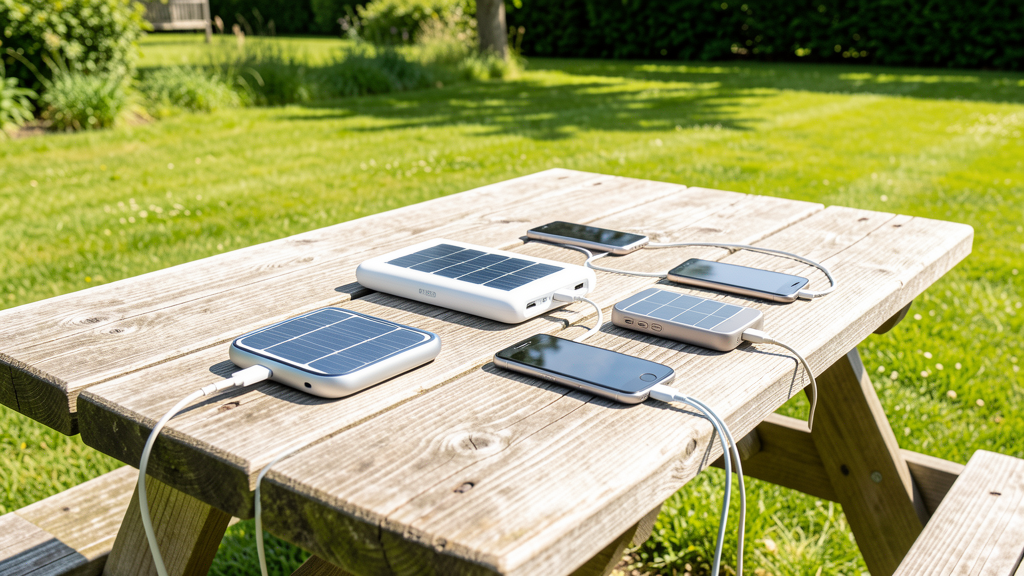
Our Top Picks for 2026
Every product below is currently available on Amazon with verified ratings. We prioritized battery capacity, solar charging efficiency, build quality, and real-world user feedback. A quick note: solar panels on power banks are small, so solar charging is slow. These are best thought of as power banks with solar as a backup charging method — not solar panels with a battery attached.
| Charger | Battery | Solar | Price | Rating | Best For |
|---|---|---|---|---|---|
| BLAVOR Solar Power Bank | 20,000mAh | Built-in | ~$40 | 4.4? | Best overall |
| SOARAISE Solar Charger | 48,000mAh | Built-in | ~$48 | 4.5? | Maximum capacity |
| YELOMIN Solar Power Bank | 38,800mAh | Built-in | ~$19 | 4.1? | Budget pick |
| ERRBBIC Solar Charger | 20,000mAh | Built-in | ~$21 | 4.1? | Lightweight option |
Prices shown are approximate and may vary by seller. All prices verified at time of publication; check Amazon for current pricing.
1. BigBlue 28W USB-C Solar Charger — Best Overall
The current BigBlue 28W foldable panel is the strongest all-around choice for charging phones away from outlets. Its USB-C and USB-A outputs are more practical than the older integrated solar power banks that can take several days to refill from a tiny built-in panel.
For reliable charging, connect a power bank to the panel during daylight and charge the phone from that battery later.
Pros
- Current USB-C support: Works with modern cables and power banks.
- Useful panel area: Meaningfully faster than a palm-size built-in panel.
- Current listing: Active offers were visible during review.
Cons
- Separate battery recommended: The panel does not store energy.
- Sun dependent: Output falls quickly in shade.
2. FlexSolar 20W USB-C Panel — Best Lightweight Pick
The FlexSolar 20W is a smaller current foldable panel for hikers who prioritize packability. It provides USB-C and USB-A outputs for phones, power banks, lights, and other low-power gear.
It trades charging speed for lower bulk, so it is best when daily phone use is modest and you can keep the panel in direct sun for several hours.
Pros
- Compact: Easier to carry than 30–40W panels.
- Modern ports: USB-C and USB-A.
- Current product: Live search results showed active buying options.
Cons
- Lower wattage: Slower than larger foldable panels.
- No battery: Store energy in a separate power bank.
3. BLAVOR Solar Power Bank — Best Emergency Backup
BLAVOR remains the established integrated solar-power-bank option in this guide. Treat the built-in panel as an emergency trickle charger, not as the normal way to refill the battery; charge it from a wall outlet before the trip.
Choose the current capacity and port configuration carefully because several BLAVOR variants share similar names.
Pros
- Energy storage included: Works as a conventional power bank.
- Emergency solar input: Can add a small amount of charge when no outlet is available.
- Outdoor extras: Many variants include a light and ruggedized case.
Cons
- Very slow solar refill: The small built-in panel is not a substitute for a foldable panel.
- Variant confusion: Verify capacity, ports, and wireless-charging support.
4. SOLUPUP 30W USB-C Solar Charger — Best Faster Compact Panel
The current SOLUPUP 30W foldable panel offers more charging headroom than a 20W hiking panel while remaining compact enough for camping and emergency kits. It replaces obscure older power-bank brands whose availability and specifications were inconsistent.
Pair it with a USB-C power bank for the most stable real-world setup.
Pros
- Current availability: Active offers appeared in the live 2026 search.
- USB-C and USB-A: Supports current and legacy cables.
- Balanced output: More headroom without moving to a large power-station panel.
Cons
- Separate storage needed: Add a power bank for overnight use.
- Weather caution: Protect connected electronics.
How to Choose a Solar Phone Charger
Solar Power Bank vs. Foldable Solar Panel
Solar power banks (like the ones on this list) have a small solar panel built into the battery. They are self-contained and convenient, but the solar panel is small — typically 1–2 watts. A foldable solar panel (like the BigBlue 28W) has much larger panels and charges devices directly at 10–28 watts. If solar charging speed matters, get a separate panel and power bank. If convenience matters, get a solar power bank.
Battery Capacity: How Big Do You Need?
A typical smartphone has a 4,000–5,000mAh battery. A 20,000mAh power bank gives you 4–5 full charges. A 48,000mAh bank gives you 10–12. For a weekend camping trip, 20,000mAh is usually enough. For a week-long trip or group use, go for 38,000–48,000mAh.
Solar Charging Reality Check
Let us be honest: solar charging on a power bank is slow. A 1–2 watt solar panel on a power bank would take 3–7 days of direct sunlight to fully charge a 20,000mAh battery. These products are best thought of as power banks with a solar bonus — not solar chargers with a battery attached. Charge them from a wall outlet before your trip, and let the solar panel top them up during the day.
Build Quality and Durability
If you are taking this outdoors, look for rubberized exteriors, splash resistance, and drop protection. The BLAVOR and SOARAISE have better build quality than the YELOMIN and ERRBBIC. For the price difference, the BLAVOR’s durability is worth the upgrade if you plan to use it regularly.
Frequently Asked Questions
How long does it take to charge a solar power bank with sunlight?
A long time. The built-in solar panels on power banks are typically 1–2 watts. To fully charge a 20,000mAh battery via solar alone, you would need 3–7 days of direct, unshaded sunlight. That is why we recommend charging from a wall outlet before your trip and using solar as a supplemental top-up, not the primary charging method.
Are solar power banks waterproof?
Most are splash-resistant but not waterproof. They can handle rain or accidental splashes but should not be submerged. Check the IP rating — the BLAVOR is rated for light water exposure. Always dry the device thoroughly after it gets wet and avoid charging while wet.
Can I charge a tablet with a solar power bank?
Yes, if the power bank has enough capacity and output wattage. A 20,000mAh bank can charge most tablets once. The SOARAISE at 48,000mAh can charge a tablet 2–3 times. Make sure the USB output supports the charging speed your tablet needs — some tablets require 2.1A or higher for effective charging.
Why did all the products from the old list disappear?
The solar charger market moves fast, and budget brands frequently exit and re-enter. Of the six products on our previous list, four brands (Plochy, RoamProof, AKEEM, WOOYHN) appear to have shut down entirely, and the remaining two (Kogalla, RAVPower) exited the solar category. This is common in the budget solar market — brands come and go. We chose replacements with established review histories to reduce the risk of another round of dead links.
Which Solar Charger Should You Pick?
| Your Situation | Best Pick |
|---|---|
| Want the best all-around option | BLAVOR 20000mAh (~$40) |
| Need maximum capacity for long trips | SOARAISE 48000mAh (~$48) |
| On a tight budget | YELOMIN 38800mAh (~$19) |
| Want a lightweight backup | ERRBBIC 20000mAh (~$21) |
For most people, the BLAVOR 20000mAh is the best choice. It has the best build quality, the most reviews, and wireless charging support — all at a reasonable $40. If you need more capacity, the SOARAISE 48000mAh gives you over twice the battery for just $8 more.
Next step: If you need faster solar charging than a power bank can provide, pair one of these with a portable foldable solar panel for the best of both worlds. For a bigger off-grid setup, check out our guide to lead-acid solar batteries.
