
Build or buy in 60 seconds
If you want a portable solar generator for light backup, camping, van use, or small tools, start with the calculator before you buy anything: size your exact build here. For many readers, a prebuilt power station is the safer and faster choice. DIY starts to make sense when you want a specific battery chemistry, a repairable parts stack, or a lower cost per watt-hour at larger capacities.
This article is the shopping and decision layer. If you already know you want to build, use the companion guide to build, size, and wire the system. If you would rather buy, compare the branded options in Best Solar Generators of 2026.
Bottom line: DIY can be cheaper, but not always. The smaller the system, the more likely a branded unit wins on simplicity, warranty, and total headache cost. The bigger the system, the more likely DIY wins on flexibility and cost per watt-hour.
The core parts you actually need
The exact parts will vary by size and use case, but a basic DIY solar generator usually needs five building blocks: battery storage, battery protection, power conversion, solar charging hardware (panel + MPPT controller), and a safe enclosure with wiring and fusing. The ranges below are planning ranges, not a quote sheet; re-verify current prices before purchase.
Affiliate disclosure: AESV is reader-supported. If you buy through links on this page, we may earn a commission at no extra cost to you. As an Amazon Associate, AESV earns from qualifying purchases.
| Part | What it does | Typical 2026 planning range | Notes |
|---|---|---|---|
| LiFePO4 battery pack Shop LiFePO4 batteries |
Stores the energy | $150–$1,000+ | Larger capacity, better cells, and name-brand packs cost more. |
| BMS Shop LiFePO4 BMS units |
Protects the battery from overcharge, overdischarge, and imbalance | $35–$140 | Choose a BMS that matches battery chemistry, voltage, and current. |
| Pure-sine inverter Shop pure-sine inverters |
Runs AC appliances | $90–$350 | Size for surge current, not just running watts. |
| Solar panel Shop 200W solar kits |
Captures sunlight for charging | $120–$400 | Add this on top of the $380 core stack if you do not already own a compatible panel. |
| MPPT charge controller Shop MPPT controllers |
Charges the battery from solar panels | $60–$220 | MPPT is usually the better choice for efficiency and flexibility. |
| Enclosure, wiring, fuses, breakers, connectors Shop wiring and fuse kits |
Holds the system together safely | $45–$180 | Do not skip fusing, cable sizing, or strain relief. |
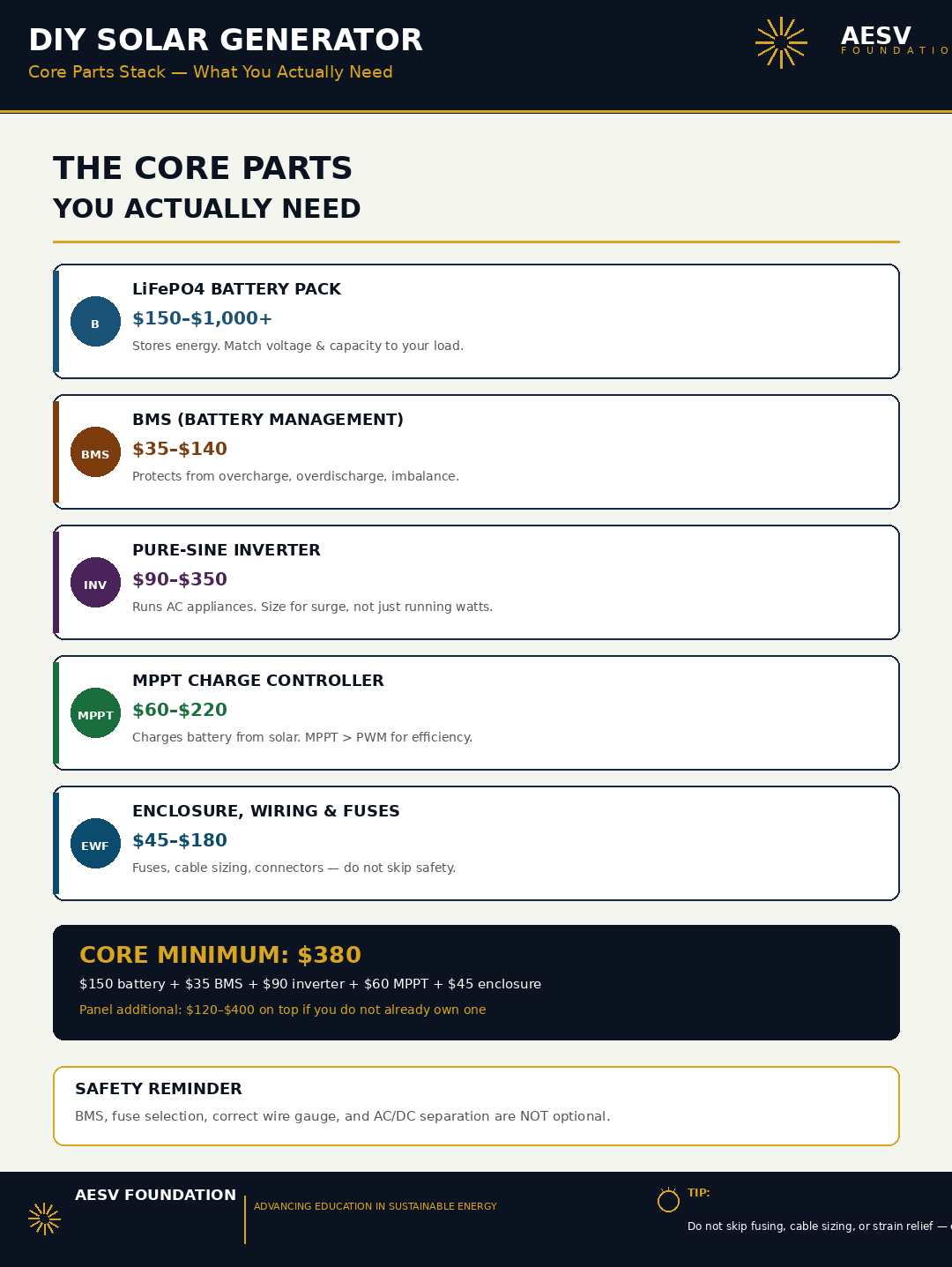
At the low end, the core stack totals $380 before the panel: battery $150 + BMS $35 + inverter $90 + MPPT $60 + enclosure $45. For battery, controller, and inverter details, cross-check the companion technical guides on LiFePO4 battery-bank safety, sizing, and wiring, solar charge controllers, and inverter sizing.
Worked cost examples: 500Wh, 1,000Wh, and 2,000Wh
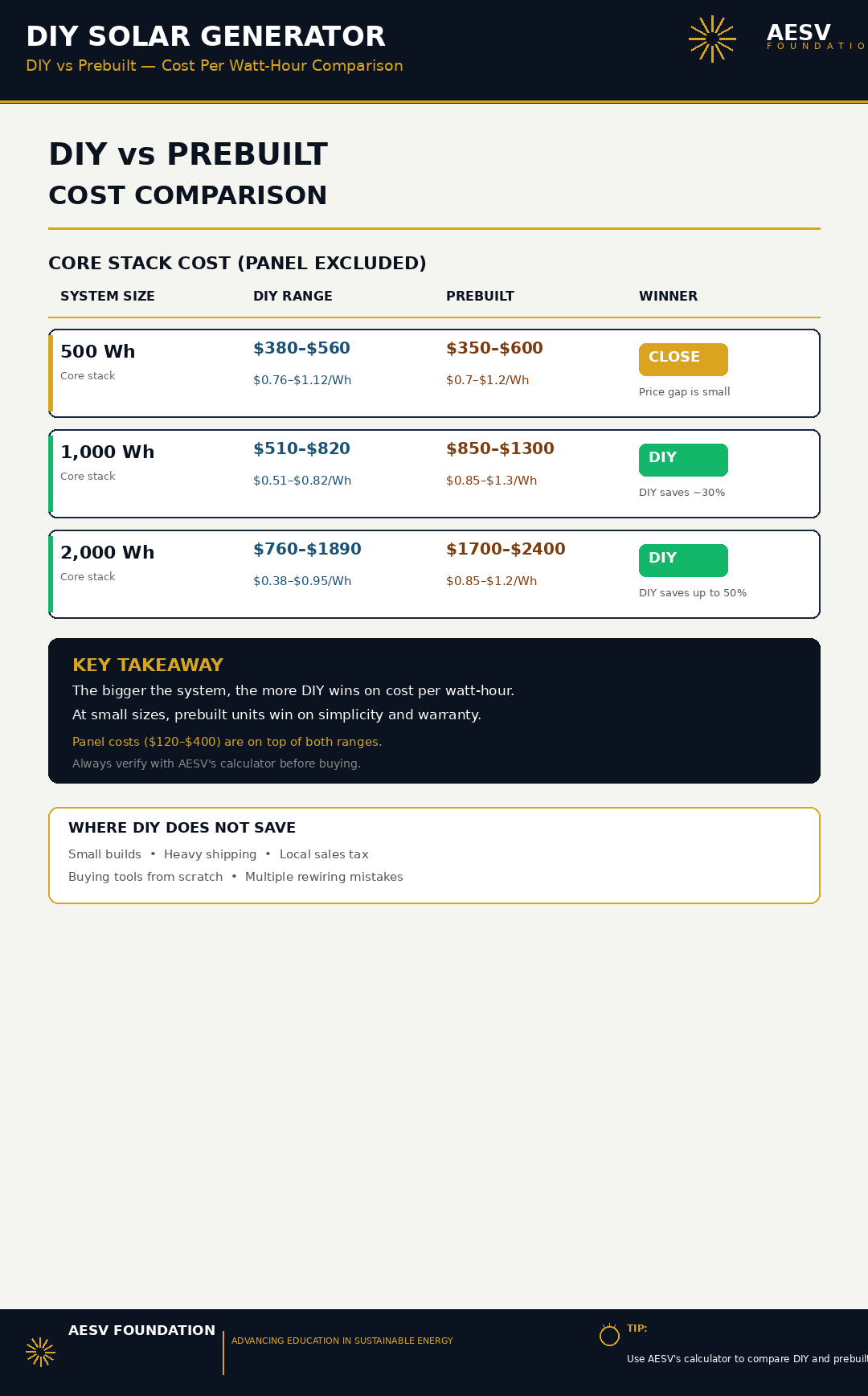
These are illustrative planning examples for the core electrical stack. They exclude the solar panel, which is listed separately in the parts table because panel costs vary the most. If you are starting from zero, add $120–$400 for the panel. Re-check the exact parts you are about to buy.
| System size | DIY planning range (core, panel excluded) | DIY cost per Wh | Prebuilt planning range | Prebuilt cost per Wh |
|---|---|---|---|---|
| 500Wh | $380–$560 | $0.76–$1.12 | $350–$600 | $0.70–$1.20 |
| 1,000Wh | $510–$820 | $0.51–$0.82 | $850–$1,300 | $0.85–$1.30 |
| 2,000Wh | $760–$1,890 | $0.38–$0.95 | $1,700–$2,400 | $0.85–$1.20 |
- At 500Wh, DIY is only modestly cheaper unless you already own tools or can source parts locally. Those examples are core-system prices; add the panel separately if you are starting from scratch.
- At 1,000Wh, DIY usually starts to separate from prebuilt pricing if you are comfortable assembling the system. That still assumes the core stack only; add the panel separately when you compare full build cost.
- At 2,000Wh, DIY often wins on flexibility and cost per watt-hour, but only if you respect the safety basics. Add the panel separately when you compare full build cost.
The honest cost-per-watt-hour math
Cost per watt-hour is the quickest way to compare a DIY build with a branded power station. Divide the total system cost by the usable battery capacity in watt-hours. Lower is better, but only if the system is actually safe and practical for your use case.
Using the core planning ranges above, a 1,000Wh DIY build lands around $0.51–$0.82 per Wh before the panel, while a comparable prebuilt unit lands around $0.85–$1.30 per Wh. That gap is the reason DIY appeals to people who want more battery for the money. It is also why branded units still win when convenience matters more than component flexibility.
Where DIY does not always save money: small builds, heavy shipping, local sales tax, buying tools from scratch, and projects that require multiple replacement parts because the first wiring layout was wrong.
Hidden costs most first-time DIYers miss
- Tools: cable cutter, crimper, torque tools, multimeter, heat-shrink, and label materials.
- Time: planning, ordering, testing, and fixing mistakes.
- Warranty gaps: the battery, inverter, controller, and enclosure each carry different warranty terms, and the system itself usually has no single warranty.
- Integration risk: the BMS, controller, inverter, and battery do not magically coordinate unless you design for it.
- Replacement risk: a single bad fuse choice or undersized cable can turn into a much more expensive repair.
If you want a budgetary check before you buy parts, use the calculator first, compare the storage target with the home battery backup sizing guide, then compare the result with the prebuilt options in the buying guide. If the price difference is only a small amount, the branded unit may be the better trade.
Safety boundaries: when you should just buy a prebuilt unit
Buy instead of DIY if you are not comfortable with DC wiring, fuse selection, or battery protection. Buy if you need a quick setup with a clear warranty. Buy if the system will live in a vehicle, rental, or shared space where liability matters more than tinkering.
Red flags for DIY include no clear BMS plan, no overcurrent protection, cold-weather charging without a proper battery and charger strategy, or a setup that cannot be inspected and serviced later. For battery-specific safety, link readers to the LiFePO4 safety guide.
A branded power station is also the safer choice when the user needs pass-through or simultaneous charge-and-discharge behavior and does not want to manage the charging logic manually. Even then, the spec sheet still matters; not every unit supports every mode.
Can a solar generator charge and discharge at the same time?
Often, yes — but only when the battery, controller, inverter, and any built-in power management are designed for it. In community discussions, this is one of the most common first-time questions because people want to run a fan, refrigerator, or small load while the sun is still charging the battery.
The safe rule is simple: do not assume pass-through behavior. Read the manual, confirm the operating mode, and test the system under load before you rely on it. If the answer is unclear, default to a setup that separates charging and discharge or buy a unit with documented support for the mode you need.
Where to buy the parts or the prebuilt alternative
You can take either path: source the individual components for a repairable DIY build, or choose a branded prebuilt power station when convenience, integration, and a single warranty matter more.
- DIY parts path: LiFePO4 cells or battery pack, BMS, pure-sine inverter, MPPT controller, fuses, breakers, cables, enclosure.
- Buy path: Jackery, EcoFlow, Bluetti, or Anker SOLIX class power stations.
Frequently Asked Questions
Is it actually cheaper to build a solar generator?
Often, yes at medium and larger sizes. At very small sizes, the savings can shrink enough that a prebuilt unit becomes the better buy once you factor in tools, time, and warranty coverage.
What is the minimum parts list?
At minimum: battery, BMS, inverter, MPPT controller, wiring, fusing, and a safe enclosure. If any of those are missing, the system is incomplete.
Do I need LiFePO4?
LiFePO4 is a strong default for most modern DIY solar generator builds because it offers good cycle life and stable behavior compared with older battery chemistries. Match the battery choice to the inverter, controller, and charging plan.
Can I use this for a van or RV?
Yes, but only if the enclosure, wiring, fusing, and ventilation are appropriate for mobile use. For a full build path, use the companion DIY build guide.
Should I buy a controller or a complete power station?
Buy the controller when you want a custom system and are comfortable with the wiring. Buy the complete power station when convenience, compactness, and warranty matter more than modularity.
Build-if / buy-if checklist
- Build if: you want a repairable system, you understand basic DC wiring, and your capacity target is large enough that DIY can save meaningful money.
- Buy if: you need fast setup, you want one warranty, you do not want to manage charging and protection logic, or the price gap is too small to justify the risk.
- Next step: if you are still undecided, use the calculator and then compare the result with the prebuilt buying guide.
For readers who choose to proceed, end with a lead-gen CTA to download the solar backup checklist so they can track parts, loads, and wiring decisions before buying.
