
Affiliate Disclosure: AESV is reader-supported. If you buy through links on this page, we may earn a commission at no extra cost to you. Product listings change often, so verify the exact model, seller, warranty, voltage, and return policy before buying. As an Amazon Associate, AESV earns from qualifying purchases.
Last updated: July 2026
Quick verdict: For most small solar systems, a pure sine inverter is the safe default. Portable setups usually land in the 300–1,000W range, RV and cabin systems often need 1,000–3,000W, and home backup systems usually move to 48V with 3,000–6,000W or more.
If you are sizing a system, start with the AESV solar backup calculator, then match the calculator result to the inverter tier below. For battery and system context, also see the solar battery backup guide and the residential solar panels guide.
Quick answer: Size the inverter by surge demand first, then check continuous watts. Pure sine is the right choice for motors, compressors, pumps, fridges, and sensitive electronics. Modified sine is only a budget compromise for simple resistive loads.
Best inverter choices at a glance
These are category starting points, not exact model recommendations. Amazon inventory changes often, so the links below point to live search pages. That keeps the advice honest and lets you compare voltage, waveform, and wattage before you buy.
| Recommended starting point | Best for | What to check |
|---|---|---|
| 12V pure sine inverter 300–1,000W | Portable solar, phones, laptops, lights, CPAP | Look for real pure sine output and a surge rating that comfortably covers startup loads. |
| 12V inverter-charger 1,000–3,000W | RV, van, cabin, boat | Check for shore-power charging, low idle draw, and enough surge for fridge or microwave startup. |
| 48V inverter-charger 3,000–6,000W | Home backup with critical loads | Confirm battery voltage, AC input, split-phase needs, and whether the unit is rated for your generator or grid input. |
| 48V hybrid inverter 6,000–12,000W | Whole-home and larger battery systems | Look for stacking support, 120/240V split-phase, and compatibility with your battery communication protocol. |
| Inverter cable and fuse kit | Any serious battery-backed inverter install | Do not underestimate cable size, fuse rating, lugs, and busbar quality. These parts protect the whole system. |
The most common mistake is buying too much inverter for the battery bank you actually have. The inverter and battery need to be sized as a pair.
How inverter sizing really works
Inverter size is not based on daily energy use alone. A home could use only a few kilowatt-hours per day and still need a large inverter if one appliance has a big startup surge. That is why a refrigerator, well pump, or air conditioner can change the recommendation fast.
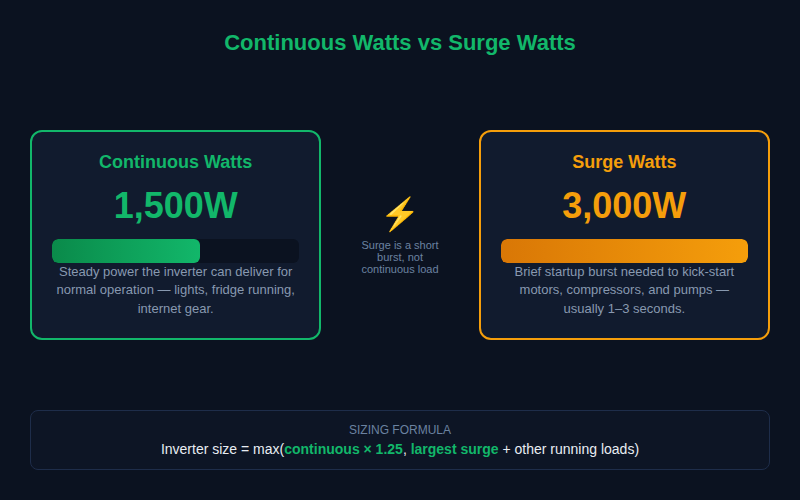
- Continuous watts are the steady load the inverter can support for normal operation.
- Surge watts are the short burst needed to start motors and compressors.
- Pure sine wave is the safest choice for compressors, motors, medical gear, and modern electronics.
- Modified sine wave is a cheaper compromise, but it is not the right answer for most modern solar backup systems.
Simple formula: Continuous demand + startup surge + a safety margin. For many systems, the right answer is the larger of continuous watts × 1.25 or the biggest appliance surge plus the other loads that may run at the same time.
Rule of thumb: If your biggest appliance is a compressor or pump, size the inverter for its surge first. If your biggest load is a heater or lighting, continuous watts matter more.
Pure sine vs modified sine
If you want the practical homeowner answer, pure sine wins. Modified sine inverters can work for simple resistive loads, but they are not the comfortable default for a modern backup system.
Pure sine
- Best for fridges, freezers, pumps, fans, and electronics.
- Runs more quietly and usually with fewer compatibility headaches.
- The safer long-term choice for most solar batteries and appliances.
Modified sine
- Cheaper upfront.
- Can be fine for simple heaters or incandescent lighting.
- More likely to cause noise, heat, or poor behavior in sensitive gear.
For AESV readers, the safe recommendation is simple: if the system matters enough to keep food cold or power tools running, buy pure sine.
Match the inverter voltage to the battery bank
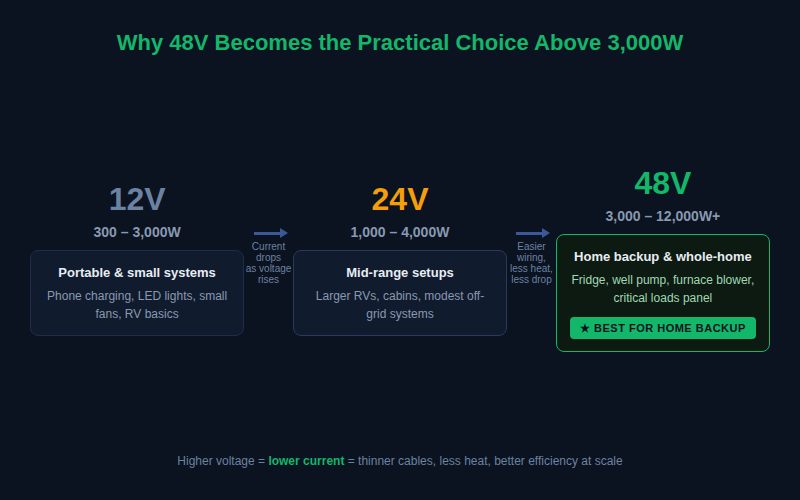
Voltage matching is where many good plans go wrong. 12V systems are fine for small loads, 24V can bridge the middle ground, and 48V is the practical standard once you are building a serious home backup system.
| Battery bank voltage | Typical inverter range | Best use | Watch out for |
|---|---|---|---|
| 12V | 300–3,000W | Portable systems, small RVs, simple backup kits | Very high current draw at larger wattages, heavy cable requirements, and more voltage drop |
| 24V | 1,000–4,000W | Larger RVs, cabins, and modest off-grid setups | Fewer consumer product options than 12V or 48V |
| 48V | 3,000–12,000W+ | Home backup, whole-home, battery-heavy systems | Battery compatibility, communication protocols, and correct split-phase wiring |
Battery chemistry matters too. LiFePO4 is the easiest fit for modern inverters. AGM can work, but it is less forgiving at scale. Whatever chemistry you use, the inverter should match the bank voltage and charging profile that the battery manufacturer recommends.
Which inverter size fits each system tier?
Portable systems: 12V, 300–1,000W
Think phone charging, laptop power, LED lights, small fans, and light-duty emergency use. A compact pure sine inverter is usually enough. Many readers at this level are better served by a solar generator with a built-in inverter.
RV and cabin systems: 12V, 1,000–3,000W
This is where startup surge starts to matter. Fridges, microwaves, coffee makers, and small pumps can all change the recommendation. Inverter-chargers are often attractive here because shore power or generator input can simplify the system.
Home backup systems: 48V, 3,000–6,000W
At this level, you are usually supporting critical loads: fridge, freezer, internet, lights, garage door, furnace blower, and sometimes a well pump. A 48V inverter-charger is usually the right starting point.
Whole-home systems: 48V, 6,000–12,000W+
Whole-home backup needs headroom. If you want to run more than one big appliance at once, or if you need 120/240V split-phase power, move into this tier and check stacking support before buying.
Battery-heavy systems: 48V, 6,000W+
When the battery bank is the star of the system, battery communication becomes more important. Check CAN or RS485 compatibility if the inverter and battery are meant to talk to each other.
Common buying mistakes
- Buying by daily watt-hours alone and ignoring surge.
- Choosing modified sine for loads that really want pure sine.
- Keeping a 12V design when the load has outgrown it.
- Forgetting that inverter cables, fuses, and busbars have to be sized correctly too.
- Assuming every 48V inverter will automatically play nicely with every 48V battery.
- Buying a whole-home inverter when the battery bank only supports a small critical-load setup.
Solar inverter FAQ
How do I know if I need surge capacity?
If your system runs anything with a motor or compressor, surge capacity matters. Fridges, freezers, pumps, and many power tools need more startup power than they need once they are running.
Is pure sine always worth it?
For most AESV readers, yes. Pure sine is the safer choice for modern appliances and backup power. Modified sine only makes sense when the load is simple and the budget is tight.
Why do bigger systems move to 48V?
Because current drops as voltage rises. Lower current means easier cable sizing, less heat, less voltage drop, and a better fit for larger inverter loads.
Do I need an inverter-charger or a standalone inverter?
If you expect shore power, generator input, or automatic battery charging from AC, an inverter-charger is often the smarter purchase. If you only need inversion, a standalone unit can be simpler.
Can I mix battery chemistries?
Not in the same bank if you can avoid it. Keep the system architecture clean. Use the battery manufacturer’s recommended voltage and charging settings, and avoid mixing old and new batteries in one string.
Bottom line
If you are sizing a solar inverter from scratch, start with surge, choose pure sine, and move to 48V as soon as your system becomes serious. The calculator should tell you the energy need; this guide tells you the inverter class that can actually deliver it.
For related planning, see the AESV calculator, the battery backup guide, and the bill savings guide.
