
This guide explains how to size and choose a solar-powered well pump for off-grid water use. It focuses on the decision between direct solar pumping and battery-buffered pumping, then walks through GPM, total dynamic head (TDH), pump type, controller selection, panel sizing, and winter freeze protection.
The goal is practical sizing, not guesswork: start with daily water demand, convert it into flow, calculate the vertical lift and friction losses, then match the pump and controller to the actual site conditions and the pump manufacturer’s curve.
Direct-on-solar vs battery-buffered pumping
For most off-grid water systems, the first decision is architectural: should the pump run directly from solar power during the day, or should batteries carry the load after dark and through cloudy periods?
| Option | Best fit | Main benefit | Main trade-off |
|---|---|---|---|
| Direct solar | Most wells, cistern fill, livestock tanks, irrigation fill-up during daylight | Lowest complexity; no battery round-trip loss; storage can be water, not electricity | No night pumping; output rises and falls with sunlight |
| Battery-buffered | Night pumping, pressurized household water, schedules that need power after sunset | More flexible runtime and steadier delivery | Higher cost, more components, more maintenance, lower overall efficiency |
For a typical off-grid property, direct solar pumping into a storage tank is usually the most resilient setup. That matches the way NMSU and other solar-pumping guides describe direct-coupled systems: panels feed a controller and pump during sunlight hours, and the system stores water instead of storing electricity. For broader system planning, see the solar inverter sizing guide and compare the battery-backed path against the DIY LiFePO4 solar battery bank sizing and wiring guide.
If you need water at night or need the pump to behave like a household pressure system, battery-buffered operation can make sense — but the controller, wiring, and storage strategy become more complex. Use battery storage only when the operating requirement really needs it.
GPM and TDH: the two numbers that actually size the pump
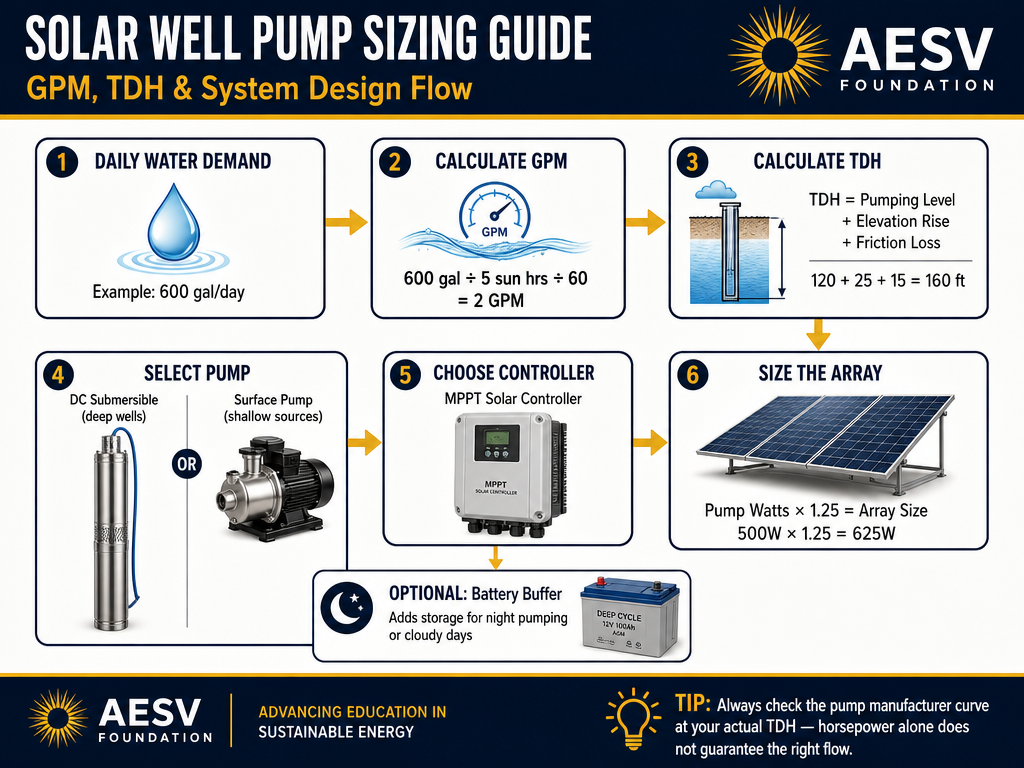
Solar water-pump sizing starts with two variables:
- GPM (gallons per minute): how fast the system must deliver water.
- TDH (total dynamic head): the total equivalent lift the pump must overcome.
TDH is not just the depth of the well. It combines pumping level, vertical lift to the discharge point, and friction losses in the pipe. In NMSU’s and GSES’s solar-pumping guidance, friction losses are added to the static/pumping lift to get the effective head the pump must meet.
A simple field formula is:
TDH = pumping level + elevation rise + friction loss
Use pumping level rather than static water level if the water table drops while the pump runs. If the pump feeds a tank on higher ground, include that climb as elevation rise. If you use long pipe runs, smaller pipe diameters, or many fittings, friction loss goes up and the pump has to work harder.
Worked example for illustration only: if a property needs 600 gallons per day and has about 5 peak sun hours, the daily flow target is 120 gallons per hour, or 2 GPM. If static water level is 100 ft and drawdown adds 20 ft so the pumping level is 120 ft, then elevation rise adds 25 ft and friction loss adds 15 ft, for a TDH of 160 ft.
That example does not select a pump by itself. It only gives the two numbers the pump curve must satisfy: the required flow rate and the required head at that flow.
Pump type: submersible vs surface, DC vs AC
Once GPM and TDH are known, choose the pump type that fits the source and the required lift.
- Submersible well pump: best for deeper wells and sealed boreholes.
- Surface pump: best for shallow lifts, ponds, cistern transfer, or near-surface sources.
- DC solar pump: usually the simplest option for direct solar systems.
- AC pump with inverter/controller: useful when you already need an AC pump or a hybrid power path.
For most off-grid wells, a DC submersible matched to a dedicated solar controller is the cleanest choice. That is consistent with NMSU’s direct-coupled solar-pumping model and with manufacturer sizing tools that separate “direct drive solar” from “night-time battery operation.” For controller selection details, pair this section with the best solar charge controller guide.
Surface pumps are generally a better fit when the water source is shallow and accessible. If the application is a deep well, do not force a surface pump into a job better handled by a submersible pump curve.
Important caution: the pump must be selected from its performance curve at the actual TDH, not from horsepower alone. A pump that looks large on paper can still miss the target if its curve falls off at your head requirement.
Controller selection and panel sizing
The controller is the bridge between the array and the pump. In the sources reviewed for this draft, the controller is doing three jobs: matching panel output to the motor, protecting the pump from over-voltage or over-current, and maximizing daily water output through MPPT or a similar power-tracking method.
SunPumps’ controller documentation describes a solar-module-direct controller that provides over-voltage and over-current protection and boosts output under low sunlight. GSES’s solar-water-pumping guidance also notes that controllers commonly include MPPT so the array runs near its maximum power point.
For panel sizing, use the pump maker’s minimum voltage window first, then add a modest margin for real-world losses. A conservative source-backed rule is to size the array about 20% to 30% above the pump’s peak rated wattage, then confirm the string voltage stays within the controller limits in hot and cold weather.
Worked example for illustration only: if the selected pump’s rated input is 500 W, a 25% oversize target is 625 W. That would usually be rounded to a practical array size that satisfies the controller voltage window and the manufacturer’s curve.
If the design needs night pumping or household-pressure behavior, a battery-backed controller path may be appropriate. If the goal is simply to move water into a tank during the day, direct solar control is usually simpler and more efficient.
Install notes, pipe sizing, and freeze protection
Installation affects performance as much as the pump selection does. Pipe diameter, pipe length, and fittings all change friction loss, and friction loss changes TDH. A larger-diameter pipe usually reduces friction loss, but it can increase material cost.
Keep the system layout simple where possible: pump, controller, properly sized array, check valve or tank control as required, and storage that matches the use case. Avoid unnecessary plumbing restrictions that increase head for no benefit.
Freeze note: in cold climates, protect exposed pipe, valves, pressure controls, and storage connections from freezing. Texas A&M and Clemson Extension guidance both stress that above-ground plumbing is vulnerable, that small-diameter lines freeze first, and that insulating or draining exposed components matters. A deep submersible pump is less exposed than above-ground hardware, but the rest of the system can still freeze and fail.
That means winter planning is not optional. Insulate exposed components, drain seasonal lines where appropriate, and do not assume the well itself protects the whole system.
Calculator CTA
If you want to move from estimate to build-ready sizing, use the AESV calculator to estimate the daily watt-hours and panel capacity for your battery-backed loads, then apply those results to the battery side of a pump system.
Calculator CTA: size the battery and panel side of your off-grid system before you buy hardware, especially if the pump needs night-time or pressurized operation. The calculator is the fastest way to check the battery-backed path before you buy hardware.
FAQ
Can a solar well pump run without batteries?
Yes. Most off-grid solar pumping systems run directly when the sun is available and store water in a tank instead of storing electricity in batteries.
What is more important: horsepower or TDH?
TDH is more important for fit. Horsepower alone does not tell you whether the pump can deliver the needed flow at the actual head.
How do I estimate GPM from daily water use?
Divide daily gallons by the number of effective pumping hours, then divide by 60 to convert gallons per hour into gallons per minute.
Do I need an MPPT controller?
In most solar-water-pumping systems, an MPPT-style controller is the right choice because it helps the pump use available panel power more effectively as sunlight changes.
What should I do before winter?
Insulate or drain exposed lines, protect pressure equipment, and confirm the above-ground plumbing and controls are not left exposed to freezing air.
