
If a solar battery looks full at sunset and is low again by morning, the cause is not always the battery itself. In off-grid and RV systems, overnight loss is often driven by inverter idle draw, controller self-consumption, phantom loads, temperature effects, or a battery pack that is no longer balancing correctly.[1][2][3][4][5] This guide separates those possibilities in a safe order. Start by confirming that the reading is real, then isolate loads, check standby draw, verify charge settings, and only then look at cell imbalance or battery replacement.[1][2][3][4][5]
Safety first: do not open a sealed battery, bypass a BMS, or keep probing live battery terminals. If the battery is hot, swollen, leaking, or smells burnt, disconnect the system and stop using it. Treat repeated fuse or breaker trips as a fault to find, not a reason to fit a larger fuse.[3][4]
First question: is the battery really draining?
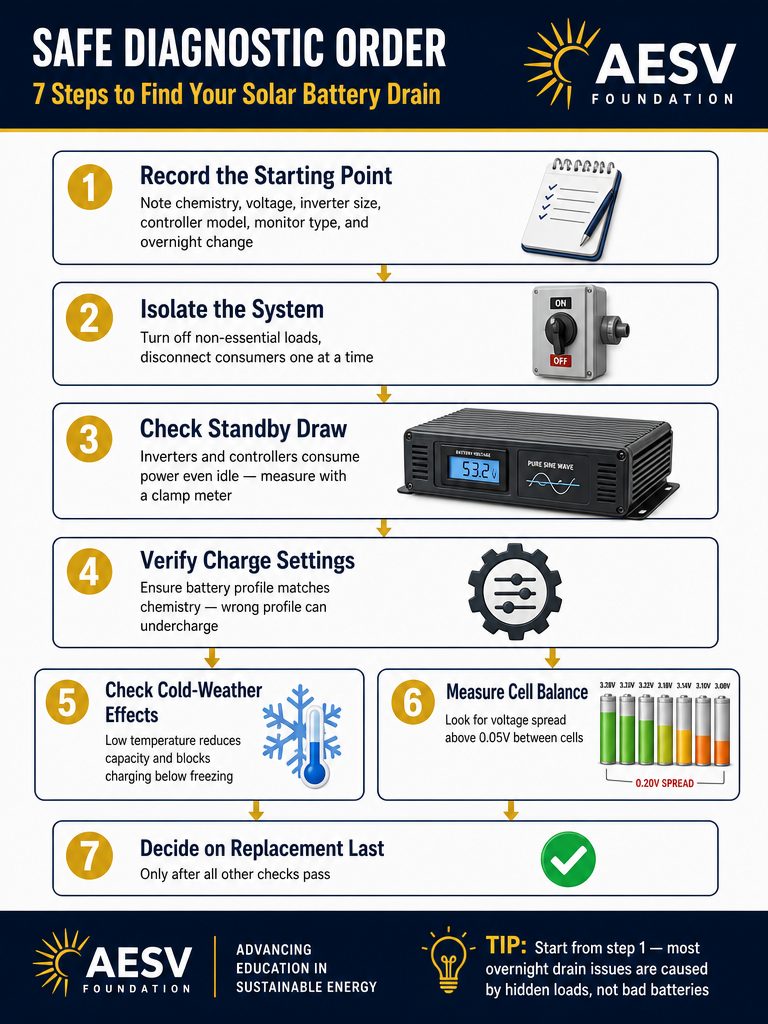
A state-of-charge display is only as good as the thing measuring it. LiFePO4 systems are especially prone to confusion because voltage stays fairly flat through much of the discharge curve, so a quick voltage check can look worse than the real amp-hour picture. If you have a shunt-based monitor, compare its amp-hours or watt-hours against the inverter and controller logs. If you only have a simple voltage display, assume it is a rough clue, not proof, until you have verified the current draw with a known-good meter.[1][3][6] A common complaint is “it dropped to 85% overnight” when the battery actually did not lose that much energy. In practice, that can be a monitor artifact, a small standby load, or the battery management system correcting its estimate after resting.[1][3][5][6]Safe diagnostic order
- Record the starting point. Note battery chemistry, bank voltage, inverter size, controller model, monitor type, and the exact overnight change in voltage or state of charge.[1][2][3]
- Isolate the system. Turn off non-essential loads, then disconnect the largest obvious consumers one at a time so you can see which branch matters most.[2][3]
- Check standby draw. Inverters and controllers consume power even when nothing is actively running; that idle loss is often the first real clue.[1][2]
- Verify charge settings. Make sure the battery profile matches the chemistry. A lead-acid profile on LiFePO4 can end charging early and make the bank look like it is “draining” when it actually started the night undercharged.[1][4]
- Check cold-weather effects. Low temperature can reduce usable capacity and, if charging is attempted below freezing, can damage lithium cells.[3][4]
- Measure cell balance. If the pack has accessible cell data, look for a widening voltage spread. A deviation above about 0.05 V is a reason to investigate further.[5][6]
- Decide on replacement last. If parasitic loads are gone, settings are correct, temperatures are normal, and the pack still self-discharges unusually fast, the battery itself may be failing.[3][5][6]
What the overnight symptom usually points to
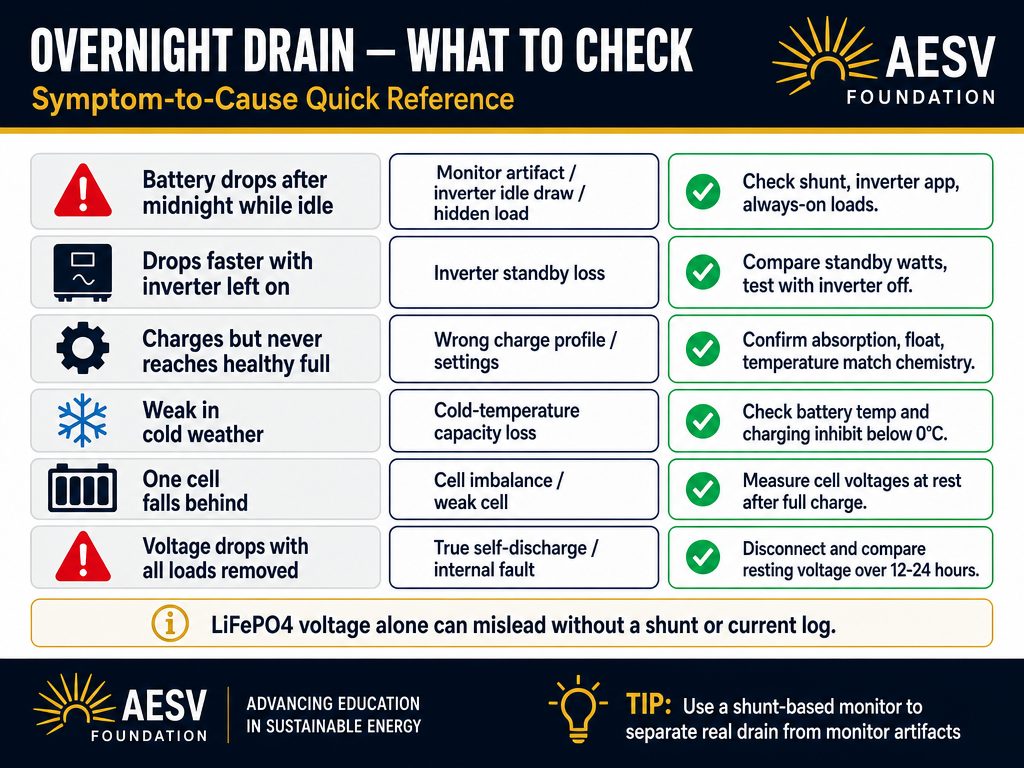
| What you notice | Most likely cause | First check | What not to do |
|---|---|---|---|
| Battery “drops” after midnight while the system is idle | Monitor artifact, inverter idle draw, or a hidden overnight load.[1][2][3][6] | Look at the shunt, inverter app, and any always-on loads such as routers, fans, or display panels.[1][2] | Do not assume the battery is bad before measuring current draw.[1][2][3] |
| Battery drops faster when the inverter is left on | Idle/standby loss from the inverter itself.[2] | Compare inverter standby watts against the night load; then test with the inverter off if that is safe for the system.[2] | Do not leave a large inverter on all night just to avoid switching it off.[2] |
| Battery seems to charge, then never reaches a healthy full state | Wrong battery profile or charge settings.[1][4] | Confirm absorption, float, and temperature settings match the chemistry and the battery maker’s guidance.[1][4] | Do not keep raising voltage blindly to force a “full” reading.[1][4] |
| Battery looks weak in cold weather | Cold-temperature capacity loss or charging inhibit.[3][4] | Check battery temperature and whether charging is being blocked below 0°C.[3][4] | Do not charge LiFePO4 below freezing unless the battery is specifically designed for it.[4] |
| One cell or section falls behind the rest | Cell imbalance or a weak cell in the pack.[5][6] | Measure cell voltages at rest and after a full charge/balance cycle.[5][6] | Do not keep cycling the pack deep and hoping it will self-correct.[5][6] |
| Voltage drops even with all loads removed | True self-discharge or an internal fault.[3][5][6] | Disconnect external loads and compare resting voltage over 12 to 24 hours.[3][5] | Do not ignore a pack that continues dropping with no external load connected.[3][5][6] |
What to check on the charging side
A small MPPT controller still draws power from the battery side even after sunset. Victron’s SmartSolar datasheet lists self-consumption of 10 to 25 mA depending on model and operating state, which is not much by itself but becomes relevant in a small system with limited reserve.[1] That is why a “mystery drain” on a small system often turns out to be several ordinary small losses adding together: controller self-consumption, inverter idle draw, Bluetooth monitoring, and one or two standby devices that were left powered.[1][2][3][6] If the controller is set for the wrong chemistry, or if absorption and float settings are too conservative, the battery may never truly start the night at 100%. In that case the battery is not draining unusually fast — it is simply undercharged before darkness begins.[1][4]What to check on the battery itself
For LiFePO4 banks, true chemical self-discharge is usually modest. Battle Born states that its LiFePO4 batteries average about 2% to 3% per month, which means a one-night drop is usually more likely to be load-related or measurement-related than pure chemical loss.[3] If the pack is older, has been repeatedly deep discharged, or has a meaningful cell spread, the whole system can look like it is “dying overnight” even though the root issue is one weak cell pulling down the pack before the BMS steps in.[5][6] A voltage difference of more than about 0.05 V between cells is a reasonable alarm threshold for further investigation. That does not mean the pack is instantly unusable, but it does mean balancing, calibration, or a cell-by-cell test is justified.[5][6]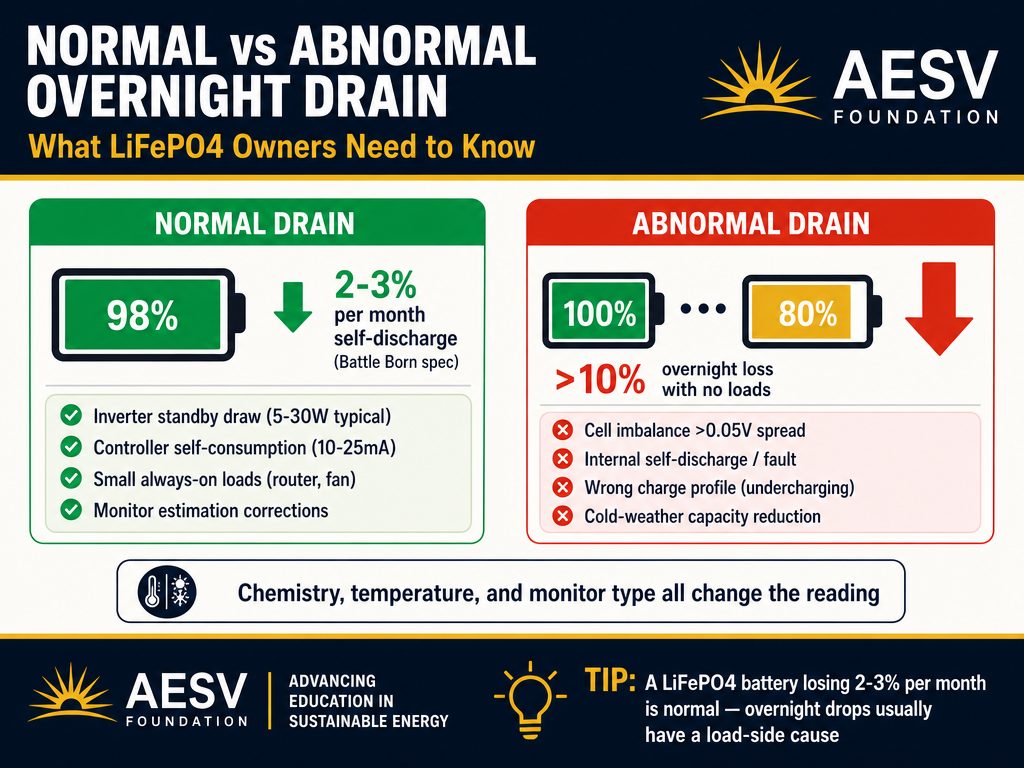
Cold weather can look like fast drain
Cold weather changes the diagnosis. Renogy notes that lithium batteries should not be charged below 32°F (0°C) unless the battery has self-heating designed to warm the cells for that condition.[4] That means a winter battery complaint can be a mix of reduced usable capacity, a charging cutoff, and a normal-looking overnight voltage drop that feels much worse than it really is. Before replacing the battery, confirm the temperature and check whether the battery has self-heating that warms the cells before charging begins.[3][4] If the cold-weather issue is recurring, compare the system against the winterization and storage guidance in the winterizing off-grid solar system guide and then re-test in warmer conditions.[3][4]When replacement starts to make sense
Replacement is a last step, not a first step. It becomes reasonable when the system has already passed the other checks: standby draw is acceptable, settings are correct, cold weather is not the main issue, and the pack still loses charge or balance without an external load.[3][4][5][6] If the battery loses voltage with all loads disconnected, and the behavior repeats after a full charge and rest period, the pack may have internal damage or excessive self-discharge. At that point, a replacement battery or a professional bench test is usually the next practical move.[3][5][6] If you are comparing whether to replace the battery, expand the bank, or reduce the load, use the calculator first. Then compare the result with the Home Battery Backup Sizing Guide so you can tell the difference between a failing battery and a bank that was never large enough for the night load.[2][3]FAQ
Why does my solar battery drop overnight when nothing is running?[1][2][3]
Usually because something is still drawing power: inverter standby loss, controller self-consumption, a small hidden load, or a monitor that is estimating state of charge imperfectly.[1][2][3][6]
How can I tell if it is the inverter?[2]
Check whether the drop is much larger when the inverter is left on than when it is off. Idle draw is a common overnight loss source in off-grid systems.[2]
What is a normal self-discharge rate for LiFePO4?[3]
Battle Born states roughly 2% to 3% per month on average. That is slow enough that a one-night drop is usually caused by something else.[3]
Can cold weather make the battery seem to drain faster?[4]
Yes. Cold reduces usable capacity and can block charging below freezing unless the battery is designed for low-temperature charging.[4]
When should I suspect a bad cell?[5][6]
If cell voltages are drifting apart, or if one cell repeatedly hits the limit before the others, investigate imbalance or a weak cell. A spread above about 0.05 V is a good trigger for closer inspection.[5][6]
Should I keep forcing it to charge harder?[1][4]
No. If the charge profile is wrong or the battery is cold, forcing higher charge voltage or current can make the problem worse instead of better.[1][4]
Sources and evidence ledger
- [1] Victron SmartSolar charge controller datasheet — self-consumption load-on/load-off values and charge-controller housekeeping draw. https://www.victronenergy.com/upload/documents/Datasheet-SmartSolar-charge-controller-MPPT-75-10%2C-75-15%2C-100-15%2C-100-20_48V-EN.pdf
- [2] EDECOA inverter standby consumption article — standby/idle loss reduces battery runtime and is measured in the tens of watts in common systems. https://www.edecoa.com/blogs/technical-resources/inverter-standby-consumption
- [3] Battle Born LiFePO4 winterization and storage guide — average 2% to 3% monthly self-discharge and storage/disconnect guidance. https://battlebornbatteries.com/blogs/articles/faq-how-to-winterize-your-batteries
- [4] Renogy low-temperature protection / self-heating guide — charging below 0°C should be prevented unless the battery is designed for it. https://www.renogy.com/blogs/buyers-guide/self-heating-vs-low-temperature-protection-lithium-battery
- [5] Anern BMS balancing guide — cell deviation above 0.05 V is a poor balance signal that needs further attention. https://www.anernstore.com/blogs/diy-solar-guides/bms-balancing-calibration-lifepo4
- [6] DigiKey cell balancing explainer — supports the general need to monitor cell imbalance and correct it before it becomes a pack-level problem. https://www.digikey.com/en/maker/blogs/2025/cell-balancing-and-why-it-matters
