
Winter changes three parts of an off-grid solar system at once: batteries lose usable capacity, sunlight arrives at a lower angle, and snow or frost can cut panel output until the array clears. The right response is usually not to “do more” everywhere, but to protect the battery first, then tune the array and operating schedule around the season.
Important: Low-temperature charge limits vary by battery chemistry and battery-management system. Before you add heaters, change charging behavior, or leave a system active all winter, check the manufacturer’s spec sheet for the exact battery you installed.
What winter actually changes
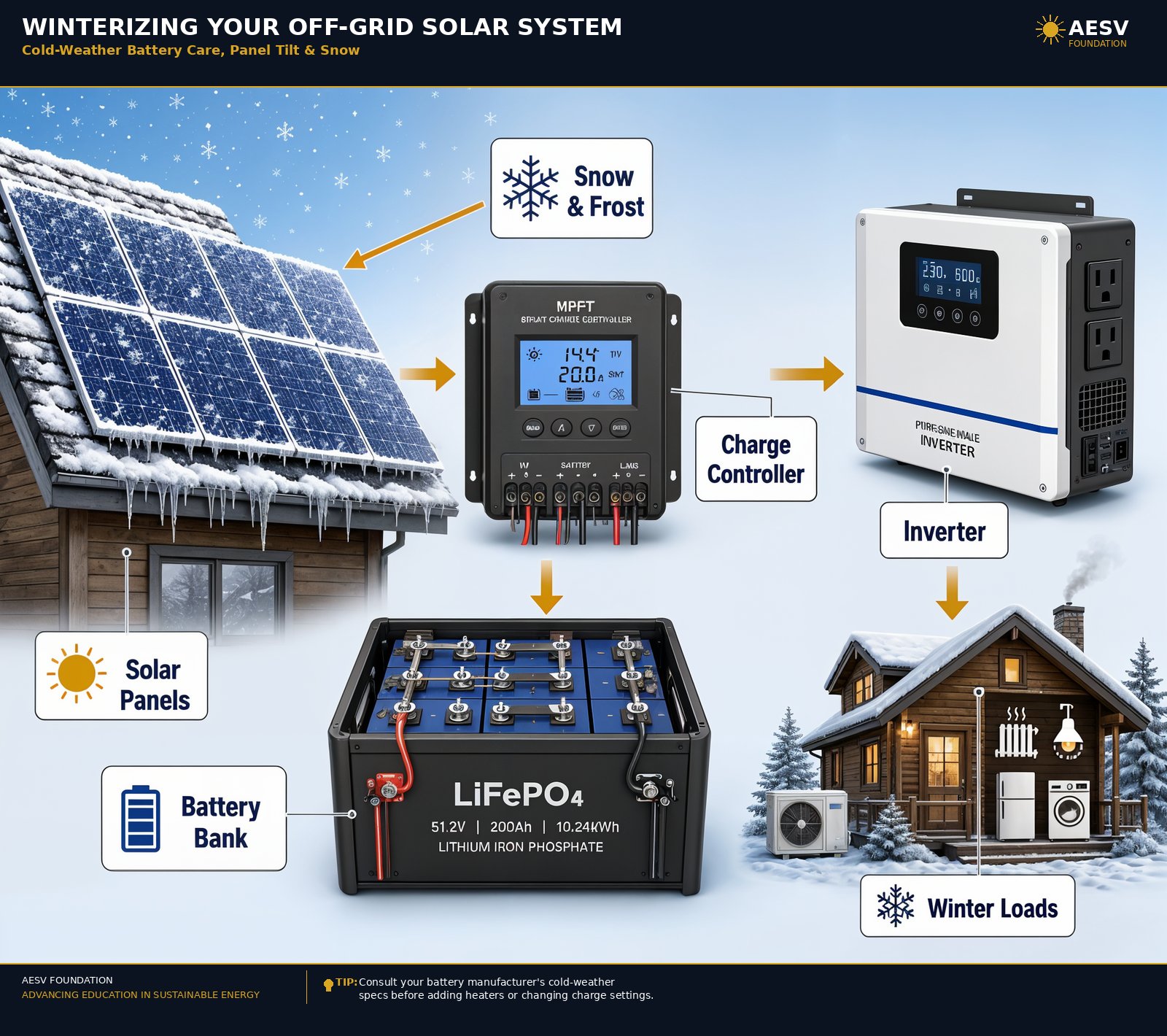
Cold weather does not affect every part of the system in the same way. Batteries may temporarily deliver less usable energy, solar harvest is often reduced by shorter days and lower sun angle, and snow can create a short but very real production outage until it slides or is cleared safely. In other words: winter is mainly a storage-and-collection problem, not a “solar stopped working” problem.
That is why winter prep should focus on the battery compartment, the charge settings, and the physical condition of the array before you worry about the inverter or loads.
Start with the battery bank
Battle Born’s winterization guidance says its LiFePO4 batteries have a self-discharge rate of about 2% to 3% per month on average and a storage range of –15°F to 140°F.[1] The same guide recommends storing the batteries fully charged in an environment above freezing if possible, and it warns against leaving a completely drained battery in storage for an extended period because that can damage the cells.[1]
The practical takeaway is simple: if your system will be parked or idle for the season, don’t leave the battery bank half-discharged and forgotten. Put the bank in a known state, disconnect parasitic loads where appropriate, and verify that any disconnect switch, battery guardian, or equivalent isolation method is actually doing its job.[1]
For an active off-grid system, the most important winter question is not “can the batteries survive the cold?” but “can the batteries be charged safely when the temperature drops?” That depends on chemistry, BMS limits, and whether the bank has low-temperature protection or self-heating support.
How to winterize batteries without overcomplicating the system
- Confirm the battery chemistry and charge-temperature limits from the manufacturer.
- Check whether the BMS blocks charging below a low-temperature threshold.
- Use insulation, a heated battery box, or a self-heating battery only when the product is designed for that use.
- Keep the battery compartment dry and ventilated enough to avoid condensation problems.
- If the system is being stored, fully charge the bank and isolate nuisance loads before you leave it unattended.[1]
If you want the numbers behind the decision, pair this article with the off-grid calculator and the LiFePO4 battery-bank guide. Winterizing is much easier when you already know your daily watt-hour load, your autonomy target, and your worst-case winter sun-hours.
Panel tilt and snow management
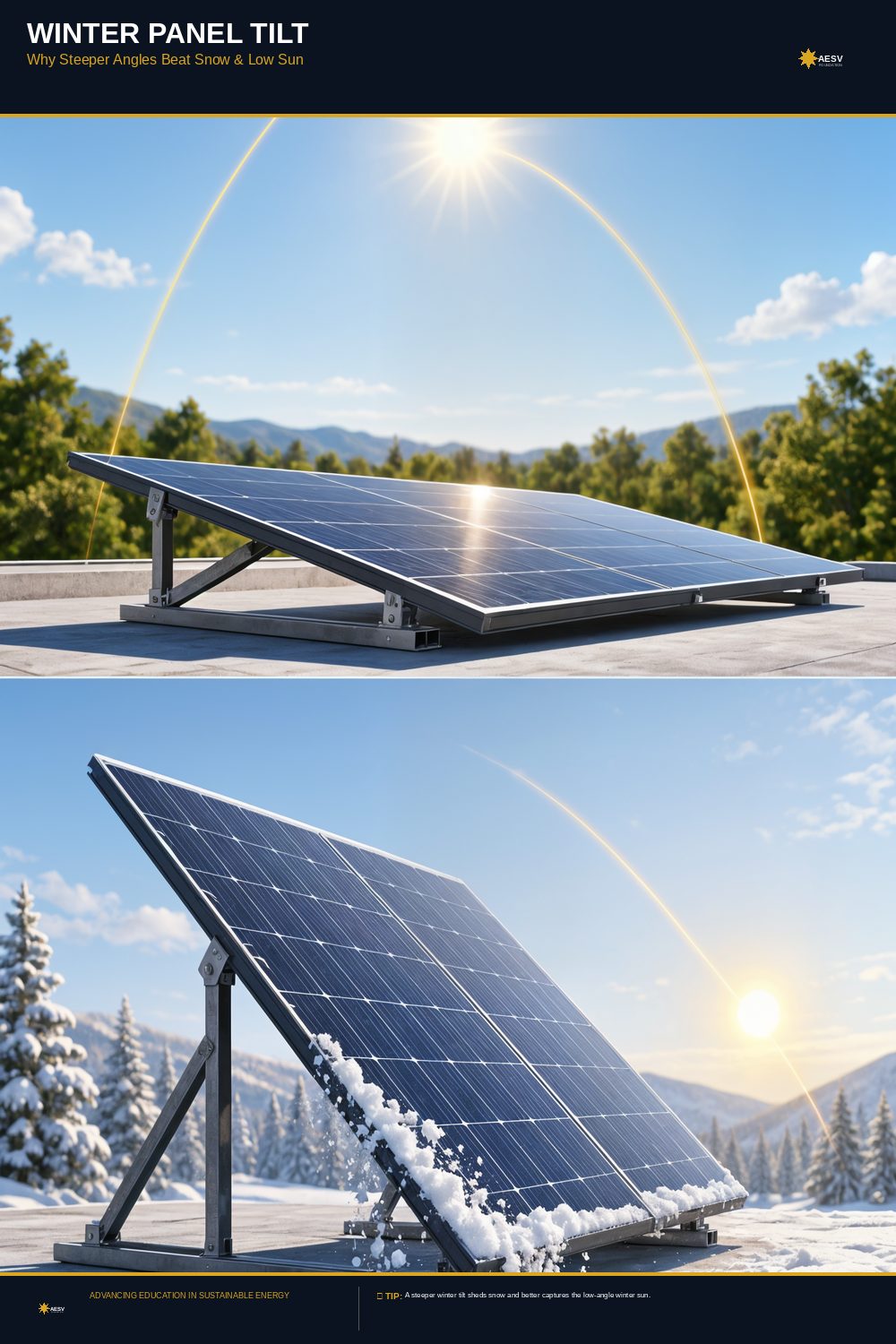
A steeper winter tilt can better match the lower winter sun angle and usually improves winter collection on fixed arrays.[2][7]
That does not mean every system should be re-mounted. For a cabin, shed, or ground-mount system, adjustable brackets may be worth the effort if winter production matters. For roof mounts, the decision is often simpler: leave the hardware alone, clear only what you can safely reach from a safe access method, and treat roof snow work as a fall-risk task rather than routine maintenance.[3][4]
Do not treat snow removal as a race. If the array is unsafe to reach, the safer option is usually to wait for natural shedding or to live with a temporary production loss rather than taking a fall.
Should you shut the system down for winter?
The right answer depends on whether the system is seasonal or mission-critical. A seasonal cabin or RV setup that will sit unused for months should usually be put into storage mode: batteries charged, parasitic loads disconnected, and the system checked before spring return.[1]
An occupied cabin or year-round off-grid home is different. In that case, the system usually stays online, but the owner should expect lower winter yield because the sun sits lower and the days are shorter. Plan for tighter energy discipline, more attention to state of charge, and no long storage periods at a partially depleted state.[1][2]
As a rule, if winter creates a shortfall, first reduce demand, then improve collection, and only then consider changing hardware.
| Winter use case | Operating mode | Primary actions |
|---|---|---|
| Seasonal cabin or RV | Storage mode | Fully charge the battery bank, disconnect parasitic loads where appropriate, and check the system before returning in spring. |
| Year-round off-grid home | Operate if designed for year-round use | Expect lower winter yield from shorter days and lower sun angle, reduce discretionary demand, and monitor state of charge more closely. |
Winter checklist for an off-grid system
- Confirm battery chemistry, cold-charge limits, and BMS behavior.
- Fully charge the bank before storage if the system will sit idle.[1]
- Disconnect parasitic loads or verify the disconnect switch works.[1]
- Inspect seals, cable entries, and vents for moisture ingress.
- Check controller settings, especially low-voltage and temperature-related limits.
- Set a winter maintenance reminder so the system is not forgotten until spring.
Frequently Asked Questions
Can I leave my off-grid solar system running all winter?
Yes, if the system is designed for year-round use and the battery bank can charge safely in the temperatures you expect. For seasonal storage, Battle Born recommends fully charging the batteries, isolating parasitic loads, and avoiding long-term storage in a fully drained state.[1]
Do lithium batteries need to be trickle-charged in storage?
Not according to Battle Born’s winterization guidance, which says its batteries do not require a trickle charge during storage.[1] The more important step is to store the bank charged and protected from unnecessary loads.[1]
Is it safe to charge batteries below freezing?
That depends on chemistry and the BMS. Many LiFePO4 batteries should not be charged below freezing unless the product has internal heating or a manufacturer-approved low-temperature charge design; always follow the exact battery-maker limits for the product you own.[5][6]
What is the simplest winter upgrade if my system is short on energy?
Usually the first upgrade is not more hardware — it is better winter planning. Reduce load, confirm the battery bank is healthy, and use the calculator to see whether your array and storage still match winter demand. If not, then consider tilt adjustments, insulation, battery heating, or a larger array.
Closing recommendation
Winterizing an off-grid solar system is mostly about protecting the battery bank, then managing reduced solar harvest with realistic expectations. If you already know your load profile, use the calculator to test whether your winter setup still covers the basics — and if it does not, fix the gap before the first cold snap.
