
Planning an off-grid cabin solar system starts with the cabin’s loads, not with a panel count. Lights, refrigeration, pumps, internet equipment, tools, and seasonal heating needs determine how much energy the system must deliver each day. The array then has to replace that energy during the available solar window, while the battery supplies loads at night and during poor weather.
This guide gives you a preliminary sizing method for a small cabin system. It is not an electrical design or a substitute for permits, the equipment manufacturer’s instructions, local code, or a qualified installer. For a location-specific production estimate, use the AESV solar calculator alongside local solar-resource data.
Safety note: A cabin system combines high-current batteries, photovoltaic DC circuits, AC wiring, and sometimes a generator. Do not improvise protection devices, battery connections, grounding, or transfer equipment. Have the final design and installation reviewed by a qualified electrician familiar with off-grid systems and your jurisdiction.
1. Decide what the cabin must power
Write down every load that may operate when the cabin is occupied. Include the appliance’s running watts, expected hours per day, and whether it has a starting surge. A nameplate is preferable to a guess; for unknown loads, use a plug-in power meter or manufacturer data.
- Lighting and smoke/CO alarms
- Refrigerator or freezer
- Router, satellite internet, radio, or monitoring equipment
- Water pump, pressure pump, or well controls
- Phone and laptop charging
- Fans and small kitchen appliances
- Tools, washing equipment, or workshop loads
- Heating, cooling, and hot-water equipment—often the loads that change the design completely
Separate essential loads from optional loads. A small system might reserve battery capacity for lighting, refrigeration, communications, and water, while moving high-power tools or electric resistance heat to daylight-only operation or a generator.
2. Convert the load list into daily energy
For each appliance, calculate watt-hours (Wh) as:
watts × hours used per day = watt-hours per day
For cycling equipment such as a refrigerator, use measured or documented average consumption where possible. Do not multiply the compressor’s maximum running watts by 24 hours unless that is genuinely the operating profile. Add the rows, then allow for conversion, wiring, controller, and battery losses. The worked example below uses a 20% planning allowance; the correct value depends on equipment, temperature, wiring length, operating mode, and system design.
| Load | Assumed rating/use | Daily energy |
|---|---|---|
| LED lighting | 40 W × 5 h | 200 Wh |
| Refrigerator average | 80 W × 24 h | 1,920 Wh |
| Internet equipment | 60 W × 8 h | 480 Wh |
| Water pump | 750 W × 0.5 h | 375 Wh |
| Charging | 20 W × 4 h | 80 Wh |
| Miscellaneous small loads | 100 W × 4 h | 400 Wh |
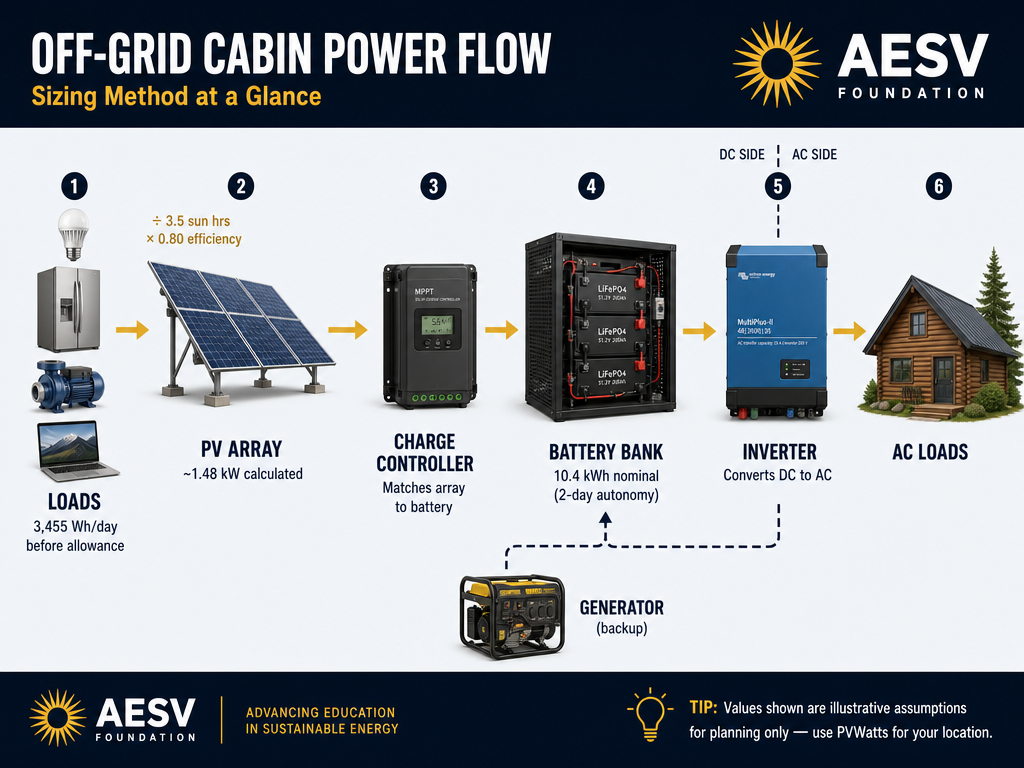
| Total before allowance | — | 3,455 Wh/day |
Adding a 20% planning allowance gives approximately 4,146 Wh/day, or 4.15 kWh/day. This is an illustrative calculation, not a promise of runtime. Actual refrigeration duty cycle, pump pressure, internet uptime, occupancy, and winter conditions can change the result.
3. Size the solar array for the difficult season
Use the average daily energy requirement, the site’s conservative peak-sun-hours estimate, and an explicit system-derate assumption:
array kW ? daily energy kWh ÷ (peak sun hours × system efficiency)
Using the example’s 4.146 kWh/day, 3.5 peak sun hours, and an assumed 80% system efficiency gives about 1.48 kW of PV. A designer would normally round up to a practical array, such as approximately 1.8 kW, then check module electrical limits, winter production, shading, tilt, temperature, snow, and controller capacity.
Do not use a national average as the final sun-hours input. NREL’s PVWatts calculator estimates production from location and system assumptions, but its results remain estimates with uncertainty. For a year-round cabin, inspect the lowest-production months rather than sizing only from annual average output. If the cabin is seasonal, model the months when it will actually be occupied.
Shade deserves special attention. A chimney, tree, ridge, or snow accumulation can reduce production more than a small change in nominal panel wattage. Record the array’s orientation and tilt, and plan for access to remove snow only if the method is safe and manufacturer-approved.
4. Size the battery for night-time and poor weather
Battery sizing has two separate questions: how much energy the bank stores (kWh) and how much power it can safely deliver (kW). Start with the essential daily energy, multiply by the desired autonomy, then account for the permitted depth of discharge and conversion losses.
nominal battery energy ? daily energy × days of autonomy ÷ usable fraction
For the example, two days of autonomy and an assumed 80% usable fraction gives 4.146 × 2 ÷ 0.8 = approximately 10.4 kWh nominal storage. The selected battery may need more or less capacity depending on its specified usable energy, temperature limits, reserve policy, charge/discharge current limits, and battery-management system.
Cold weather matters. Some lithium batteries restrict charging below a specified temperature, while all batteries have temperature-dependent performance. Provide the ventilation, enclosure, heating, clearances, and monitoring required by the battery manufacturer. The U.S. Department of Energy advises that stand-alone batteries be protected from temperature extremes and placed in an appropriate, maintained space; local fire and electrical rules may impose additional requirements.
5. Choose inverter and charge-controller capacity
The inverter must handle the continuous AC load and the starting surge of motors and compressors. List which loads can run at the same time. In the example, a refrigerator and pump may start together; the inverter selection must use the actual equipment surge specifications, not just the daily energy total. A preliminary 4 kW-class inverter might be reasonable for some combinations, but it is not a recommendation without the complete load and surge schedule.
Match the inverter’s DC voltage, continuous output, surge duration, waveform, low-voltage behavior, and battery compatibility to the system. A higher-voltage battery bank can reduce current for a given power, but it also changes equipment, isolation, fusing, and installation requirements.
The charge controller must accept the array’s maximum voltage and current under the relevant temperature conditions and provide the correct charging profile for the battery chemistry. Check the controller’s maximum PV open-circuit voltage, short-circuit current allowance, output-current rating, and communications or battery-temperature requirements. Never assume that two components are compatible merely because their nominal voltages look similar.
6. Plan protection, wiring, and installation
An off-grid system is a complete electrical installation, not just panels connected to a battery. A final plan may include module and string overcurrent protection, DC disconnects, battery overcurrent protection, AC breakers, grounding and bonding, surge protection, enclosure ratings, cable routing, labels, and a safe shutdown procedure. Requirements vary by jurisdiction and system architecture.
- Use cable sizes, fuses, breakers, disconnects, lugs, and busbars rated for the voltage, current, fault current, temperature, and installation method.
- Keep high-current battery conductors short where practical and protect them against abrasion and accidental short circuits.
- Verify polarity before energizing each circuit; a battery can deliver extremely high fault current.
- Use listed or certified equipment as required by local rules, and follow the manufacturer’s approved combinations.
- Do not connect a generator or grid source without correctly engineered transfer/islanding equipment.
- Keep batteries away from ignition sources and living areas when the chemistry, enclosure, or local code requires separation or ventilation.
DOE identifies batteries, charge controllers, power-conditioning equipment, safety equipment, and meters as typical balance-of-system equipment for stand-alone systems. UL Solutions also warns that mismatching a PV inverter with a battery can create fire and shock hazards; confirm the complete inverter, battery, BMS, and protection compatibility rather than assembling an unverified combination.
7. A practical cabin system workflow
- Measure or document each load and identify starting surges.
- Classify essential, flexible, and high-power loads.
- Calculate daily Wh and add a clearly stated loss allowance.
- Use conservative, location-specific solar data and check the worst occupied season.
- Choose autonomy days and battery operating limits with the battery manufacturer.
- Check simultaneous continuous and surge power for the inverter.
- Match array voltage/current to the charge controller and battery charging profile.
- Design overcurrent protection, disconnects, grounding, enclosure, and cable routing.
- Confirm permits, inspection, fire separation, and any generator or transfer requirements.
- Commission with measured voltages, currents, polarity, temperatures, and monitoring—not assumptions.
After commissioning, compare actual daily energy use and battery state of charge with the design assumptions. If the cabin repeatedly reaches a low state of charge, reduce discretionary loads first, then investigate shading, battery temperature, wiring voltage drop, controller settings, and array production before adding equipment.
Frequently asked questions
How many solar panels does an off-grid cabin need?
There is no universal panel count. Divide the cabin’s daily kWh by conservative peak sun hours and the expected system efficiency, then round up to a practical array and verify winter output. A refrigerator, pump, electric heat, and frequent tool use can make the required array much larger than lights and phone charging alone.
Is a battery required for an off-grid cabin?
Most cabins that need power after sunset or during cloudy weather need storage or another dispatchable source. Direct daytime loads may operate without a battery in some designs, but refrigeration, lighting, communications, and overnight loads generally require storage or a generator backup.
Can a 12-volt battery system power a cabin?
It can suit small loads, but current rises as voltage falls: power divided by voltage equals current. Larger cabins often use a higher DC system voltage to reduce conductor current, subject to compatible equipment, protection, and code requirements. Do not choose voltage from convenience alone.
Should I size for summer or winter?
Size for the season in which reliable operation is required. Winter often brings shorter days, lower solar resource, snow, and battery temperature constraints. A seasonal cabin occupied only in summer can use a different design, but the assumptions must match the occupancy calendar.
Can I install the system myself?
Some owners assemble permitted low-voltage equipment, but the complete system can involve hazardous battery fault current, rooftop or ground-mount work, AC circuits, grounding, and fire requirements. Follow local law and have the design and final connections inspected by a qualified professional.
Next step: Put your measured appliance list into the AESV solar backup and battery sizing calculator, then compare its assumptions with a location-specific production estimate and a professional electrical review.
