
A DIY solar water heater uses sunlight to warm domestic hot water before it reaches a conventional backup heater or storage tank. The idea is simple; the installation is not. Collector temperature, stored-water temperature, roof loading, plumbing pressure, freeze risk, scald protection, and local permits all affect whether a design is safe and useful.
Short answer: the most practical DIY path is usually to choose a listed collector and storage package, design the freeze and overheating protection first, and treat the conventional water heater as backup. Building the absorber is a useful educational experiment, but it is not automatically suitable for household hot water.
How a solar water heater works
A collector absorbs solar radiation and transfers heat to water or to a separate heat-transfer fluid. A storage tank holds the heated water because hot-water demand often occurs in the morning or evening, not exactly when sunlight is strongest. A backup heater supplies heat when solar energy is insufficient.
- Collector: commonly a glazed flat-plate or evacuated-tube collector; an unglazed collector is generally a lower-temperature product and must not be assumed suitable for domestic potable water.
- Storage: an insulated solar tank or a listed tank arrangement that can accept solar preheat.
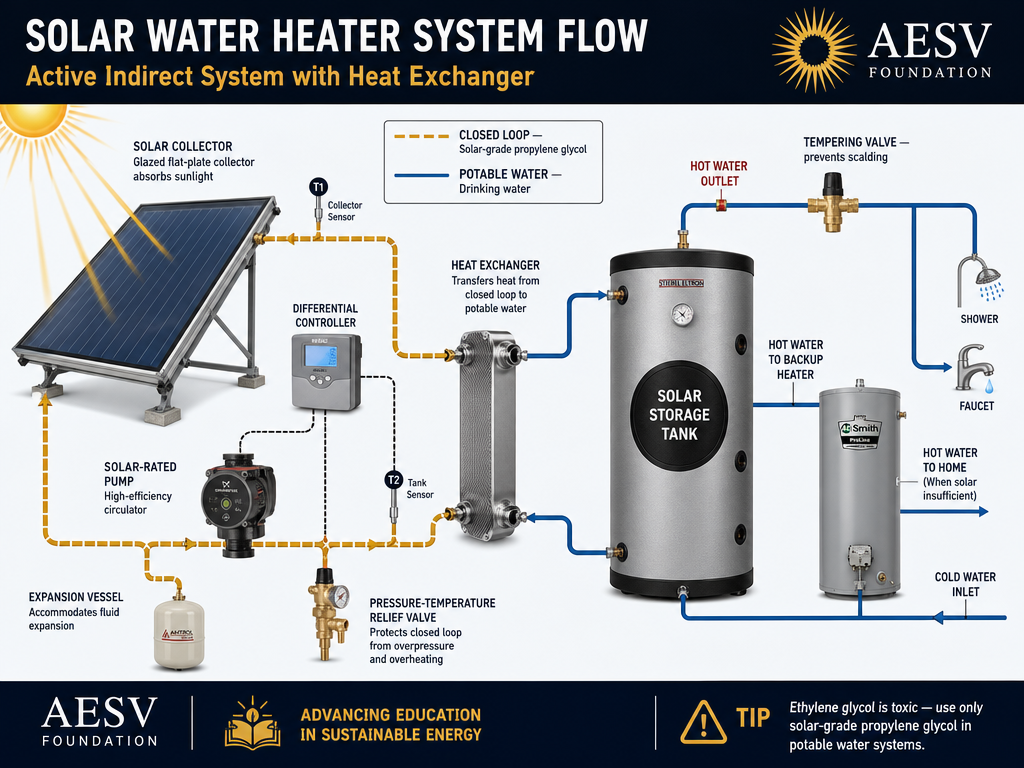
- Heat-transfer loop: either potable water in a direct system or a separate fluid and heat exchanger in an indirect system.
- Controls and circulation: a pump and differential controller in an active system, or natural convection in a passive thermosyphon system.
- Backup and safety hardware: a conventional heater, expansion control, pressure-temperature relief, check valves, isolation valves, mixing/tempering protection, and correctly rated piping.
Choose the system type before buying parts
Passive versus active
Passive systems use buoyancy or household water pressure rather than a circulation pump. Thermosyphon systems place the tank above the collector so heated water rises naturally. Integral collector-storage systems combine collection and storage. Passive designs can be simpler and more reliable, but they are climate- and layout-dependent and are not automatically freeze-safe.
Active systems use a pump and controls. They provide more flexibility for tank location and can use an indirect loop for freeze protection, but they add wiring, sensors, moving parts, and commissioning requirements.
Direct versus indirect circulation
In a direct system, household water circulates through the collector. DOE describes direct circulation as appropriate where freezing is rare. In an indirect system, a non-freezing heat-transfer fluid circulates through the collector and transfers heat to potable water through a heat exchanger. Indirect designs are generally the safer starting point for freeze-prone climates.
Drainback versus antifreeze protection
A drainback system drains the collector loop into a protected reservoir when the pump is off. It needs correct pipe slope, a suitable drainback tank, air management, and a controller that reliably completes the drain cycle. An antifreeze system uses a correctly formulated solar-grade propylene-glycol mixture and a heat exchanger; the fluid concentration and condition must be checked over time. DOE says antifreeze fluids degrade and normally require replacement on a three-to-five-year interval, depending on the system and manufacturer.
A safer DIY planning sequence
- Record the hot-water demand. Note occupants, showers, fixtures, laundry, seasonal occupancy, and the desired delivery temperature. Do not size from collector area alone.
- Check the climate. Record the lowest local temperatures, freeze duration, hard-water conditions, summer stagnation risk, and available solar exposure.
- Choose the architecture. Decide passive or active, direct or indirect, and drainback or antifreeze before selecting fittings.
- Plan the storage and backup. Solar should preheat or supply water with a conventional backup path. Include bypass and isolation valves so the system can be serviced.
- Confirm the structure and route. Verify roof framing, wind and snow loads, collector orientation, pipe runs, roof penetrations, tank location, drainage, and access. A roof is not a safe work surface just because a panel can physically fit.
- Use listed, compatible components. Match collectors, pumps, controllers, sensors, tanks, heat exchangers, valves, sealants, pipe materials, and insulation to the manufacturer’s temperature and pressure limits.
- Obtain permits and commission the system. Plumbing, structural, electrical, backflow, pressure-relief, and water-quality requirements vary by jurisdiction. Test stagnation, pump operation, freeze protection, relief discharge, mixing temperature, and backup operation before normal use.
A useful first-pass heat estimate is water mass × specific heat × temperature rise. In US customary units, that is approximately gallons × 8.34 lb/gal × ?T in °F, producing BTU. This estimates the thermal energy in the water; it does not determine collector area, because real output also depends on solar resource, collector efficiency, losses, storage temperature, shading, and control strategy.
Parts checklist for a listed DIY system
- Solar thermal collector(s) certified or listed for the intended application
- Insulated solar storage tank or compatible preheat tank
- Solar-rated pump, controller, temperature sensors, and wiring where an active loop is used
- Heat exchanger and solar-grade propylene glycol for an indirect system, or a properly engineered drainback assembly
- Expansion vessel, pressure-temperature relief, air separator, gauges, check valves, isolation valves, and drain/fill points as required by the design
- Tempering or mixing valve to reduce scald risk at fixtures
- High-temperature, UV-resistant pipe and correctly rated insulation
- Roof flashing, mounting hardware, structural attachments, and weather sealing designed for the collector and local loads
- Conventional backup heater, bypass, and service access
Do not substitute pool-heating parts, garden hose, unlisted plastic tanks, or ordinary sealants merely because they are inexpensive. Domestic hot-water temperatures and collector stagnation temperatures can exceed the limits of those materials.
Freeze, overheating, and scald protection
Freezing can split collectors and piping. DOE advises that insulation alone is not freeze protection. Use a properly designed antifreeze or drain strategy, and make sure collectors and piping can drain completely where drainback is used. DOE notes a minimum slope of 0.25 inches per foot (2.1 centimeters per meter) for collector-loop drainage in the cited maintenance guidance; the final design must follow the manufacturer and local code.
Overheating is also a design condition. A low-demand household, an oversized collector, a failed pump, or a full hot-water tank can leave a collector at high stagnation temperature. The design may need a heat dump, drainback behavior, stagnation-rated components, or controls that prevent unsafe operation.
Stored water can be hot enough to scald. Set and test the distribution temperature with a suitable tempering valve, retain required tank disinfection temperatures where applicable, and follow local plumbing requirements. Do not guess at a safe setting from the tank dial alone; measure at the fixture and use the system manual.
Maintenance checklist
- Inspect collector glazing, seals, shading, mounting hardware, and roof flashing.
- Look for leaks, damaged insulation, corrosion, unusual noises, and controller or pump faults.
- Verify valves are in their intended operating positions and that relief discharge paths are unobstructed.
- Inspect water quality and scale where hard water is present; follow the manufacturer’s cleaning procedure.
- Test or have a qualified technician test antifreeze concentration, pH, and condition on the prescribed schedule.
- Before freezing weather, confirm the drainback or freeze-protection sequence and that drains are not blocked.
- Do not climb onto a roof, open a pressurized hot loop, solder hot piping, or service electrical controls without the correct training and isolation procedure.
DOE’s maintenance guidance recommends professional help for roof work, ladders, soldering or hot work, and other hazardous tasks. Keep an installation diagram, component manuals, commissioning readings, and maintenance dates with the system.
Federal incentive note for US readers
The IRS Residential Clean Energy Credit page currently states that the 30% credit applied to qualifying new residential clean-energy property installed from 2022 through December 31, 2025, and is not available for property placed in service after December 31, 2025. That page also lists solar water heaters among qualifying property and describes certification requirements. Because tax rules and eligibility can change, verify the current IRS guidance and speak with a qualified tax professional before relying on an incentive. State, utility, and local programs may have separate rules.
Frequently asked questions
Can I build a solar water heater from a black hose?
A black-hose experiment may demonstrate solar heat, but it is not automatically safe for potable water, pressure, ultraviolet exposure, stagnation temperature, or freeze conditions. Keep experiments separate from household plumbing unless the complete design uses suitable listed components and is reviewed for code compliance.
Is a solar water heater useful in winter?
It can collect heat in winter, but performance and freeze protection depend on climate, collector design, solar access, storage, and controls. Cold climates generally need an indirect or properly engineered drainback system plus backup heat.
Does this need solar panels and batteries?
No. Solar thermal collectors heat water directly. An active system may use a small pump and controller, but it is not the same as a photovoltaic battery system. Do not use an electrical solar-battery calculator to size the thermal collector.
Should solar hot water replace my existing water heater?
Usually it should be designed with backup rather than treated as the only heat source. A conventional heater can provide reliable hot water during cloudy weather, high demand, maintenance, or a solar-loop fault.
What is the safest DIY approach?
Do the demand, climate, layout, and component research yourself, then use a qualified professional for the structural, pressure, plumbing, electrical, freeze-protection, and commissioning work. A kit does not remove the need for correct design.
Bottom line
A DIY solar water heater is best approached as a small solar-thermal engineering project, not as a plumbing shortcut. Choose the system architecture from the climate and safety requirements first, keep potable water isolated where appropriate, retain backup heat, and have the final installation inspected and commissioned. That process costs more time than improvising a collector, but it is what separates a useful preheat system from a freeze, scald, leak, or pressure hazard. Explore more practical projects in the AESV DIY & Off-Grid hub.
Last reviewed: September 28, 2026. Technical information is educational and is not a substitute for local code, the component manufacturer’s instructions, or qualified professional advice.
