


What most homeowners need to know
For most homeowners in 2026, rooftop solar panels with optional battery backup offer the best balance of cost, simplicity, and long-term payoff. Solar works on almost any home with decent sun exposure, requires minimal maintenance, and qualifies for federal tax credits.
Wind turbines only make sense on rural properties with strong, consistent wind and enough space for a proper tower — they’re rarely practical in suburban neighborhoods.
Geothermal systems are excellent for heating and cooling efficiency, but they don’t generate electricity. They reduce your energy bills, not your grid dependence.
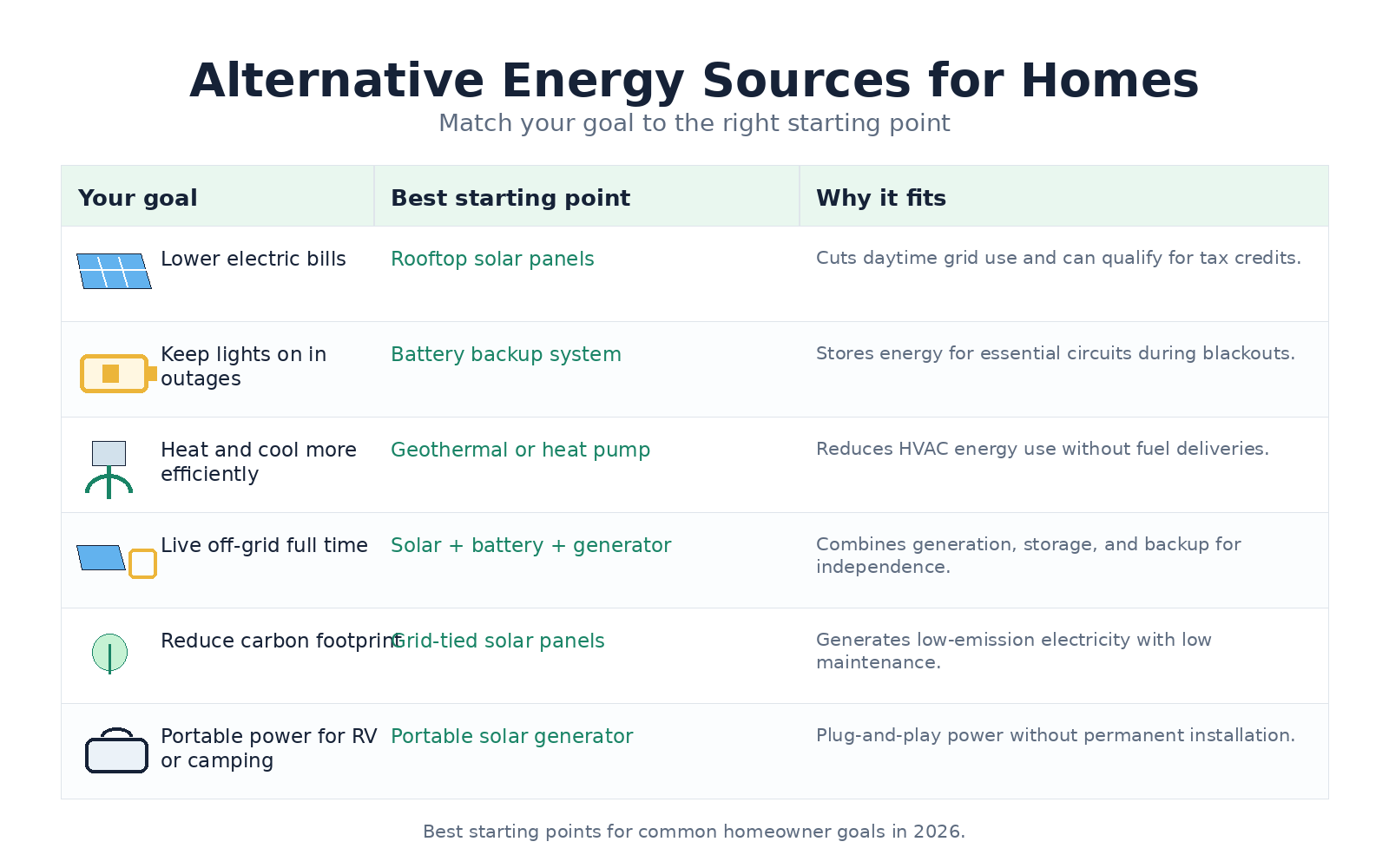
The key is matching the energy source to your specific goal:
| Your Goal | Best Starting Point | Why |
|---|---|---|
| Lower my electric bills | Rooftop solar panels | Offsets daytime use, qualifies for tax credits, minimal maintenance |
| Keep lights on during outages | Battery backup system | Stores solar or grid energy for essential circuits |
| Heat/cool my home more efficiently | Geothermal or heat pump | 30–60% reduction in HVAC costs, no fuel delivery |
| Generate power completely off-grid | Solar + battery + generator | Full independence from utility grid |
| Reduce my carbon footprint | Solar panels (grid-tied) | Zero-emission electricity generation |
| Portable power for camping/RV | Portable solar generator | Plug-and-play, no installation required |

Start with efficiency before buying energy equipment
Alternative energy equipment works best when it is not fighting avoidable waste. Before pricing a solar array, wind turbine, battery, generator, or heating system, reduce the loads that do not need to exist. This can lower the size and cost of every system you consider.
Start with simple checks: LED lighting, air sealing, insulation gaps, thermostat settings, appliance age, standby loads, duct leaks, water-heater temperature, and whether major loads run at the same time. If your home uses electric resistance heat, an old air conditioner, or an inefficient water heater, the fastest energy improvement may be replacing that equipment before adding generation.
Pull 12 months of utility bills and write down annual kWh, peak seasonal months, fuel use, and average cost per unit. This gives you a baseline. A solar contractor, battery designer, or HVAC installer can make better recommendations when you know whether your biggest problem is summer cooling, winter heating, outage protection, or year-round electric use.
The best default path for most homes: solar panels plus optional battery backup
For many homeowners, rooftop or ground-mounted solar panels are the most practical renewable energy option. Solar photovoltaic panels generate electricity, have no fuel deliveries, include few moving parts, and can be sized from your electric use, roof space, sun exposure, and local utility rules.
A grid-tied solar system is usually the simplest version. It offsets daytime electricity use and may send extra power to the grid for credit, depending on local net metering or export rules. If your main goal is lowering bills, this is often the first system to price.
Battery backup changes the purpose. A battery can keep selected circuits running during outages, store solar energy for evening use, and reduce reliance on the grid during expensive time-of-use periods. Batteries add cost, so they should be sized around actual backup loads: refrigerator, freezer, internet, lights, medical devices, well pump, sump pump, garage door, or a few outlets.
If you are early in the process, read the home solar energy guide, then use the Solar Backup Calculator to estimate essential loads before comparing batteries or full solar proposals.
Portable solar generators and power stations for simple outage backup
Not every home needs a roof project immediately. A portable power station, often marketed as a solar generator, can be a practical first step for renters, apartment dwellers, small homes, and homeowners who mainly need short outage backup.
These systems combine a battery, inverter, outlets, charge controller, and charging inputs in one unit. They can often recharge from a wall outlet, car outlet, or portable solar panels. They are best for phones, laptops, lights, internet equipment, small medical devices, fans, and sometimes a refrigerator for limited periods.
The limitation is capacity. A portable unit is not the same as whole-home backup. It will not run central air conditioning, electric heat, large well pumps, or heavy 240-volt loads unless the model and installation are specifically designed for that purpose. Still, for many families, a portable unit is an affordable bridge while they plan a larger system.
For product research, see AESV’s solar powered generators guide. If you later move into DIY solar hardware, the solar charge controller guide can help explain the charging side of small systems.
Small wind: useful only for the right rural and windy sites
Small wind turbines can generate electricity for homes, farms, cabins, and remote properties, but wind is much more site-specific than solar. A property that feels breezy at ground level may still be a poor wind site if the air is turbulent, blocked by trees, or limited by zoning restrictions.
Wind works best on open rural land with strong average wind speeds, enough space for a proper tower, few nearby obstacles, and local rules that allow the necessary height and setbacks. Short rooftop turbines in suburban neighborhoods usually disappoint because they sit in choppy air and have limited rotor size.
For a serious wind project, estimate annual energy production at tower height, not just the turbine’s peak watt rating. Include tower, foundation, wiring, controller, inverter, maintenance access, permits, noise considerations, and neighbor impacts. Wind can pair with solar and batteries because windy seasons or nights may complement sunny periods, but only a good site makes the equipment worthwhile.
Use the home wind energy guide before treating wind as a solar alternative.
Geothermal heat pumps: efficient HVAC, not home electricity generation
Residential geothermal usually means a ground-source heat pump. It does not generate electricity for your house. Instead, it uses the stable temperature underground to heat and cool more efficiently than many conventional HVAC systems.
In winter, a geothermal heat pump moves heat from the ground into the home. In summer, it moves heat from the home back into the ground. The system may use horizontal loops, vertical boreholes, pond loops, or open-loop wells, depending on the site.
Geothermal can be excellent for homes with high heating and cooling loads, long ownership timelines, suitable land or drilling access, and a budget for a more involved installation. The upfront cost can be high because excavation or drilling is part of the project. The payoff depends on local climate, electric rates, incentives, home insulation, ductwork, and what system it replaces.
Think of geothermal as an efficiency and comfort upgrade, not a substitute for solar panels. In many homes, geothermal reduces heating and cooling energy use while solar produces electricity to help supply the remaining load. Read more in the geothermal energy guide.
Biomass heat: when pellet and wood systems make sense
Biomass energy uses organic material such as wood, pellets, crop residue, manure, food waste, or other plant and animal material. For homeowners, the most common practical uses are pellet stoves, wood stoves, wood boilers, and backup heat in rural areas.
Biomass can make sense where fuel is local, affordable, dry, and responsibly sourced, and where the home has a real heating need. A pellet stove may reduce reliance on oil, propane, or electric resistance heat. A wood boiler may be useful for rural properties with access to wood and space for safe storage.
It is not automatically clean or convenient. Combustion creates emissions, ash, storage needs, chimney maintenance, and safety responsibilities. Local rules may limit wood burning, especially in areas with air-quality concerns. If you are considering biomass, compare fuel cost, handling effort, emissions controls, insurance requirements, and whether a heat pump would solve the same problem with less maintenance.
For a balanced overview, see the biomass energy guide.
Solar water heating and heat-pump water heaters
Water heating is one of the largest energy uses in many homes, so it deserves attention. Solar water heating uses collectors to capture heat from the sun and transfer it to water. It can work well in the right climate and household, especially where hot-water demand is steady.
However, solar thermal systems are less flexible than solar PV panels because they produce heat, not electricity. They also require plumbing, storage tanks, freeze protection in some climates, and maintenance. In many homes, a heat-pump water heater is a simpler comparison. It uses electricity to move heat into the water more efficiently than standard electric resistance water heaters.
If you plan to install solar PV, a heat-pump water heater can be a strong companion because it turns a major household load into an efficient electric load. The right answer depends on climate, utility rates, available space, ventilation, incentives, and whether your current water heater is near replacement age.
Micro-hydro: rare, but powerful where legal water flow exists
Micro-hydro systems generate electricity from moving water. Where a property has reliable year-round water flow, enough vertical drop, and legal rights to use it, micro-hydro can produce steady power day and night. That consistency can be valuable for off-grid homes and remote cabins.
The reason micro-hydro is not common is that few homeowners have the right site. You need water flow, head, permissions, environmental compliance, intake design, piping, a turbine, wiring, controls, and safe maintenance access. Seasonal streams may produce less when power is most needed, and many waterways are regulated.
If your property truly has legal water resources, micro-hydro may outperform solar on consistency. If not, it should stay in the “interesting but unlikely” category while you focus on efficiency, solar, batteries, and heating upgrades.
Decision table: match the energy source to your goal
| Homeowner goal | Best first options | Consider carefully | Why |
|---|---|---|---|
| Lower electric bills | Efficiency upgrades, grid-tied solar PV | Batteries if export credits are weak | Reducing waste and generating electricity usually gives the clearest path. |
| Outage backup | Portable power station, solar plus battery, critical-load backup panel | Whole-home batteries or fuel generator | Backup should be sized around essential loads and outage duration. |
| Off-grid cabin | Solar PV, batteries, efficient appliances, backup generator | Wind or micro-hydro if the site is excellent | Off-grid systems need conservative load planning and redundancy. |
| Rural windy property | Solar plus battery, small wind assessment | Tower height, permits, maintenance | Wind can help, but only with strong clean wind at turbine height. |
| Heating and cooling | Air-source heat pump, geothermal heat pump, insulation | Biomass heat in rural settings | The most important energy source may be a more efficient HVAC system. |
| Low budget first step | LEDs, air sealing, smart load habits, portable backup | DIY solar kits for small loads | Start with changes that reduce risk and teach your actual energy needs. |
Budget ranges and complexity levels
Costs vary by location, home condition, labor market, incentives, utility rules, and equipment choices, so treat any range as a planning category rather than a quote.
| Option | Typical complexity | Budget category | Planning caveat |
|---|---|---|---|
| Efficiency upgrades | Low to medium | Low to medium | Air sealing, insulation, and appliance changes can reduce system size later. |
| Portable solar generator | Low | Low to medium | Good for small outage loads, not whole-home power. |
| Grid-tied solar PV | Medium | Medium to high | Roof condition, permitting, interconnection, and utility credits matter. |
| Solar plus battery | Medium to high | High | Battery capacity and inverter output must match backup expectations. |
| Geothermal heat pump | High | High | Drilling or excavation drives much of the cost. |
| Small wind | High | Medium to high | Only worth pricing after a realistic site assessment. |
| Biomass heat | Medium | Low to high | Fuel handling, emissions, chimney safety, and local rules matter. |
| Micro-hydro | High | Site-specific | Legal water access and year-round flow are the deciding factors. |
Recommended path: audit, size, choose, then compare equipment
The most expensive mistake is buying equipment before defining the job. Follow this order instead:
- Audit usage. Gather utility bills, list fuel use, note outage history, and identify the biggest loads.
- Reduce waste. Fix obvious efficiency problems before paying for generation or storage.
- Define the goal. Decide whether you want bill savings, emergency backup, comfort, off-grid power, or a phased plan.
- Size the loads. For backup, list essential devices and how long they must run. For bill savings, review annual kWh and roof or site conditions.
- Choose the system type. Solar PV, battery backup, portable solar generator, heat pump, biomass heat, wind, or a combination.
- Compare buyer guides and quotes. Match equipment to the design instead of letting marketing claims define the design.
If your next step is solar hardware, compare the best home solar kit guide. If your priority is backup, start with the Solar Backup Calculator and the solar battery guide.
Your next step
Now that you understand the options, take one action based on your primary goal:
If you want lower bills
Start with your utility bills. Pull 12 months of usage data, identify your peak seasons, and fix obvious efficiency gaps (LED lighting, air sealing, insulation). Then get a solar PV estimate from a licensed installer. Read the home solar energy guide to understand system sizing, and compare options in the home solar kit guide if a smaller or DIY-friendly setup fits your situation.
If you want backup power
Use the Solar Backup Calculator to estimate your essential loads — refrigerator, well pump, internet, lights, medical devices. Then compare the solar battery guide for installed backup or portable solar generators for a simpler, plug-and-play starting point.
If you want both
Start with solar panels (grid-tied), then add battery backup later. This phased approach spreads the cost and lets you size the battery based on real outage experience rather than guesswork.
FAQ: alternative energy sources for homes
What is the best alternative energy source for most homes?
Rooftop solar panels with optional battery backup. Solar works on almost any home with decent sun exposure, requires minimal maintenance, and qualifies for federal tax credits.
Can alternative energy power my whole house during an outage?
It depends on your system size. A properly sized battery backup can run essential circuits (refrigerator, lights, internet, medical devices) for 1–3 days. Whole-home backup requires a larger battery bank and careful load management.
Are portable solar generators worth it?
Yes, for renters, small homes, or as a first step before committing to a full solar installation. They’re limited in capacity but affordable and portable.
Is small wind better than solar?
Only on rural properties with strong, consistent wind and space for a tower. Suburban neighborhoods rarely have suitable wind conditions.
Does geothermal energy generate electricity for my house?
No. Geothermal heat pumps reduce heating and cooling costs by 30–60%, but they don’t generate electricity. They’re an efficiency upgrade, not a power source.
Should I buy batteries with solar panels?
It depends on your goal. If you want outage protection or time-of-use savings, yes. If you only want lower bills and your utility offers net metering, grid-tied solar without batteries is simpler and cheaper.
What should I do before asking for solar or backup quotes?
Audit your usage, reduce waste, define your goal, and size your loads. This puts you in control of the conversation instead of relying on a salesperson’s estimates.
What is the cheapest alternative energy source for homes?
Efficiency upgrades (LED lighting, insulation, air sealing) have the fastest payback. After that, grid-tied solar panels typically offer the lowest cost per kilowatt-hour.
Can I install alternative energy sources myself?
Some components (portable solar generators, LED lighting, smart thermostats) are DIY-friendly. Full solar installations, battery systems, and electrical work require licensed professionals and permits.